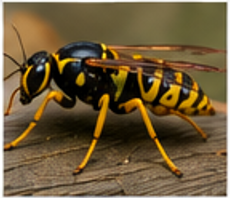
Northwestern Yellowjackets are social wasps belonging primarily to the genus Vespula, including species common throughout the Pacific Northwest such as the western yellowjacket (Vespula pensylvanica). These wasps are familiar around homes, parks, campgrounds, restaurants, orchards, and outdoor recreation areas because of their distinctive yellow-and-black coloration and persistent interest in human food. Although yellowjackets are beneficial predators of many insects during much of the growing season, mature colonies can become a significant stinging and nuisance pest during late summer and fall.
The greatest concern occurs when people unknowingly approach a nest or when large numbers of workers begin scavenging around outdoor meals. Yellowjackets vigorously defend their colonies and, unlike honeybees, can sting repeatedly. Multiple stings can be extremely painful, while even a single sting may cause a dangerous allergic reaction in a sensitive person.
Taxonomy and Classification
Yellowjackets belong to the order Hymenoptera and family Vespidae, which also contains hornets and paper wasps. Species occurring in northwestern North America include several members of the genera Vespula and Dolichovespula, although their nesting habits and behavior can differ considerably.
Most yellowjacket colonies follow an annual life cycle. A fertilized queen survives winter in a protected location and becomes active in spring. She searches for a suitable nesting site, constructs the first cells, lays eggs, and initially raises the developing larvae herself. Once the first workers emerge, they assume responsibility for gathering food, expanding the nest, feeding larvae, and defending the colony.
Colonies increase dramatically during summer and may contain hundreds or thousands of workers by late season. New queens and males are eventually produced. After mating, newly fertilized queens seek protected overwintering locations, while the workers, males, and original queen normally die as colder weather arrives.
Physical Description
Adult Northwestern Yellowjacket workers are generally about 1/2 to 3/4 inch long, although size varies between species and colony members.
- Appearance: Workers have smooth, relatively hairless bodies marked with contrasting black and bright yellow patterns.
- Body Shape: They possess the characteristic narrow waist found among many wasps.
- Wings: Adults have two pairs of wings that are usually folded lengthwise over the body while resting.
- Stinger: Female workers possess a smooth stinger and can deliver multiple stings.
- Flight: Yellowjackets are fast, direct fliers and frequently hover around food, garbage cans, flowering plants, and nest entrances.
Yellowjackets are sometimes mistaken for honeybees, but honeybees generally have noticeably hairier bodies and a more subdued coloration. Paper wasps may have similar markings but usually have longer legs and construct exposed, umbrella-shaped paper combs rather than the enclosed nests characteristic of most yellowjackets.
Nests and Identification
A yellowjacket nest is constructed from paper-like material made by workers chewing weathered wood fibers and mixing them with saliva. Depending on the species, nests may occur underground or inside protected cavities.
- Underground Nests: Abandoned rodent burrows and other existing soil cavities are common nesting locations.
- Structural Voids: Wall cavities, attics, soffits, crawl spaces, and spaces beneath siding may provide suitable nest sites.
- Natural Cavities: Hollow logs, tree cavities, and protected spaces beneath roots can also be occupied.
One of the most reliable signs of a concealed colony is a steady stream of yellowjackets entering and leaving the same opening. People should avoid standing directly in this flight path because disturbance near the entrance can trigger defensive behavior.
Distribution and Habitat
Yellowjackets are widespread across the Pacific Northwest and occur in both the United States and Canada. They occupy forests, grasslands, agricultural landscapes, residential neighborhoods, urban parks, campgrounds, and commercial areas.
Human environments can provide especially favorable conditions. Buildings offer protected nesting cavities, irrigated landscapes support abundant insects, and garbage, outdoor dining, fallen fruit, pet food, and sugary drinks provide easily accessible food.
Behavior and Diet
Yellowjackets have an important ecological role as predators and scavengers. During spring and early summer, workers capture caterpillars, flies, and other insects. Much of this animal protein is carried back to the nest and fed to developing larvae, making yellowjackets beneficial natural predators of numerous potential pests.
Later in the season, their behavior around people becomes much more noticeable. Workers increasingly seek sugar-rich foods and may investigate ripe fruit, soda, juice, desserts, garbage, and other human food. This is why yellowjacket problems frequently peak at picnics, outdoor restaurants, festivals, and campgrounds during late summer.
Stings and Human Conflict
The primary conflict associated with Northwestern Yellowjackets is their defensive sting. Individual foragers are not necessarily seeking to attack people, but workers near a nest can respond rapidly when they perceive vibration, digging, mowing, or other disturbance.
A sting normally causes immediate pain, redness, and localized swelling. Some people experience larger local reactions. Individuals allergic to wasp venom can develop anaphylaxis, a potentially life-threatening emergency requiring immediate medical attention.
Another risk occurs when yellowjackets crawl into open beverage cans or bottles. A hidden wasp can sting the mouth or throat when someone takes a drink. Keeping beverages covered and checking containers before drinking can reduce this risk.
Management and Prevention
Yellowjacket management should use an Integrated Pest Management (IPM) approach. Not every colony requires destruction. Nests located well away from people may be left undisturbed because the wasps provide beneficial insect control.
- Food Management: Keep outdoor food covered and promptly clean spills, especially sugary liquids.
- Garbage Control: Use trash containers with tight-fitting lids and clean food residue from their exterior surfaces.
- Fallen Fruit: Regularly collect overripe or damaged fruit beneath trees.
- Pet Food: Avoid leaving pet food outdoors for extended periods.
- Exclusion: Seal appropriate structural gaps before colonies become established, particularly around siding, soffits, vents, and utility penetrations.
- Trapping: Commercial yellowjacket traps may reduce local foraging activity but generally should not be expected to eliminate an established colony.
Nest Removal
Established nests near doorways, playgrounds, patios, workplaces, or other frequently occupied areas may require treatment. Do not plug or seal an active structural nest entrance before the colony has been eliminated. Wasps trapped inside a wall or ceiling void may search for another exit and potentially emerge inside the building.
Underground and concealed structural colonies can contain large numbers of defensive workers. Attempting to dig out, burn, flood, strike, or otherwise disturb a nest can provoke a mass defensive response. High-risk nests are best evaluated and treated by a qualified pest management professional, particularly when occupants have known allergies to stinging insects.
Ecological Importance and Research
Despite their reputation as pests, yellowjackets perform useful ecological functions. They consume numerous insects, scavenge animal material, and contribute to nutrient cycling. Their pest status is therefore largely determined by where the colony is located and how frequently the wasps interact with people.
Research into Northwestern Yellowjackets focuses on improved attractants, species-specific trapping systems, colony behavior, biological control, and safer methods of managing nests in parks and other public spaces. Effective management seeks to reduce unacceptable stinging risks while avoiding unnecessary destruction of colonies that are located away from human activity.