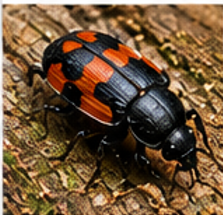
Nicrophorus Beetles, commonly known as Burying Beetles or Carrion Beetles, are medium-sized beetles in the genus Nicrophorus that play an important role in decomposition and nutrient recycling. Unlike many insects encountered around dead animals, these beetles are not considered pests. Instead, they are highly beneficial scavengers that help remove small animal carcasses from the environment and return nutrients to the soil.
Burying Beetles are especially well known for their unusual reproductive behavior. A male and female may work together to locate, bury, prepare, and preserve the carcass of a small bird, rodent, reptile, or other vertebrate. The carcass becomes both a nursery and food source for their developing larvae. This level of parental care is unusual among beetles and has made Nicrophorus species important subjects in studies of insect behavior, ecology, and evolution.
Taxonomy and Classification
Nicrophorus Beetles belong to the order Coleoptera and the family Silphidae, commonly known as carrion beetles.
- Kingdom: Animalia
- Phylum: Arthropoda
- Class: Insecta
- Order: Coleoptera
- Family: Silphidae
- Genus: Nicrophorus
- Common Names: Burying Beetles, Carrion Beetles
They undergo complete metamorphosis, progressing through egg, larval, pupal, and adult stages. Their reproductive cycle is closely tied to the availability of small vertebrate carcasses.
Physical Description
Adult Nicrophorus Beetles are typically between approximately 1/2 and 1 inch long. They have robust bodies, powerful legs, and clubbed antennae that help them detect odors associated with carrion.
- Body: Stout, flattened, and robust
- Color: Primarily glossy black
- Markings: Bright orange, reddish-orange, or red bands or patches on the wing covers
- Antennae: Clubbed and highly sensitive to carrion odors
- Legs: Strong and adapted for digging
The bold orange-and-black pattern is one of the easiest characteristics to recognize in many species. The exact pattern varies between species and can sometimes be used for identification.
Distribution and Habitat
Burying Beetles are found primarily across temperate portions of the Northern Hemisphere. They occur in forests, woodland edges, grasslands, meadows, and other environments where small animal carcasses periodically become available.
Typical habitats include:
- Deciduous forests
- Mixed woodlands
- Grasslands
- Meadows
- Forest edges
- Undisturbed soils with abundant organic matter
Adults spend much of their time near the ground, using their sensitive antennae to locate recently dead animals.
Carrion Detection
Nicrophorus Beetles have an exceptional ability to detect the chemical odors released during the early stages of decomposition. These odors can guide beetles toward a carcass from considerable distances.
When a suitable carcass is located, several beetles may initially compete for control of it. Eventually, a dominant pair may remain and begin preparing the carcass for reproduction.
Burying Behavior
The most famous behavior of Burying Beetles is their ability to bury small carcasses. The adults crawl beneath the body and remove soil from underneath it, allowing the carcass to gradually sink into the ground.
This process can accomplish several important goals:
- Protect the carcass from competing scavengers
- Reduce access by blowflies
- Provide a stable environment for larvae
- Reduce moisture loss
- Create a protected brood chamber
Once buried, the carcass is modified into a compact mass sometimes described as a brood ball.
Carrion Preparation
After burial, the beetles remove fur, feathers, and other surface material from the carcass. They shape the remaining tissue into a more compact form and coat it with secretions.
These secretions help suppress microbial growth and slow excessive decomposition. By managing bacteria and fungi on the carcass, the beetles preserve the food long enough for their larvae to develop.
Parental Care
One of the most remarkable features of Nicrophorus Beetles is their biparental care. Both the male and female may participate in preparing the carcass, defending the brood chamber, and caring for developing offspring.
After the eggs hatch, larvae move toward the prepared food source. Parents may feed young larvae by regurgitating partially digested carrion.
This feeding behavior is highly unusual among beetles and resembles parental provisioning seen in some birds and social insects.
Life Cycle
Once a pair has secured a carcass, the female lays eggs in the surrounding soil. The larvae hatch nearby and move toward the prepared carcass.
The developmental stages include:
- Egg: Deposited in soil near the buried carcass.
- Larva: Feeds on carrion, sometimes with assistance from the parents.
- Pupa: Mature larvae leave the brood chamber and pupate in soil.
- Adult: Newly emerged beetles begin searching for carrion and mates.
The carcass provides concentrated nutrition, allowing larvae to grow rapidly before pupation.
Phoretic Mites
Adult Nicrophorus Beetles often carry small mites on their bodies. These mites commonly use the beetles for transportation, a relationship known as phoresy.
The mites are carried to a fresh carcass, where they may feed on fly eggs, fly larvae, and other tiny organisms competing for the same food source.
In some circumstances, this relationship can benefit the beetles because reducing fly competition leaves more carrion available for beetle larvae.
Ecological Importance
Burying Beetles are important decomposers. By burying and consuming dead animals, they accelerate nutrient recycling and reduce the amount of exposed carrion in the environment.
Their ecological contributions include:
- Breaking down animal remains
- Returning nutrients to the soil
- Reducing exposed carrion
- Competing with blowflies and other scavengers
- Supporting soil food webs
They are therefore a valuable component of healthy forest and grassland ecosystems.
Are Nicrophorus Beetles Pests?
Nicrophorus Beetles are not considered pests. They do not infest homes, damage structures, consume crops, or attack stored food.
People may occasionally encounter them around:
- Dead rodents
- Dead birds
- Small wildlife carcasses
- Carrion traps
- Wildlife-monitoring stations
Their presence simply indicates that they have located a natural food and breeding resource.
Management and Prevention
No control is generally necessary. Burying Beetles should usually be left undisturbed so they can perform their ecological role.
When Found Outdoors
If beetles are found feeding on or burying a small animal carcass in a location where it does not create a sanitation concern, the best approach is to leave them alone.
When Found Near a Home
If carrion is located immediately beside or inside a structure, removal of the carcass will usually eliminate the attraction. There is no need to treat surrounding areas with insecticides.
Repeated carrion beetle activity inside a building may indicate a dead rodent, bird, or other animal in a wall void, attic, chimney, or crawl space.
Scientific Importance
Nicrophorus Beetles are widely used in scientific research because their reproductive behavior provides an excellent model for studying:
- Parental care
- Mate cooperation
- Competition
- Social behavior
- Microbial ecology
- Carrion preservation
- Evolution of family behavior
Researchers are particularly interested in the antimicrobial compounds the beetles use to preserve carcasses and how parents adjust their care depending on brood size and environmental conditions.
Conservation
Although many Nicrophorus species remain common, some have experienced substantial population declines. The best-known example in North America is the American Burying Beetle (Nicrophorus americanus).
Conservation programs for vulnerable species may include:
- Habitat protection
- Captive breeding
- Reintroduction
- Population monitoring
- Research into carrion availability
- Reduction of unnecessary pesticide exposure
Because these beetles depend on suitable soil, habitat, and appropriately sized animal carcasses, changes to entire ecosystems can influence their populations.
Conclusion
Nicrophorus Beetles are remarkable carrion beetles that combine decomposition with one of the most sophisticated forms of parental care found among insects. Adults locate small carcasses, bury them, remove fur or feathers, preserve the tissue with antimicrobial secretions, and prepare the remains as food for their offspring.
Rather than being pests, Burying Beetles provide valuable ecological services by removing carrion and returning nutrients to the soil. Their interactions with phoretic mites, competing flies, microorganisms, and vertebrate carcasses make them important members of natural food webs.
Control is unnecessary in nearly every situation. When these orange-and-black beetles are encountered outdoors, they should generally be protected and appreciated as beneficial decomposers and fascinating examples of advanced insect behavior.