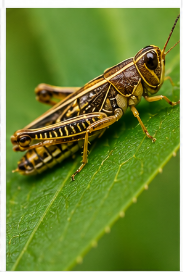
Locusts are certain species of short-horned grasshoppers capable of undergoing a remarkable transformation in behavior, appearance, and movement when environmental conditions cause their populations to become crowded. In low numbers, locusts behave much like ordinary grasshoppers, living independently and avoiding one another. Under favorable breeding conditions, however, they can shift into a highly social form known as the gregarious phase.
Gregarious locusts gather into dense groups, march across the ground as immature hopper bands, and later form enormous flying swarms. These swarms may contain millions or even billions of insects and can consume crops, pasture, and natural vegetation over vast areas. For thousands of years, locust outbreaks have been associated with agricultural destruction, famine, displacement, and economic hardship.
Although locust plagues occur mainly in Africa, the Middle East, and Asia, their effects can spread far beyond the immediate outbreak zone by disrupting food supplies, livestock production, trade, and regional stability.
Taxonomy and Classification
Locusts belong to the order Orthoptera and the family Acrididae, which includes the short-horned grasshoppers. The term “locust” does not refer to a separate taxonomic family. Instead, it describes grasshopper species with the biological ability to change between solitary and gregarious phases.
- Kingdom: Animalia
- Phylum: Arthropoda
- Class: Insecta
- Order: Orthoptera
- Family: Acrididae
- Primary Pest Species: Desert Locust, Schistocerca gregaria
Other important species include the Migratory Locust, Red Locust, Brown Locust, Italian Locust, Moroccan Locust, and Australian Plague Locust. Each species has its own geographic range, breeding ecology, and outbreak pattern.
What Is Phase Transition?
The defining feature of a locust is its ability to undergo phase transition. Solitary locusts avoid one another and occur at relatively low densities. When rainfall creates abundant vegetation, breeding success increases and populations may rise rapidly.
As suitable habitat begins to shrink or dry, large numbers of locusts may become concentrated into smaller areas. Frequent physical contact, especially repeated stimulation of the hind legs, contributes to changes in the insects’ nervous systems, hormone activity, behavior, coloration, and body development.
The resulting gregarious locusts become attracted to one another rather than avoiding contact. This behavioral change leads to the formation of groups, hopper bands, and eventually migratory swarms.
Physical Description
Adult locusts generally measure between 1 and 3 inches long, depending on the species, sex, developmental stage, and environmental conditions. They have long hind legs for jumping, powerful chewing mouthparts, and two pairs of wings.
- Body: Elongated and strongly built
- Size: Commonly 1 to 3 inches long
- Hind Legs: Enlarged and adapted for powerful jumping
- Wings: Long and capable of sustained flight
- Mouthparts: Strong chewing jaws
- Antennae: Shorter than the body
Solitary and Gregarious Forms
Solitary Phase
Solitary locusts typically have green, tan, or brown coloration that helps them blend into vegetation and soil. They avoid other individuals, move relatively little, and behave like ordinary grasshoppers.
At this stage, populations may remain unnoticed because the insects are widely scattered and cause only localized feeding injury.
Gregarious Phase
Gregarious locusts become more active, social, and mobile. Their color may change according to species, age, and reproductive condition. Immature Desert Locust adults, for example, may appear pinkish, while mature males often become bright yellow.
Gregarious individuals develop longer wings, improved flight capacity, and a strong tendency to travel together. This transformation allows entire populations to move across large geographic areas in search of food and breeding habitat.
Distribution and Habitat
Locusts are primarily associated with arid, semi-arid, and seasonally dry regions. The Desert Locust is found across parts of Africa, the Arabian Peninsula, the Middle East, and Southwest Asia.
During quiet periods, populations remain within relatively restricted desert regions known as recession areas. After periods of heavy rainfall, vegetation grows rapidly, providing food and moist soil suitable for egg laying.
When outbreaks develop, swarms may move far beyond their normal breeding zones and enter:
- Agricultural fields
- Pasturelands
- River valleys
- Irrigated farming regions
- Grasslands
- Savannas
- Orchards
- Vegetable-growing areas
Because swarms can cross national borders, effective management requires international monitoring and cooperation.
Life Cycle
Locusts undergo incomplete metamorphosis, progressing through egg, nymph, and adult stages. There is no pupal stage.
Egg Stage
Females deposit clusters of eggs into moist soil. The eggs are surrounded by a protective foam-like material that hardens into an egg pod. Warmth and soil moisture influence how quickly the eggs hatch.
Hopper Stage
Young locusts are called hoppers. They resemble wingless adults and pass through several developmental stages before gaining functional wings.
Gregarious hoppers form dense marching bands that move across the landscape while feeding. Because they cannot yet fly, hopper bands are often easier to locate and treat than adult swarms.
Adult Stage
After the final molt, adults develop wings and become capable of long-distance movement. Immature adults may travel extensively before reaching reproductive maturity. Once suitable rainfall and vegetation are found, they mate and begin another generation.
Swarms and Migration
Locust swarms are among the largest coordinated insect movements on Earth. Swarms travel with the wind and may remain airborne for many hours.
The size of a swarm can vary greatly. Small swarms may cover a limited area, while exceptionally large swarms may stretch across hundreds of square miles. Swarms are not perfectly organized, but individual locusts respond to the movements of nearby insects, producing coordinated group behavior.
Migration allows locusts to escape deteriorating habitat and locate fresh vegetation. Unfortunately, this also brings them into farming regions where large quantities of food are concentrated.
Feeding Habits
Locusts are generalist herbivores. They use strong chewing mouthparts to consume leaves, stems, flowers, fruits, seeds, bark, and tender shoots.
Host plants may include:
- Wheat
- Barley
- Rice
- Millet
- Sorghum
- Maize
- Vegetables
- Fruit trees
- Pasture grasses
- Native vegetation
A single locust consumes only a relatively small amount each day. However, the combined appetite of millions of insects can strip vegetation with extraordinary speed.
Agricultural Damage
Locust damage can be rapid and nearly complete. Swarms may descend on a field and remove most green plant material within hours.
Common damage includes:
- Complete defoliation
- Consumption of grain heads
- Destruction of seedlings
- Loss of fruit and vegetables
- Damage to orchard foliage
- Removal of livestock forage
- Reduced crop yields
- Plant death
Young crops are particularly vulnerable because they may be destroyed before becoming established. Even mature plants can suffer serious yield loss when flowers, fruit, or grain heads are consumed.
Food Security and Economic Conflict
The primary conflict associated with locusts is their ability to threaten food security across entire regions. Large outbreaks can damage both food crops and grazing land, affecting farmers, livestock owners, food markets, and rural communities.
Consequences may include:
- Loss of household income
- Shortages of food and animal feed
- Higher market prices
- Livestock losses
- Increased dependence on emergency aid
- Displacement of farming communities
The economic impact often continues after the swarm has disappeared because farmers may lack seed, income, or resources needed to replant.
Monitoring and Early Detection
Early detection is the most important part of locust management. It is far easier to control small groups and hopper bands than large, mobile swarms.
Monitoring programs survey known breeding zones for:
- Recent rainfall
- Green vegetation
- Moist soil
- Egg-laying activity
- Hopper bands
- Increasing adult density
- Newly forming swarms
Field surveys may be supported by satellite imagery, weather data, vegetation maps, aircraft, drones, and reports from local communities.
Chemical Control
Insecticides remain the primary emergency tool used against severe locust outbreaks. Treatments are often applied as ultra-low-volume sprays from aircraft, vehicles, or ground equipment.
Control teams attempt to target concentrated hopper bands, resting swarms, or newly formed adult groups before the insects disperse.
Applications must be carefully planned to reduce risks to people, livestock, pollinators, water, and other wildlife. Product selection, dosage, weather, application timing, and equipment calibration all influence effectiveness and safety.
Biological Control
Biopesticides containing the insect-pathogenic fungus Metarhizium acridum may be used against locusts and grasshoppers. Fungal spores attach to the insect, penetrate the outer covering, and cause a fatal infection.
These products are generally more specific to grasshoppers and locusts than broad-spectrum chemical insecticides. However, they often act more slowly, making them better suited to early-stage outbreaks or environmentally sensitive areas where immediate knockdown is not required.
Natural Enemies
Locust eggs, hoppers, and adults are eaten by numerous predators, including:
- Birds
- Reptiles
- Spiders
- Predatory beetles
- Ants
- Parasitic flies
- Parasitic wasps
- Fungal pathogens
Natural enemies help regulate small populations but cannot usually stop a rapidly developing regional plague once locust numbers become extremely high.
Research and International Cooperation
Locust management is coordinated across borders because swarms can move rapidly between countries. International agencies, governments, researchers, and local monitoring teams share information about rainfall, vegetation, breeding, and swarm movement.
Research focuses on:
- Improved satellite monitoring
- More accurate outbreak forecasting
- Phase-transition biology
- Locust migration patterns
- Selective biopesticides
- Reduced pesticide impacts
- Drone-based surveying
- Rapid community reporting systems
Understanding how climate variability affects breeding and migration is becoming increasingly important for long-term forecasting.
Conclusion
Locusts are specialized grasshoppers capable of changing from isolated individuals into highly social, migratory insects. When environmental conditions support rapid reproduction and crowding, they form hopper bands and massive adult swarms.
These swarms can destroy crops, grazing land, and natural vegetation over enormous areas, making locusts one of the world’s most serious agricultural pests. Their mobility and rapid reproduction make control difficult once a plague is fully established.
Successful management depends on continuous surveillance, early detection, international cooperation, and rapid treatment of concentrated populations before they develop into large swarms. Chemical insecticides remain important during emergencies, while fungal biopesticides and improved forecasting offer more targeted and environmentally responsible options.