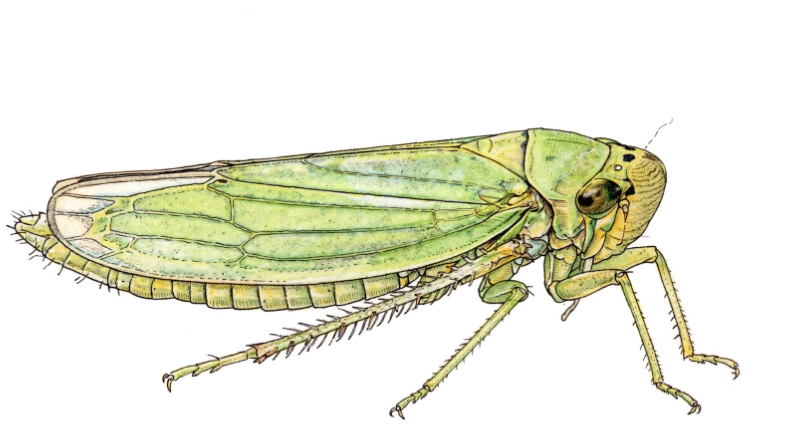
Leafhoppers are small, highly mobile sap-feeding insects belonging to the family Cicadellidae. They are found throughout the world and occur in nearly every habitat where grasses, shrubs, trees, vegetables, flowers, or agricultural crops grow. Although individual leafhoppers are tiny, large populations can cause extensive damage to plants through direct feeding and through the transmission of destructive plant diseases.
Leafhoppers use piercing-sucking mouthparts to remove fluids from leaves, stems, and plant vascular tissues. Feeding may produce pale spots, stippling, yellowing, curling, drying, or browning of foliage. Some species inject irritating saliva that interferes with normal plant growth and causes a condition known as hopperburn. Other species are especially important because they carry viruses, bacteria, and phytoplasmas from infected plants to healthy plants.
The combination of rapid reproduction, strong jumping ability, seasonal migration, and disease transmission makes leafhoppers serious economic pests in farms, orchards, vineyards, nurseries, gardens, and commercial landscapes.
Taxonomy and Classification
Leafhoppers belong to the order Hemiptera, commonly called the true bugs, and the family Cicadellidae. They are included in the suborder Auchenorrhyncha, a group that also contains cicadas, treehoppers, planthoppers, and spittlebugs.
- Kingdom: Animalia
- Phylum: Arthropoda
- Class: Insecta
- Order: Hemiptera
- Suborder: Auchenorrhyncha
- Family: Cicadellidae
Leafhoppers are among the most diverse groups of plant-feeding insects. Thousands of species have been described, and many remain closely associated with particular host plants. Some feed mainly on grasses, while others specialize on trees, vines, vegetables, legumes, or ornamental plants.
The Potato Leafhopper, Empoasca fabae, is one of the best-known generalist species. It feeds on potatoes, beans, alfalfa, fruit crops, ornamental plants, and many other hosts.
Physical Description
Adult leafhoppers are generally small, slender insects measuring approximately 2 to 15 millimeters long. Their bodies are usually wedge-shaped, with the head wider than the rear of the body. When resting, the wings are held in a roof-like position over the abdomen.
- Body Shape: Slender, tapered, and wedge-shaped
- Size: Usually 2 to 15 millimeters long
- Color: Green, yellow, tan, brown, gray, or brightly patterned
- Wings: Held roof-like over the body
- Hind Legs: Enlarged and adapted for powerful jumping
- Mouthparts: Piercing-sucking beak used to remove plant fluids
Many species are green or brown and blend closely with foliage. Others display colorful stripes, spots, or contrasting patterns. The hind legs are often lined with small spines and allow the insect to leap quickly when disturbed.
Leafhopper Nymphs
Leafhopper nymphs resemble smaller, wingless adults. They are commonly found on the undersides of leaves, along stems, or near tender terminal growth.
A useful identification feature is their unusual sideways movement. When disturbed, nymphs may rapidly scuttle sideways or backward across the leaf surface before jumping or dropping away.
Nymphs pass through several developmental stages known as instars. Their wing pads become more visible as they approach adulthood.
Distribution and Habitat
Leafhoppers occur worldwide in tropical, subtropical, temperate, and even relatively cool environments. They inhabit almost every terrestrial area containing vegetation.
Common habitats include:
- Agricultural fields
- Vegetable gardens
- Fruit orchards
- Vineyards
- Forests and woodlands
- Grasslands and meadows
- Greenhouses
- Nurseries
- Urban landscapes
- Roadside vegetation
Some species remain near their host plants throughout the year, while others migrate over long distances. Migratory species may move northward during spring and summer, causing sudden infestations in areas where they cannot survive the winter.
Life Cycle
Leafhoppers undergo incomplete metamorphosis, developing through egg, nymph, and adult stages. There is no pupal stage.
Egg Stage
Female leafhoppers commonly insert their eggs into plant tissue, including leaf veins, stems, petioles, or tender shoots. Because the eggs are hidden within the plant, they are difficult to detect during routine inspection.
Nymph Stage
After hatching, nymphs begin feeding immediately. They usually pass through five instars, increasing in size after each molt. Warm weather can greatly accelerate their development.
Adult Stage
Adults continue feeding and reproduce on suitable host plants. Some species produce several generations each year, especially in warm climates or protected greenhouse environments.
Behavior
Leafhoppers are highly active insects. Their powerful hind legs allow them to jump many times their body length, while adults can also fly between plants and fields.
When approached, they may run sideways, leap into the air, or fly quickly to nearby vegetation. Their rapid, darting movements make them difficult to capture by hand.
Many species feed on the undersides of leaves, which helps protect them from direct sunlight, rain, and some predators. Others concentrate on stems, leaf veins, or terminal shoots where plant fluids are easier to obtain.
Feeding Habits
Leafhoppers feed by inserting their needle-like mouthparts into plant tissue and withdrawing fluids. Depending on the species, they may feed on sap from the xylem, phloem, or individual plant cells.
Feeding can remove nutrients, interfere with water movement, damage plant cells, and introduce toxic saliva. Heavy infestations may weaken plants and reduce their ability to produce healthy leaves, flowers, fruit, or seeds.
Direct Feeding Damage
Direct feeding symptoms vary according to the leafhopper species and host plant.
Common symptoms include:
- Pale or white stippling on leaves
- Yellowing or bronzing of foliage
- Leaf curling or distortion
- Reduced plant vigor
- Premature leaf drop
- Stunted growth
- Reduced crop yield
- Brown or scorched leaf margins
Damage may initially resemble drought stress, nutrient deficiency, spider mite feeding, or chemical injury. Close inspection of the undersides of leaves may reveal active nymphs and adults.
Hopperburn
Hopperburn is a distinctive type of plant injury commonly associated with Potato Leafhoppers and related species. It results from feeding and the injection of saliva that disrupts plant tissues and vascular function.
Symptoms often begin as yellowing at the tips and margins of leaves. The affected tissue then turns brown, curls upward, and appears scorched. Severe hopperburn can stunt plants and greatly reduce the yield of potatoes, beans, alfalfa, and other crops.
Disease Transmission
The most serious threat caused by some leafhoppers is their ability to transmit plant pathogens. As a leafhopper feeds on an infected plant, it may acquire bacteria, viruses, or phytoplasmas. The insect can then introduce the pathogen into healthy plants during later feeding.
Important leafhopper-associated diseases include:
- Aster Yellows: A phytoplasma disease affecting vegetables, flowers, and weeds
- Pierce’s Disease: A bacterial disease of grapevines
- Beet Curly Top: A viral disease affecting beets, tomatoes, peppers, and other crops
- Elm Yellows: A destructive disease of elm trees
- Maize Streak and Related Diseases: Important problems in grain-producing regions
Plants infected with many of these diseases cannot be cured. Removing diseased plants may be necessary to reduce the source of infection for additional leafhoppers.
Signs of an Infestation
Leafhopper infestations may be detected by inspecting foliage and gently disturbing plants.
Common signs include:
- Small insects jumping from leaves
- Nymphs running sideways on leaf undersides
- White stippling or pale spots
- Yellow, curled, or browned leaf margins
- Stunted shoots
- Premature leaf drop
- Symptoms of plant disease
Yellow sticky cards may help detect adult activity in gardens, greenhouses, vineyards, and nurseries, although traps alone will not eliminate an infestation.
Natural Enemies
Leafhoppers are preyed upon by numerous beneficial organisms, including:
- Ladybugs
- Lacewing larvae
- Predatory bugs
- Spiders
- Parasitic wasps
- Birds
- Entomopathogenic fungi
Preserving these natural enemies can help suppress leafhopper populations, particularly in gardens and diversified agricultural systems.
Management and Prevention
Effective leafhopper management combines monitoring, exclusion, sanitation, biological control, and carefully timed insecticide applications when necessary.
Monitor Plants Regularly
Inspect susceptible plants during warm weather, especially the undersides of leaves. Early detection is particularly important where leafhoppers transmit plant diseases.
Use Row Covers
Fine-mesh row covers can prevent migrating adults from reaching young vegetables and other high-value plants. Covers should be installed before leafhoppers arrive and sealed around the edges.
Control Weeds
Weeds such as clover, asters, grasses, and other broadleaf plants may support leafhopper populations and serve as reservoirs for plant pathogens. Removing weeds near crops can reduce local breeding and disease sources.
Remove Infected Plants
Plants showing confirmed symptoms of an incurable leafhopper-transmitted disease should be removed and disposed of appropriately. Leaving infected plants in place may allow additional insects to acquire and spread the pathogen.
Encourage Beneficial Insects
Avoid unnecessary broad-spectrum insecticides that kill predators and parasitoids. Flowering plants can provide nectar and pollen for beneficial insects that attack leafhoppers.
Chemical Control
Insecticides may be necessary when leafhopper populations threaten valuable crops or when disease transmission is a major concern. Treatment is most effective when timed against newly arriving adults or young nymphs.
Contact insecticides may reduce exposed populations, while systemic products are sometimes used in nurseries, landscapes, and commercial production. However, systemic insecticides may affect pollinators if used improperly.
Always select a product labeled for the host plant and leafhopper species, follow all label directions, and avoid applying insecticides to flowering plants when bees are active.
Conservation and Research
Leafhoppers are not generally conservation priorities because many species are abundant and some are serious agricultural pests. However, they are also part of natural food webs and serve as prey for birds, spiders, insects, and other predators.
Research focuses on leafhopper migration, insecticide resistance, host-plant relationships, pathogen transmission, biological control, and the development of crop varieties resistant to feeding damage or disease.
Conclusion
Leafhoppers are small, wedge-shaped insects capable of causing substantial agricultural and landscape damage. They feed by removing plant fluids, producing stippling, curling, yellowing, hopperburn, and reduced growth.
Their greatest economic importance comes from their ability to transmit plant pathogens such as phytoplasmas, bacteria, and viruses. Early monitoring, weed management, row covers, conservation of natural enemies, and timely treatment can reduce both feeding injury and disease transmission.
Because symptoms may resemble drought stress or nutrient problems, accurate identification is essential before control measures are applied.