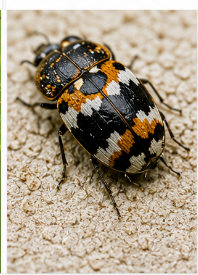
Larder Beetles (Dermestes lardarius) are common stored-product and sanitation pests that feed on dried animal materials, protein-rich foods, and organic debris. They are members of the dermestid beetle family, which also includes carpet beetles, hide beetles, and other insects capable of damaging food, museum specimens, animal products, and household materials.
In nature, Larder Beetles serve as useful decomposers by feeding on dried carcasses, shed animal material, and other remains. Problems develop when adults enter homes, warehouses, restaurants, pet-food storage areas, museums, or processing facilities and locate suitable food indoors. Their larvae may infest dried meat, cheese, pet food, animal feed, feathers, hides, taxidermy specimens, dead insects, or animal remains hidden inside attics and wall voids.
The larvae cause most of the feeding damage. When fully grown, they often leave the food source and bore into wood, cork, insulation, foam, plaster, or other relatively soft materials to create protected pupation chambers. This behavior can produce small holes and minor structural or cosmetic damage even when the original food source is located elsewhere.
Taxonomy and Classification
Larder Beetles belong to the order Coleoptera and the family Dermestidae, commonly known as skin beetles. Their scientific name is Dermestes lardarius.
- Kingdom: Animalia
- Phylum: Arthropoda
- Class: Insecta
- Order: Coleoptera
- Family: Dermestidae
- Genus: Dermestes
- Species: Dermestes lardarius
- Common Name: Larder Beetle
Larder Beetles undergo complete metamorphosis, developing through egg, larval, pupal, and adult stages. The larval stage is the most destructive because it feeds continuously on suitable food and organic material.
Physical Description
Adult Larder Beetles are dark brown or black and measure approximately 1/4 to 3/8 inch long. Their bodies are elongated, oval, and somewhat flattened.
- Length: Approximately 6–10 millimeters
- Color: Dark brown to black
- Body: Elongated, oval, and moderately flattened
- Wings: Hardened forewings cover the abdomen
- Antennae: Short with clubbed tips
The most useful identification feature is the broad, pale yellow or yellowish-white band extending across the front portion of the wing covers. This band contains several dark spots, commonly appearing as three black spots on each side.
The rear portion of the wing covers is uniformly dark, creating a distinctive two-toned appearance.
Larval Identification
Larder Beetle larvae are dark brown, reddish brown, or nearly black and may reach approximately 1/2 inch long. Their segmented bodies are covered with coarse hairs that give them a bristly appearance.
- Body: Elongated, tapered, and heavily segmented
- Color: Brown to dark reddish brown
- Hairs: Dense, long, and conspicuous
- Rear End: Two curved, horn-like projections called urogomphi
- Movement: Active crawlers that may wander away from food
The pair of curved spines at the rear of the body is an important feature separating Larder Beetle larvae from many carpet beetle larvae.
Distribution and Habitat
Larder Beetles are cosmopolitan insects found throughout much of the world. They are widespread across the United States and may occur indoors or outdoors wherever dried animal material or protein-rich food is available.
Common habitats include:
- Residential kitchens and pantries
- Pet-food storage areas
- Warehouses
- Restaurants
- Food-processing facilities
- Rendering plants
- Museums
- Taxidermy collections
- Attics and wall voids
- Bird and rodent nests
Outdoors, adults and larvae may feed on dead animals, dried remains, insect carcasses, bird nests, and other decomposing material.
Life Cycle
The Larder Beetle life cycle begins when females lay eggs directly on or near a suitable food source. Eggs may be hidden in cracks, folds, packaging, animal remains, or stored products.
Egg Stage
The eggs are small, pale, and difficult to see. They hatch more quickly under warm conditions.
Larval Stage
After hatching, larvae begin feeding on protein-rich materials. They molt repeatedly as they grow and may remain in the larval stage for several weeks or months, depending on food, temperature, humidity, and other conditions.
Pupal Stage
When fully grown, larvae often leave the original food source and search for a sheltered place to pupate. They may bore into wood, insulation, cork, foam, books, or structural materials to create a chamber.
Adult Stage
Adults emerge from the pupal chambers and begin searching for food and egg-laying sites. Indoors, overlapping generations may occur when suitable food remains continuously available.
Diet and Feeding Habits
Larder Beetles prefer dried animal products and other materials rich in protein and fat.
Common food sources include:
- Dried meat
- Cured meats
- Dried fish
- Cheese
- Dry pet food
- Animal feed
- Hides and leather
- Feathers
- Fur and hair
- Taxidermy specimens
- Dead insects
- Animal carcasses
They may also infest stored foods contaminated with animal products or organic residue. In museums and collections, they may damage preserved insects, animal skins, bones with remaining tissue, and mounted specimens.
Signs of an Infestation
Common warning signs include:
- Adult beetles near windows or food-storage areas
- Hairy larvae crawling along walls or floors
- Shed larval skins
- Small holes in wood, insulation, cork, or foam
- Damaged pet food or dried animal products
- Frass and insect debris
- Repeated beetle activity near an attic or wall void
Adults are attracted to light and may be found near windows after emerging from hidden pupation sites. Larvae may wander considerable distances from the original source, making the infestation difficult to locate.
Food Contamination
Larder Beetles contaminate food with larvae, adults, shed skins, frass, hairs, and body fragments. Even limited feeding can make products unacceptable for household use or commercial sale.
Pet food and animal feed are especially vulnerable when stored in opened bags, cardboard boxes, or containers without tight-fitting lids.
Infested food should generally be discarded because removing visible insects does not eliminate hidden eggs, small larvae, waste, or contamination.
Hidden Animal Sources
A persistent Larder Beetle infestation may originate from a dead animal rather than pantry food. Rodents, birds, bats, or other animals that die inside chimneys, attics, crawl spaces, or wall voids can provide a concentrated food source.
Clues suggesting a hidden animal source include:
- Beetles appearing from a specific wall or ceiling area
- Previous rodent or bird activity
- Unexplained odors
- Larvae near vents, light fixtures, or baseboards
- No visible infestation in stored food
Removing the carcass or nest is essential. Insecticide treatments alone will not provide lasting control while the food source remains.
Pupation Damage
Mature larvae may damage materials that they do not eat. They bore into nearby surfaces to form protected pupal chambers.
Materials that may be damaged include:
- Soft wood
- Wood trim and molding
- Insulation
- Cork
- Foam
- Cardboard
- Books
- Stored materials
The resulting holes are usually small and superficial, but large infestations can produce numerous visible marks.
Spring Sightings
Finding one or two adult Larder Beetles indoors during spring does not always indicate an active infestation. Adults can fly and may enter through doors, windows, vents, or structural gaps after overwintering outdoors.
An isolated beetle without larvae, damaged food, shed skins, or repeated sightings may simply be an accidental visitor. Multiple adults or the presence of larvae should trigger a more thorough inspection.
Overwintering Behavior
Adult Larder Beetles may overwinter beneath bark, in protected outdoor crevices, or within buildings. Indoor sites include attics, wall voids, storage rooms, and other sheltered areas.
As temperatures rise, overwintered adults become active and may move toward light, which explains why they are frequently noticed near windows during spring.
Inspection
Effective management begins with locating the primary food source. Inspect all areas where animal products or dry food are stored.
Check:
- Dry pet food
- Birdseed and animal feed
- Dried meat and cheese
- Pantry shelves
- Taxidermy and animal collections
- Attics and crawl spaces
- Rodent and bird nesting areas
- Dead insects in light fixtures or window areas
- Cracks near larval activity
A flashlight and vacuum can help inspect shelf corners, baseboards, storage bins, and gaps behind appliances.
Management and Prevention
Larder Beetle control depends primarily on source removal, sanitation, food storage, exclusion, and monitoring.
Remove the Food Source
- Discard infested food in sealed bags.
- Remove dead animals and abandoned nests.
- Dispose of heavily damaged taxidermy or animal material when restoration is not practical.
- Clean grease, crumbs, pet food, and organic debris.
Vacuum Thoroughly
Vacuum larvae, adults, shed skins, frass, and food particles from shelves, cracks, baseboards, and nearby flooring. Empty the vacuum outdoors immediately after cleaning.
Improve Storage
- Store pet food in sealed hard-plastic, glass, or metal containers.
- Keep dried meats and animal products tightly wrapped.
- Inspect stored food regularly.
- Rotate products so older items are used first.
- Clean pet-feeding areas frequently.
Seal Entry Points
Repair screens and seal gaps around doors, windows, vents, siding, pipes, and rooflines to reduce the number of adult beetles entering from outdoors.
Indoor Sprays and Dusts
Indoor insecticide sprays or dusts provide only temporary relief when the food source remains present. Larder Beetle larvae can continue feeding and developing inside infested products, nests, or carcasses despite surface treatments.
After the source has been removed and the area cleaned, a properly labeled residual insecticide may be applied to cracks, crevices, wall voids, or other confirmed activity areas. Products should never be applied directly to food, dishes, pet food, food-preparation surfaces, or preserved specimens unless the label specifically permits that use.
When to Call a Professional
Professional pest management may be necessary when:
- Larvae continue appearing after sanitation
- The source appears to be inside a wall or ceiling
- Large numbers of beetles occur throughout the building
- A dead animal cannot be located or removed
- High-value museum or taxidermy collections are affected
- Commercial food-storage areas are involved
A licensed professional can inspect inaccessible areas, identify hidden food sources, recommend exclusion repairs, and apply targeted treatments when appropriate.
Conservation and Research
Larder Beetles are beneficial decomposers in natural environments but are managed as stored-product, museum, and sanitation pests indoors. Their ability to consume dried animal material contributes to nutrient recycling and the breakdown of carcasses.
Research focuses on improved monitoring, pest detection in food facilities and museums, pheromone-based trapping, safer treatment options, and methods for protecting sensitive collections without damaging valuable objects.
Conclusion
Larder Beetles (Dermestes lardarius) are recognizable dermestid beetles with a pale band and dark spots across the wing covers. Their hairy larvae feed on dried meat, cheese, pet food, animal feed, feathers, hides, dead insects, and animal remains.
The most important step in control is finding and removing the primary food source. Thorough vacuuming, secure food storage, removal of carcasses or nests, and structural exclusion provide more reliable results than insecticide treatments alone.
Occasional adults found in spring may be accidental visitors, but repeated sightings, larvae, shed skins, damaged food, or holes in nearby materials indicate that a more detailed inspection is necessary.