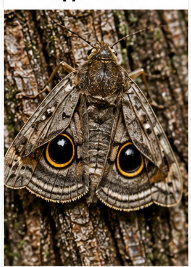
Lappet Moths are a diverse group of moths belonging to the family Lasiocampidae. They are best known for their unusual caterpillars, which are often densely covered with hairs and possess distinctive flap-like or fringe-like projections along the sides of the body. These projections help break up the caterpillar’s outline, allowing it to blend remarkably well with tree bark, twigs, leaves, and other vegetation.
Lappet Moths occur in forests, woodlands, gardens, orchards, grasslands, and ornamental landscapes. Their caterpillars feed primarily on the foliage of trees and shrubs, including oak, birch, willow, and various fruit trees. Most species cause only minor feeding damage and should be considered part of the normal insect community. However, unusually large populations can occasionally produce noticeable defoliation of trees and ornamental plants.
Because Lappet Moths provide food for birds and other wildlife, management should generally focus on monitoring and selective control rather than automatically eliminating caterpillars whenever they are discovered.
Taxonomy and Classification
Lappet Moths belong to the order Lepidoptera, which includes both moths and butterflies. They are classified in the family Lasiocampidae, a widespread group containing numerous genera and species.
- Kingdom: Animalia
- Phylum: Arthropoda
- Class: Insecta
- Order: Lepidoptera
- Family: Lasiocampidae
- Common Name: Lappet Moths
Genera associated with the family include Phyllodesma, Gastropacha, Tolype, and numerous other groups. Like other moths, Lappet Moths undergo complete metamorphosis, progressing through egg, larva, pupa, and adult stages.
Why Are They Called Lappet Moths?
The name “lappet” refers primarily to the unusual lateral structures found on many of the caterpillars. These projections, combined with body hairs and cryptic coloration, help conceal the caterpillar’s body shape.
When a caterpillar rests against bark or along a branch, its outline may become surprisingly difficult to distinguish from the surrounding surface. Some species resemble bark, dried leaves, lichens, or irregular pieces of vegetation.
This camouflage provides protection from predators such as birds that hunt caterpillars visually.
Physical Description
Adult Lappet Moths are generally medium-sized to relatively large, heavy-bodied moths. Brown, tan, gray, reddish-brown, and other earthy colors are common.
The adults often have:
- Stout, densely hairy bodies
- Broad wings
- Brown, gray, tan, or reddish coloration
- Subtle lines, bands, or mottled wing patterns
- Camouflage resembling bark or dried vegetation
When resting, the wings may be held in a tent-like position over the body. Their subdued coloration helps adults remain concealed on tree trunks and vegetation during daylight hours.
Lappet Moth Caterpillars
The caterpillar is usually the most distinctive life stage. Lappet Moth larvae can be relatively large and are commonly covered with dense hairs.
Important identification characteristics can include:
- A broad or somewhat flattened body
- Dense body hairs
- Lateral fringes or lappet-like projections
- Brown, gray, greenish, or bark-like coloration
- Strong camouflage against branches and trunks
Some caterpillars rest lengthwise along branches, making them particularly difficult to detect. Their body coloration and outline can closely match the bark beneath them.
Although many Lappet Moth caterpillars are not considered dangerous, hairy caterpillars should generally be handled cautiously. Sensitive individuals may experience skin irritation after contact with the hairs of some species. Gloves are advisable when manual removal is necessary.
Distribution and Habitat
Lappet Moths occur in numerous regions around the world and occupy a broad range of environments containing suitable host plants.
Typical habitats include:
- Deciduous forests
- Mixed woodlands
- Forest edges
- Orchards
- Gardens
- Parks
- Ornamental landscapes
- Shrublands
In residential landscapes, caterpillars may be discovered on ornamental trees and shrubs. Adults may occasionally appear around outdoor lighting, porches, windows, or other illuminated areas at night.
Life Cycle
Lappet Moths undergo four developmental stages: egg, caterpillar, pupa, and adult.
Egg Stage
Adult females deposit eggs on or near suitable host plants. Depending on the species, eggs may be laid individually or in groups.
After development is complete, young caterpillars emerge and begin feeding on foliage.
Larval Stage
The caterpillar is the primary feeding stage. Larvae consume leaves while progressing through several developmental stages known as instars.
During the day, some larvae remain motionless against branches or bark where their camouflage protects them from predators. Feeding may become more noticeable during evening or nighttime hours.
Pupal Stage
Once fully developed, the caterpillar constructs a protective cocoon. The cocoon may incorporate silk, plant material, and larval hairs.
Cocoons can be attached to:
- Branches
- Tree trunks
- Leaves
- Vegetation
- Protected surfaces near the host plant
Inside the cocoon, the caterpillar transforms into an adult moth.
Adult Stage
Adults emerge primarily to locate mates and reproduce. Adult feeding behavior varies among species, and some Lasiocampidae have reduced mouthparts and rely heavily on energy accumulated during the larval stage.
Many species have approximately one generation per year, although development and generation number can vary according to species, geography, and climate.
Host Plants
Lappet Moth caterpillars feed primarily on the foliage of woody plants. Host preferences vary considerably among species.
Common host plants can include:
- Oak
- Birch
- Willow
- Apple
- Cherry
- Other deciduous trees
- Various ornamental shrubs
Many healthy, established trees can tolerate moderate caterpillar feeding without experiencing permanent injury.
Feeding Damage
Damage is caused by the caterpillar stage. Larvae chew foliage rather than sucking plant fluids.
Typical symptoms include:
- Irregular holes in leaves
- Chewed leaf margins
- Partial defoliation
- Reduced foliage density
- Visible caterpillars along branches
Small populations usually produce only scattered feeding damage. This rarely justifies treatment on established trees.
Higher populations can remove substantially more foliage, particularly from smaller trees or ornamental plants.
Are Lappet Moths Serious Pests?
Most Lappet Moths are considered minor or occasional pests rather than major destructive insects.
Healthy mature trees can generally tolerate some leaf loss. Problems are more likely when large caterpillar populations develop on:
- Young trees
- Recently transplanted trees
- Already stressed plants
- Fruit trees
- High-value ornamentals
Repeated heavy defoliation can reduce plant vigor because the tree must use stored energy to replace lost foliage.
Signs of a Lappet Moth Infestation
Property owners should look for a combination of caterpillars and foliage damage rather than relying on leaf damage alone.
Possible signs include:
- Large hairy caterpillars resting on branches
- Irregularly chewed leaves
- Partial defoliation
- Cocoons attached to trees or vegetation
- Adult moths appearing near host trees
- Reduced foliage density during an outbreak
Because the caterpillars are exceptionally well camouflaged, carefully inspect branches and trunks as well as leaves.
Ecological Importance
Lappet Moths have an important place in natural food webs. Although their caterpillars consume vegetation, they also provide food for numerous predators and parasitoids.
Natural enemies may include:
- Birds
- Predatory insects
- Spiders
- Parasitic wasps
- Parasitic flies
- Other insect-eating wildlife
These natural enemies help prevent most Lappet Moth populations from reaching damaging levels.
Management and Control (IPM)
Management should follow an Integrated Pest Management (IPM) approach. Because most populations cause little permanent damage, treatment should be based on actual plant injury rather than simply the presence of caterpillars.
Monitoring
Regularly inspect susceptible trees and shrubs for feeding damage and caterpillars. Early detection is particularly useful on young or valuable ornamental trees.
Look carefully along branches because the caterpillars’ camouflage can make them difficult to see.
Mechanical Removal
Small infestations can often be managed without insecticides.
- Remove individual caterpillars by hand while wearing gloves.
- Prune heavily infested small branches when appropriate.
- Remove accessible cocoons when population reduction is necessary.
Mechanical control is particularly practical on small ornamental trees and shrubs.
Maintain Plant Health
Healthy plants are better able to tolerate temporary foliage loss.
Provide appropriate irrigation during dry periods, maintain suitable mulch around the root zone, and avoid unnecessary injury to trunks and roots.
Biological Control
Natural predators and parasitoids provide significant population suppression. Avoid unnecessary use of broad-spectrum insecticides that can kill beneficial insects along with the caterpillars.
Encouraging a diverse landscape can help support birds, parasitic wasps, and other natural enemies.
Bacillus thuringiensis (Bt)
If treatment becomes necessary while caterpillars are young, products containing Bacillus thuringiensis var. kurstaki may be appropriate where they are labeled for the target pest and plant.
Bt works best against young caterpillars because it must be consumed while they are actively feeding. Always follow the product label.
When Chemical Control May Be Necessary
Conventional insecticide treatment is rarely justified for a few Lappet Moth caterpillars.
Control may be considered when:
- Large numbers of caterpillars are present
- Significant defoliation is occurring
- Young trees are being heavily damaged
- High-value ornamental or fruit trees are threatened
- Repeated defoliation is weakening plants
When treatment is required, targeting young caterpillars generally provides better results than waiting until larvae are mature.
Lappet Moths Around Homes
Adult moths may occasionally be attracted to exterior lighting and appear on walls, doors, windows, and screens. Their presence does not normally indicate an indoor infestation.
Reducing unnecessary outdoor lighting at night may decrease the number of moths gathering immediately around a structure.
Cocoons discovered on exterior surfaces can usually be removed manually if they are considered unsightly.
Conservation Considerations
Because most Lappet Moths cause limited damage and serve as prey for other wildlife, automatic pesticide treatment is unnecessary.
In natural woodlands and landscapes where serious defoliation is not occurring, allowing the insects to remain supports local biodiversity and normal predator-prey relationships.
The objective of IPM should therefore be to protect valuable plants when necessary while conserving harmless populations whenever practical.
Conclusion
Lappet Moths are distinctive members of the family Lasiocampidae, best recognized by their hairy, remarkably camouflaged caterpillars. Their unusual lappet-like body structures allow many larvae to blend into bark, branches, and vegetation, making them surprisingly difficult to detect.
The caterpillars feed on the foliage of trees and shrubs, including oak, birch, willow, fruit trees, and ornamental plants. Although outbreaks can occasionally result in noticeable defoliation, most populations cause only minor damage and do not require treatment.
Monitoring, manual removal, maintaining plant health, and conserving natural predators are usually sufficient. Where valuable plants face significant defoliation, targeted treatment of young caterpillars may be appropriate. Overall, Lappet Moths are better viewed as interesting members of the landscape ecosystem than as pests requiring routine control.