Overview
Khapra Beetles (Trogoderma granarium) are among the most destructive stored-product pests in the world. These invasive beetles attack a wide variety of dried foods and grains, including wheat, rice, corn, barley, pasta, dried milk, seeds, pet food, and processed grain products.
Originally native to South Asia, Khapra beetles are now considered one of the world’s most dangerous quarantine pests due to their extreme survival abilities, rapid spread through trade, and resistance to many conventional control methods. Even small infestations can lead to severe contamination and economic losses in warehouses, grain silos, shipping containers, mills, and food-processing facilities.
The larval stage causes nearly all damage. Larvae feed aggressively on stored materials while leaving behind cast skins, hairs, and frass that contaminate products and render them unsuitable for consumption. Their ability to survive long periods without food makes eradication especially difficult once they become established.
Quick Facts
- Common Name: Khapra Beetle
- Scientific Name: Trogoderma granarium
- Order: Coleoptera
- Family: Dermestidae
- Main Targets: Stored grains and dried foods
- Primary Damage Stage: Larvae
- Threat Level: Severe global quarantine pest
- Origin: South Asia
Taxonomy and Classification
Khapra beetles belong to the family Dermestidae, a group commonly known as skin beetles or carpet beetles. Unlike carpet beetles that feed on fabrics or animal products, Khapra beetles specialize in stored grain and dry food materials.
- Kingdom: Animalia
- Phylum: Arthropoda
- Class: Insecta
- Order: Coleoptera
- Family: Dermestidae
- Genus: Trogoderma
- Species: Trogoderma granarium
They undergo complete metamorphosis consisting of egg, larval, pupal, and adult stages.
Identification
Adult Beetles
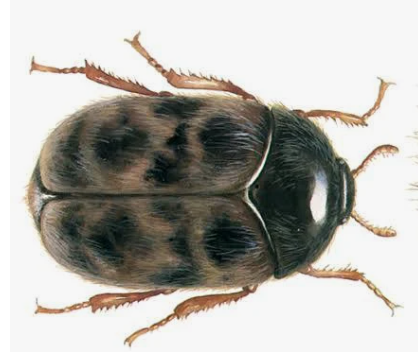
Adult Khapra beetles are very small, oval-shaped beetles measuring approximately 1/16 to 1/8 inch long.
- Dark reddish-brown coloration
- Compact oval body
- Fine body hairs
- Weak or absent flight ability
- Slow-moving behavior
Adults are short-lived and cause little direct damage compared to larvae.
Larvae
The larvae are the destructive stage and are highly recognizable.
- Yellowish-brown to reddish-brown coloration
- Dense body hairs
- Elongated, segmented appearance
- Tufts of longer hairs near the tail end
- Approximately 1/4 inch long when mature
Larvae are extremely hardy and can survive extended periods under harsh conditions.
Habitat and Distribution
Khapra beetles thrive in warm, dry environments associated with stored food products.
Common infestation sites include:
- Grain silos
- Warehouses
- Food processing facilities
- Shipping containers
- Mills
- Pantries
- Livestock feed storage
- Import/export terminals
Although established in parts of Asia, Africa, and the Middle East, many countries aggressively regulate and quarantine Khapra beetles to prevent establishment.
In the United States and Europe, infestations are treated as major regulatory emergencies.
Life Cycle
The Khapra beetle life cycle varies depending on temperature, humidity, and food availability.
Egg Stage
Females lay eggs directly on food sources or in nearby cracks and crevices.
Larval Stage
Larvae emerge and begin feeding immediately. This stage causes virtually all economic damage.
Larvae may molt several times and can enter prolonged dormancy called diapause when conditions become unfavorable.
Dormancy Ability
One of the most dangerous characteristics of Khapra beetles is their ability to survive:
- Long periods without food
- Extreme heat
- Low humidity
- Chemical exposure
- Cold temperatures
Larvae may remain dormant for months or even years before resuming development.
Pupal and Adult Stages
Pupation occurs within protected spaces near food sources, followed by emergence of adults that continue reproduction.
Damage and Impact
Khapra beetles are among the most economically devastating stored-product pests worldwide.
Food Consumption
Larvae feed on:
- Stored grain
- Rice
- Corn
- Wheat
- Seeds
- Dried milk
- Beans
- Pasta
- Animal feed
- Processed cereals
Contamination
Even limited feeding can ruin large quantities of stored food due to contamination by:
- Larval hairs
- Cast skins
- Frass
- Dead insects
Contaminated food products are often unsuitable for human consumption or export.
Economic Losses
Infestations can result in:
- Destroyed grain reserves
- Export restrictions
- Facility shutdowns
- Costly fumigation programs
- Trade embargoes
- Long-term contamination issues
Signs of Infestation
- Hairy larvae in grain or stored products
- Accumulated cast larval skins
- Fine powdery frass
- Chewed grain kernels
- Dead beetles near food storage
- Larvae hiding in cracks and seams
- Foul or dusty odor in storage areas
Behavior and Survival
Khapra beetles are exceptionally difficult to eradicate because of their biological adaptations.
Hidden Infestations
Larvae hide deep within:
- Equipment seams
- Storage cracks
- Packaging materials
- Insulation gaps
- Structural crevices
This behavior allows infestations to persist undetected.
Resistance and Hardiness
Khapra beetles display resistance to many insecticides and environmental stresses, making them one of the toughest stored-product pests to control.
Prevention and Control
Management requires aggressive sanitation, monitoring, and regulatory action.
Sanitation
- Clean storage areas thoroughly
- Remove spilled grain immediately
- Vacuum cracks and crevices
- Discard infested food products
- Inspect incoming shipments carefully
Storage Practices
- Use airtight containers
- Rotate stored inventory regularly
- Maintain dry conditions
- Reduce food accumulation
- Inspect warehouses routinely
Monitoring
Pheromone-baited traps are commonly used to detect infestations early.
Professional Eradication
Serious infestations may require:
- Facility-wide fumigation
- Heat treatment
- Quarantine enforcement
- Regulatory inspection
- Long-term monitoring programs
Interesting Facts
- Khapra beetles are considered one of the world’s 100 worst invasive species.
- Larvae can survive for years without food.
- They are highly resistant to environmental stress.
- Adults rarely fly.
- The larval stage causes nearly all damage.
- Many countries enforce strict import quarantines against them.
Health Concerns
Khapra beetles are not known to spread disease directly, but larval hairs may irritate:
- Skin
- Eyes
- Respiratory systems
Workers in heavily infested facilities may experience allergic reactions or respiratory discomfort.
Conservation and Research
Because of their severe economic importance, Khapra beetles are the subject of extensive international research.
Current studies focus on:
- Improved pheromone detection
- Heat treatment systems
- Alternative fumigation methods
- Resistance management
- Biological control options
- Rapid quarantine detection technologies
Researchers continue searching for safer and more effective ways to eliminate infestations without relying heavily on toxic fumigants.