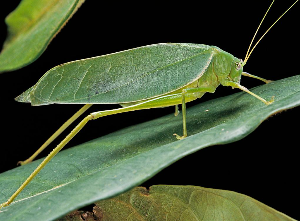
Katydids (family Tettigoniidae) are long-legged, plant-dwelling insects closely related to crickets and grasshoppers. They are often called bush crickets or long-horned grasshoppers because of their extremely long antennae and their tendency to live among shrubs, grasses, and tree foliage. Katydids are best known for their remarkable camouflage and the rhythmic nighttime songs produced by males.
Many species closely resemble leaves, twigs, bark, or other parts of plants. Their green bodies may include imitation leaf veins, brown edges, spots, and markings that resemble natural plant damage. This camouflage helps protect them from birds, reptiles, spiders, and other predators.
Katydids are generally considered neutral or beneficial members of the environment. Most feed on leaves, flowers, pollen, seeds, or soft plant tissue without causing serious harm. Some species are omnivorous and may also consume aphids, insect eggs, caterpillars, and other small arthropods. Large populations can occasionally damage garden plants, but widespread or economically important infestations are uncommon.
Taxonomy and Classification
Katydids belong to the order Orthoptera, which also includes grasshoppers and crickets. They are members of the suborder Ensifera, a group distinguished by long antennae and, in females, a prominent ovipositor used for laying eggs.
- Kingdom: Animalia
- Phylum: Arthropoda
- Class: Insecta
- Order: Orthoptera
- Suborder: Ensifera
- Family: Tettigoniidae
- Common Names: Katydids, Bush Crickets, Long-horned Grasshoppers
Thousands of katydid species occur worldwide. They are especially diverse in tropical forests, although many species are also found throughout the United States and Canada.
Physical Description
Katydids vary considerably in size and appearance. Most North American species measure approximately 1 to 3 inches long, although some tropical species may approach or exceed 4 inches.
- Body Length: Commonly 1–4 inches, depending on species.
- Color: Usually green, but some species are brown, gray, pink, yellow, or patterned.
- Antennae: Extremely long, thin, and thread-like, often longer than the entire body.
- Hind Legs: Enlarged and muscular for jumping.
- Forewings: Broad, leathery, and often shaped like leaves.
- Ovipositor: Females may have a long, flattened, blade-like or curved egg-laying organ.
The long antennae are one of the easiest ways to distinguish katydids from most grasshoppers. Grasshoppers usually have short antennae, while katydid antennae may extend several times the length of the body.
Leaf-Mimicking Camouflage
Katydids are among the most accomplished camouflage specialists in the insect world. Many species have flattened wings with patterns that imitate the veins and texture of living leaves.
Some possess:
- Dark markings resembling fungal leaf spots
- Brown edges that imitate dried plant tissue
- Irregular outlines resembling torn leaves
- Raised veins that resemble natural leaf structure
- Green or brown color variations matching local vegetation
When threatened, a katydid may remain motionless and align its body with a leaf or stem. This behavior makes the insect difficult to detect even when it is directly exposed.
Distribution and Habitat
Katydids are found on every continent except Antarctica. They are most abundant and diverse in tropical and subtropical regions, but many species are well established throughout temperate North America.
Common habitats include:
- Forests and woodland edges
- Prairies and grasslands
- Gardens and ornamental landscapes
- Meadows
- Shrublands
- Wetlands
- Agricultural fields
- Urban parks and suburban yards
Most species live above ground in trees, shrubs, vines, or tall grasses. Their camouflage is most effective when they remain within the vegetation they resemble.
Life Cycle
Katydids undergo incomplete metamorphosis, developing through egg, nymph, and adult stages without a pupal stage.
- Egg: Females deposit eggs in soil, bark, stems, leaves, or other protected plant tissue.
- Nymph: Young katydids resemble small wingless adults and begin feeding soon after hatching.
- Adult: After passing through several molts, the insect develops functional wings and reproductive organs.
In many temperate regions, katydids overwinter as eggs. Nymphs emerge during spring or early summer, and adults become most noticeable from midsummer through autumn.
In warmer climates, some species may remain active for longer periods or produce more than one generation per year.
Sound Production and Communication
Male katydids are famous for producing loud, repetitive mating calls. These sounds are created through a process called stridulation, in which specialized structures on the forewings are rubbed together.
A file-like ridge on one wing is drawn across a scraper on the opposite wing, producing a series of clicks, chirps, rattles, or pulses. The familiar name “katydid” is believed to come from the three-part call of certain species that sounds similar to the phrase “ka-ty-did.”
Katydid songs serve several purposes:
- Attracting females
- Identifying members of the same species
- Establishing territory
- Warning competing males
Different species produce distinctive calls, allowing researchers and experienced naturalists to identify katydids by sound. The calling rate may also change with temperature, generally becoming faster during warmer conditions.
Hearing and Sensory Abilities
Katydids do not hear through structures on the head. Instead, their hearing organs, known as tympana, are located on the front legs near the knee joints.
These sensitive membranes allow katydids to detect mating songs, predator-generated sounds, and the movements of nearby insects. Their long antennae also provide information about touch, air movement, humidity, and surrounding vegetation.
Diet and Feeding Behavior
Most katydids are primarily herbivorous, although feeding habits vary by species.
Plant foods may include:
- Leaves
- Flowers
- Pollen
- Seeds
- Fruit
- Grass blades
- Tender stems
Some katydids are omnivorous or partially predatory. These species may consume:
- Aphids
- Small caterpillars
- Insect eggs
- Other katydids
- Dead insects
- Soft-bodied arthropods
Occasional predation can make certain katydids useful contributors to natural pest suppression.
Plant Damage
Katydid feeding usually produces minor cosmetic damage rather than severe injury. Their chewing mouthparts remove small sections of leaf tissue.
Typical signs include:
- Irregular holes in leaves
- Scalloped leaf edges
- Small missing sections of flower petals
- Superficial feeding on soft fruit
- Light chewing on buds or developing seed pods
Healthy established plants generally tolerate this feeding without measurable reductions in growth or flowering. Damage may become more noticeable on seedlings, young ornamentals, or high-value display plants when several katydids feed in the same area.
Behavior and Human Conflict
Katydids are not aggressive toward humans and do not possess venomous stingers. If handled or trapped, a large individual may attempt to bite with its chewing mouthparts. Such bites may pinch the skin but are not medically significant.
The most common source of conflict is their nighttime calling. During late summer and early autumn, males may sing continuously from trees or shrubs near homes. A loud individual calling near a bedroom window can become disruptive, particularly on warm nights.
Katydids occasionally enter homes through open doors, damaged window screens, or gaps around exterior lighting. Indoor individuals do not reproduce successfully in typical household environments and can usually be captured and released outside.
Ecological Importance
Katydids are important components of many terrestrial food webs.
- Wildlife Food: They are eaten by birds, bats, frogs, reptiles, spiders, and predatory insects.
- Nutrient Cycling: Their feeding and waste contribute to the breakdown and recycling of plant material.
- Natural Predation: Omnivorous species may consume aphids and other small pests.
- Biodiversity: Their presence contributes to healthy and diverse grassland and woodland ecosystems.
- Environmental Monitoring: Katydid communities can help researchers assess habitat quality and ecological change.
Management and Prevention
Control is rarely necessary because katydids generally cause little damage and provide ecological benefits.
Toleration
A small number of katydids should normally be left undisturbed. Minor leaf chewing is usually cosmetic and does not threaten plant health.
Hand Removal
When katydids are feeding on valuable ornamental plants, they can be removed by hand and relocated. Gloves may be used when handling larger individuals.
Protecting Young Plants
Lightweight row covers or insect mesh may protect seedlings and tender plants. Covers should be properly secured while still allowing adequate airflow and light.
Reducing Indoor Entry
- Repair damaged window and door screens.
- Seal gaps around doors, windows, and utility lines.
- Keep doors closed during peak nighttime activity.
- Reduce bright exterior lighting near entrances when practical.
- Use less insect-attractive outdoor lighting where appropriate.
Avoiding Unnecessary Pesticides
Broad-spectrum insecticide treatments are generally not justified for katydids. Such applications can kill pollinators, predatory insects, and other beneficial organisms while providing little long-term benefit.
If unusual feeding damage becomes severe, confirm that katydids are responsible before considering any treatment. Caterpillars, beetles, grasshoppers, slugs, and other pests can produce similar leaf injuries.
Conservation and Research
Katydids are studied for their acoustic communication, camouflage, hearing, evolution, mating behavior, and responses to environmental change. Their songs allow researchers to monitor insect populations without capturing individual specimens.
Artificial lighting, pesticide exposure, habitat loss, and changes in vegetation can affect local katydid communities. Maintaining native grasses, shrubs, and trees while reducing unnecessary pesticide use helps preserve their diversity.
Conclusion
Katydids are distinctive long-horned relatives of crickets and grasshoppers known for their leaf-like camouflage and rhythmic nighttime songs. Although they occasionally chew small holes in garden foliage, they rarely cause serious plant damage and are not dangerous to people. Their roles as herbivores, occasional predators, and prey for wildlife make them valuable members of natural ecosystems. In most gardens and landscapes, tolerance, physical relocation, and basic exclusion are more appropriate than chemical control.