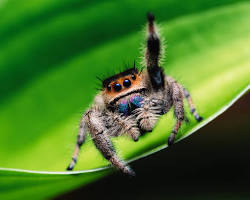
Jumping Spiders (family Salticidae) are among the most recognizable and fascinating spiders found worldwide. Known for their excellent vision, quick movements, and remarkable jumping ability, these spiders are commonly encountered in homes, gardens, fences, and outdoor structures. Unlike web-building spiders, Jumping Spiders actively hunt their prey using stealth, precision, and rapid leaps. They are considered highly beneficial predators that naturally help control nuisance insect populations. :contentReference[oaicite:0]{index=0}
Jumping Spiders are harmless to humans and play an important ecological role in reducing flies, mosquitoes, gnats, moths, and other small insects. Their curious behavior, large forward-facing eyes, and active daytime hunting habits make them one of the few spiders many people actually enjoy observing.
Quick Facts
- Scientific Family: Salticidae
- Common Name: Jumping Spider
- Class: Arachnida
- Diet: Insects and other arthropods
- Main Benefit: Natural pest control
- Habitat: Homes, gardens, forests, fences, walls
- Behavior: Active visual hunters
- Status: Beneficial predators
Taxonomy and Classification
Jumping Spiders belong to the family Salticidae, the largest spider family in the world, containing more than 6,000 described species globally. They are members of the class Arachnida, which also includes ticks, mites, and scorpions. :contentReference[oaicite:1]{index=1}
The family name derives from the Latin word saltare, meaning “to jump,” referring to their signature hunting movement. Unlike web-building spiders that passively wait for prey, Jumping Spiders actively stalk and ambush insects during daylight hours. :contentReference[oaicite:2]{index=2}
They possess some of the best vision of any arthropod and rely heavily on sight for:
- Hunting prey
- Navigation
- Mate recognition
- Courtship displays
Many species also display surprisingly complex behaviors and communication methods compared to other spider groups. :contentReference[oaicite:3]{index=3}
Physical Description
Jumping Spiders are generally small to medium-sized spiders ranging from approximately 2 mm to 20 mm in length depending on species. :contentReference[oaicite:4]{index=4}
Key Identification Features
- Large forward-facing eyes
- Compact, stocky body
- Often fuzzy or hairy appearance
- Short, powerful legs
- Quick, jerky movements
- Excellent jumping ability
The most distinctive feature is their eye arrangement. Jumping Spiders possess eight eyes, with the two large front eyes providing sharp binocular-like vision. :contentReference[oaicite:5]{index=5}
Coloration varies greatly between species. Some are dull brown or gray for camouflage, while others display vibrant metallic greens, reds, blues, or iridescent markings. Species such as Peacock Spiders are famous for elaborate colors and mating dances. :contentReference[oaicite:6]{index=6}
Jumping Ability and Vision
Jumping Spiders are famous for their extraordinary jumping capability. Instead of using large muscles like insects, they use a hydraulic system that rapidly changes internal body pressure to extend their legs explosively. :contentReference[oaicite:7]{index=7}
Some species can jump up to 50 times their body length with remarkable accuracy.
Before leaping, they attach a silk dragline to the surface behind them. This silk acts as a safety tether if the spider misses its target or falls. :contentReference[oaicite:8]{index=8}
Their visual system is equally impressive:
- Excellent depth perception
- Motion tracking ability
- Color vision
- Accurate distance calculation
- High-resolution focus
Research shows Jumping Spiders possess some of the sharpest eyesight among arthropods. :contentReference[oaicite:9]{index=9}
Behavior and Hunting Strategy
Jumping Spiders are active daytime hunters that do not rely on capture webs. Instead, they carefully stalk prey before launching a rapid attack.
Hunting Behavior
- Spot prey visually
- Slowly stalk the target
- Calculate distance
- Leap and seize prey
- Inject venom to immobilize prey
Their prey includes:
- Flies
- Mosquitoes
- Gnats
- Moths
- Ants
- Leafhoppers
- Other spiders
Jumping Spiders are considered important biological control agents because they consume large numbers of pest insects in gardens and homes. :contentReference[oaicite:10]{index=10}
Curious Behavior
Many Jumping Spiders display curious, intelligent-looking behavior. They often tilt their heads and visually track movement, making them appear unusually aware of their surroundings.
This behavior, combined with their large eyes, makes them less intimidating to many people compared to other spider species. :contentReference[oaicite:11]{index=11}
Life Cycle
Jumping Spiders undergo three main life stages:
- Egg
- Spiderling
- Adult
Females lay eggs inside protective silk sacs, often hidden beneath bark, leaves, or sheltered surfaces. Some females guard the egg sac until the spiderlings emerge. :contentReference[oaicite:12]{index=12}
Spiderlings resemble miniature adults and begin hunting shortly after dispersing. Most species mature within several months and typically live about one year.
Habitat and Distribution
Jumping Spiders are found worldwide in nearly every terrestrial habitat. Tropical forests contain the highest diversity, but they are also common in temperate climates, deserts, grasslands, gardens, and urban areas. :contentReference[oaicite:13]{index=13}
Common locations include:
- Walls and fences
- Windowsills
- Tree trunks
- Garden plants
- Sunny rocks
- Outdoor decks and railings
Indoors, they occasionally wander into homes while hunting insects. However, they do not create infestations and usually remain solitary.
Human Interaction and Bites
Jumping Spiders are generally harmless to humans. While they can bite if trapped or handled roughly, bites are uncommon and usually mild. Symptoms are typically limited to:
- Minor redness
- Mild swelling
- Slight irritation
Their venom is not medically significant to healthy humans. :contentReference[oaicite:14]{index=14}
Unlike aggressive spiders, Jumping Spiders rarely display defensive behavior and often retreat when disturbed.
Benefits in Gardens and Homes
Jumping Spiders provide valuable natural pest control by consuming nuisance insects both indoors and outdoors.
Benefits include:
- Reduced fly populations
- Mosquito control
- Natural garden pest suppression
- Reduced pesticide dependence
- Ecological balance support
Their presence is generally considered a sign of a healthy ecosystem with balanced insect populations. :contentReference[oaicite:15]{index=15}
Management and Prevention
Control is rarely necessary because Jumping Spiders are beneficial predators.
Recommended Management
- Capture and release outdoors if desired
- Seal cracks and gaps around windows and doors
- Reduce indoor insect prey populations
- Limit bright outdoor lighting that attracts insects
Avoid unnecessary pesticide use, as chemical sprays may eliminate beneficial predators while allowing pest insects to increase.
Interesting Facts About Jumping Spiders
- They have some of the best eyesight among arthropods.
- They use hydraulic pressure to jump.
- Many species perform elaborate courtship dances.
- Some species mimic ants for protection.
- They attach silk safety lines before jumping.
- Most species hunt only during daylight.
Conservation and Research
Scientists study Jumping Spiders for their:
- Advanced visual systems
- Predatory behavior
- Courtship communication
- Hydraulic jumping mechanisms
- Potential role in biological pest control
Research into Salticidae behavior continues to reveal surprisingly advanced learning abilities, navigation skills, and sensory adaptations compared to many other spiders. :contentReference[oaicite:16]{index=16}