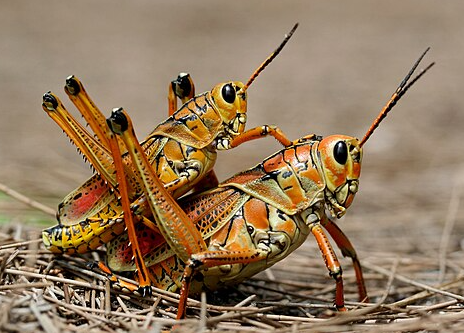
The Eastern Lubber Grasshopper (Romalea microptera) is one of the largest and most recognizable grasshopper species in North America. Native to the southeastern United States, this enormous, slow-moving insect is known for its bright warning coloration, reduced wings, and voracious appetite for vegetation. Although incapable of sustained flight, Eastern Lubber Grasshoppers can cause severe defoliation in gardens, ornamental landscapes, citrus groves, and agricultural fields when populations become abundant.
Taxonomy and Classification
The Eastern Lubber Grasshopper belongs to the order Orthoptera, which includes grasshoppers, katydids, and crickets, and the family Romaleidae, a group of large-bodied grasshoppers commonly referred to as lubbers. The species is closely related to other tropical and subtropical lubber grasshoppers found throughout the Americas.
The scientific name Romalea microptera refers to its unusually small wings. Unlike many grasshopper species capable of strong flight, Eastern Lubbers rely primarily on walking and crawling to move between feeding sites.
Identification
Eastern Lubber Grasshoppers are among the largest grasshoppers in North America, with adults commonly reaching 50–90 mm in length. Their bodies are thick, heavy, and highly robust. Adults display striking coloration that often includes combinations of black, yellow, orange, and red patterns. These bright colors serve as a warning signal to predators, indicating the insect’s unpleasant taste and chemical defenses.
Adults possess short, non-functional wings known as tegmina, rendering them effectively flightless. This characteristic distinguishes them from most other grasshopper species in the United States.
The immature nymphs appear dramatically different from adults. Young nymphs are glossy black with bright yellow, orange, or red stripes running along the body. Nymphs often congregate in large groups during early developmental stages.
Distribution and Habitat
Eastern Lubber Grasshoppers occur primarily throughout the southeastern United States, especially in Florida, Georgia, Alabama, Mississippi, Louisiana, and coastal Gulf regions. Their range extends into portions of South Carolina and Texas.
Preferred habitats include:
- Gardens
- Roadside vegetation
- Citrus groves
- Agricultural fields
- Wet meadows
- Woodland edges
- Suburban landscapes
- Weedy vacant lots
Lubbers thrive in warm, humid environments where abundant vegetation provides food and shelter. They are particularly common in unmanaged landscapes containing dense weeds and ornamental plants.
Life Cycle
The Eastern Lubber Grasshopper undergoes incomplete metamorphosis consisting of egg, nymph, and adult stages.
Females deposit clusters of eggs in the soil during late summer and autumn. The eggs overwinter underground and hatch the following spring when temperatures rise.
Newly emerged nymphs gather in conspicuous groups and begin feeding immediately on nearby vegetation. As they grow, they pass through several molts, gradually increasing in size and developing adult coloration.
The complete development process may require several months depending on environmental conditions. Adults are most abundant during summer and early autumn.
Behavior
Eastern Lubber Grasshoppers are relatively slow-moving compared to many other grasshopper species. Because they cannot fly effectively, they depend heavily on crawling and hopping to disperse across landscapes.
When threatened, Eastern Lubbers display several defensive behaviors:
- Hissing through thoracic spiracles
- Displaying bright warning colors
- Regurgitating foul-tasting foam
- Producing defensive secretions
- Remaining motionless to avoid detection
The frothy defensive fluid they expel is sometimes called “tobacco spit” and deters birds, reptiles, and mammals from attacking them.
Feeding and Damage
Eastern Lubber Grasshoppers are highly destructive herbivores capable of consuming enormous quantities of foliage relative to their body size. Their strong mandibles allow them to chew entire leaves, flowers, stems, and even soft plant tissues.
Common host plants include:
- Vegetable crops
- Citrus trees
- Amaryllis
- Crinum lilies
- Ornamental shrubs
- Wildflowers
- Garden annuals
- Landscape plants
Heavy infestations may result in:
- Complete defoliation
- Destroyed flowers
- Stunted plant growth
- Reduced crop production
- Loss of ornamental value
- Permanent plant stress
Large adults are especially difficult to manage because of their size, chemical defenses, and relative resistance to some insecticides.
Economic Importance
Eastern Lubber Grasshoppers are considered significant agricultural and ornamental pests throughout parts of the southeastern United States. Their feeding behavior can devastate gardens and nursery stock, particularly when dense populations develop.
In commercial citrus production and ornamental horticulture, severe infestations may require intensive management to prevent economic losses.
Management and Control (IPM)
Early Detection
Management is most effective when nymphs are small and concentrated. Early spring monitoring is critical.
Mechanical Control
- Hand-pick adults and nymphs
- Drop insects into soapy water
- Use trench barriers to trap migrating nymphs
- Remove egg-laying habitat
Habitat Modification
- Mow tall weeds near gardens
- Reduce unmanaged vegetation
- Eliminate dense harborage areas
- Maintain clean landscape borders
Biological Control
- Encourage birds and reptiles
- Promote predatory insects
- Use Nosema locustae biological bait products
Chemical Control
Insecticides are generally more effective against young nymphs than adults. Spot treatments may help suppress localized infestations when applied early.
Ecological Role
Despite their pest status, Eastern Lubber Grasshoppers are part of native southeastern ecosystems. They serve as prey for birds, reptiles, amphibians, and predatory insects, although many predators avoid them because of their chemical defenses.
Their feeding activity also contributes to nutrient cycling and vegetation turnover in natural habitats.
Conclusion
The Eastern Lubber Grasshopper is one of the largest and most visually striking grasshopper species in North America. Although fascinating from a biological perspective, its destructive feeding behavior makes it a serious pest in gardens, ornamental landscapes, and agricultural systems throughout the southeastern United States. Early detection, habitat management, and integrated pest management strategies are essential for minimizing damage and controlling outbreaks.