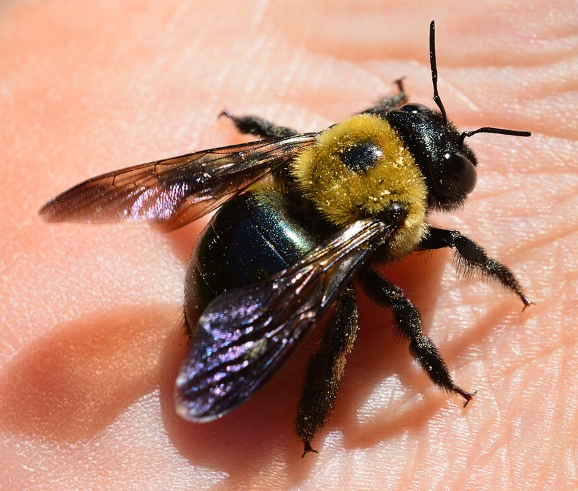
The Eastern Carpenter Bee (Xylocopa virginica) is one of the most recognizable large bee species in North America. Frequently observed hovering near wooden structures such as decks, eaves, fences, siding, and porches, this species is both a valuable pollinator and a structural nuisance pest. Although often mistaken for bumblebees because of their similar size and coloration, Eastern Carpenter Bees differ significantly in appearance, behavior, nesting biology, and impact on wooden structures.
Taxonomy and Classification
The Eastern Carpenter Bee belongs to the order Hymenoptera, which includes bees, wasps, and ants, and the family Apidae. Within this family, the genus Xylocopa contains the true carpenter bees, a group specifically adapted for boring into wood to create nesting galleries.
The species name virginica reflects its original classification from specimens collected in the eastern United States. Unlike honey bees, carpenter bees are considered solitary bees, meaning each female independently creates and provisions her own nest rather than living within a highly organized social colony.
Identification
Adult Eastern Carpenter Bees are large, robust insects measuring approximately 20–25 mm in length. Their size and fuzzy thorax frequently cause them to be confused with bumblebees. However, a major diagnostic feature is the smooth, shiny, hairless black abdomen, which clearly distinguishes carpenter bees from the fully hairy abdomen of bumblebees.
Males and females can also be distinguished by facial coloration:
- Males: Possess a white or yellow patch on the face and cannot sting.
- Females: Have an entirely dark face and possess a functional stinger.
Despite their intimidating hovering behavior, males are harmless because they lack stingers. Females rarely sting unless directly handled or threatened.
Another important identifying feature is the presence of perfectly round entrance holes approximately ½ inch in diameter drilled into exposed wood surfaces. These holes appear as though they were made using a power drill.
Distribution and Habitat
The Eastern Carpenter Bee occurs throughout much of the eastern and southeastern United States. It is particularly common in suburban environments where untreated wood provides suitable nesting material.
Common nesting locations include:
- Deck railings
- Wooden fences
- Soffits and fascia boards
- Porches
- Eaves
- Outdoor furniture
- Wooden siding
- Barns and sheds
Carpenter bees strongly prefer weathered, untreated softwoods such as cedar, pine, cypress, and redwood because these materials are easier to excavate.
Life Cycle
The life cycle begins during early spring when overwintering adults emerge and begin mating activity. Females locate suitable wood surfaces and excavate nesting tunnels using their powerful mandibles.
After drilling the initial entry hole, the female turns sharply and tunnels parallel to the wood grain, creating long galleries that may extend several feet over time.
Within the tunnel, the female creates a series of brood chambers separated by partitions made from chewed wood pulp. Each chamber contains:
- An egg
- A pollen and nectar food supply
- A sealed partition wall
The larvae hatch and feed on the stored pollen mixture before pupating within the tunnel. New adults emerge later in the summer. Most populations produce one generation annually, although adults often reuse and expand older tunnels in subsequent years.
Behavior
Eastern Carpenter Bees are highly territorial. Males commonly hover aggressively near nesting sites and may dart toward people or pets. This behavior is purely defensive intimidation and poses no physical danger.
Females spend most of their time excavating tunnels, collecting pollen, and provisioning brood cells. Their buzzing flight is loud and deliberate, often drawing attention near infested wood structures.
Unlike honey bees, carpenter bees do not form large colonies or produce honey. However, multiple females may nest in the same area when suitable wood is available.
Damage and Economic Importance
The primary concern associated with Eastern Carpenter Bees is structural damage caused by repeated wood excavation. While a single tunnel usually causes minimal harm, repeated activity over multiple years can significantly weaken wood components.
Damage commonly includes:
- Internal tunneling and hollowing of wood
- Structural weakening of railings and trim
- Accumulations of sawdust-like frass
- Yellow or dark staining beneath entrance holes
- Increased moisture penetration into wood
One of the most serious secondary problems is woodpecker damage. Woodpeckers frequently attack carpenter bee galleries to feed on larvae, causing extensive cosmetic and structural destruction.
Despite their pest status, Eastern Carpenter Bees are also important pollinators of many flowering plants and native ecosystems.
Management and Prevention
Integrated pest management for Eastern Carpenter Bees focuses primarily on prevention and exclusion.
Prevention
- Paint or seal exposed wood surfaces
- Use pressure-treated or hardwood materials when possible
- Inspect structures during spring activity periods
- Replace severely damaged wood
Mechanical Control
- Plug old tunnels after bee activity has ended
- Use wood putty, dowels, or sealant materials
- Install carpenter bee traps to intercept nesting females
Chemical Control
When infestations are severe, insecticidal dusts may be applied into active galleries before sealing entrance holes. Timing is important because sealing active tunnels too early may force bees to create additional exit holes elsewhere in the structure.
Ecological Importance
Although they can damage wood, Eastern Carpenter Bees remain ecologically valuable pollinators. They contribute to pollination of native wildflowers, ornamental plants, and some agricultural crops. Their large size and strong flight capabilities make them effective pollinators of certain deep flowers that smaller bees cannot easily access.
Conclusion
The Eastern Carpenter Bee is both a beneficial pollinator and a nuisance wood-boring insect. Its perfectly round entrance holes, loud hovering behavior, and tendency to tunnel into exposed wood make it one of the most recognizable bee species in North America. Through proper prevention, monitoring, and integrated pest management strategies, homeowners can reduce structural damage while preserving the ecological benefits these important native pollinators provide.