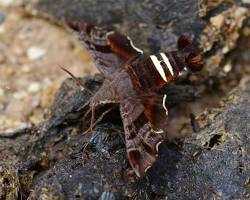
The Nessus Sphinx (Amphion floridensis) is a fast-flying hawk moth known for hovering around flowers while feeding on nectar. Because of its rapid wingbeats and hovering behavior, this moth is often mistaken for a small hummingbird. The species belongs to the family Sphingidae, a group commonly called hawk moths or sphinx moths, which are among the strongest and fastest flying moths in the world.
Nessus sphinx moths are important nighttime pollinators and are frequently observed visiting flowering plants during warm evenings. Their sleek bodies and agile flight make them one of the most distinctive moth species found in eastern North America.
Quick Facts
- Family: Sphingidae
- Common Habitat: Gardens, forests, vineyards, woodland edges
- Diet: Nectar from flowers
- Larval Host Plants: Grapevines and Virginia creeper
- Status: Beneficial pollinator
- Activity: Primarily dusk and nighttime
Identification
The Nessus sphinx is a medium-sized moth with a streamlined body and narrow wings adapted for rapid flight.
Adults are recognized by:
- Dark brown wings
- Reddish or rust-colored bands across the abdomen
- Long narrow forewings
- Rapid hovering flight
- Thick muscular body
- Wingspan of approximately 1.5 to 2 inches
When hovering near flowers, the moth strongly resembles a hummingbird due to its speed and feeding posture.
Unlike many other moths, Nessus sphinx moths are highly active fliers and can maneuver with remarkable precision.
Distribution and Habitat
The Nessus sphinx occurs throughout much of eastern North America.
Its range includes:
- Eastern United States
- Southeastern Canada
- Woodland regions
- Suburban gardens
- Vineyards
- Forest edges
- Flower-rich landscapes
This species is especially common in habitats containing grapevines and Virginia creeper, which serve as important host plants for developing caterpillars.
Adults are frequently seen near:
- Flower gardens
- Honeysuckle
- Petunias
- Phlox
- Bee balm
- Wooded trails
Life Cycle
The Nessus sphinx undergoes complete metamorphosis consisting of four stages:
- Egg
- Caterpillar
- Pupa
- Adult moth
Females lay eggs on host plants such as:
- Wild grapevine
- Virginia creeper
- Related vine species
After hatching, caterpillars begin feeding on leaves.
The caterpillars are typically green or brown and possess the characteristic rear horn common among sphinx moth larvae.
As they mature, larvae eventually leave the host plant and pupate within leaf litter or shallow soil.
Adults emerge during warm months and are most active from late spring through early fall.
Behavior
Nessus sphinx moths are powerful fliers capable of hovering in front of flowers while extending a long proboscis to drink nectar.
Adults feed on nectar from:
- Tubular flowers
- Night-blooming plants
- Garden ornamentals
- Native wildflowers
Unlike butterflies that land while feeding, hawk moths often remain airborne during nectar feeding.
Adults are most active:
- At dusk
- During warm evenings
- At night
- Occasionally during cloudy daytime conditions
They are commonly attracted to outdoor lights and flowering plants with strong fragrances.
Pest Status
The Nessus sphinx is generally not considered a pest.
Although caterpillars feed on grapevine foliage, damage is usually minimal and rarely threatens healthy plants.
In most situations, the species is viewed as beneficial because adults function as pollinators.
The moth does not:
- Bite humans
- Damage structures
- Infest homes
- Transmit diseases
Ecological Importance
Nessus sphinx moths are important nighttime pollinators.
They help pollinate:
- Wildflowers
- Garden ornamentals
- Native woodland plants
- Night-blooming flowers
Their caterpillars also serve as food sources for:
- Birds
- Spiders
- Parasitic wasps
- Small mammals
Because they are sensitive to habitat quality, healthy sphinx moth populations often indicate diverse ecosystems with abundant native plants.
Prevention
No prevention measures are generally necessary.
Gardeners wishing to support pollinators may encourage Nessus sphinx moths by:
- Planting nectar-rich flowers
- Growing native vines
- Reducing pesticide use
- Maintaining pollinator-friendly gardens
Control
Control is rarely required because the species causes very little plant damage.
If caterpillars become numerous on ornamental vines, manual removal is usually sufficient.
Broad-spectrum insecticides are discouraged because they may harm beneficial pollinators and other helpful insects.
Interesting Facts
- The Nessus sphinx is often mistaken for a hummingbird.
- Hawk moths are among the fastest flying moth species.
- The species is active primarily during dusk and nighttime.
- Caterpillars possess a horn-like structure on the rear end.
- Adults can hover in place while feeding on nectar.
- The species is an important nighttime pollinator.