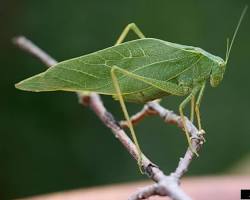
The Broad-winged Katydid (Microcentrum rhombifolium) is a common North American katydid known for its bright green leaf-like wings and loud nighttime calls. These insects are closely related to grasshoppers and crickets and are often heard singing in trees during warm summer evenings. Their remarkable camouflage allows them to blend almost perfectly into leaves and shrubs.
Broad-winged katydids are generally harmless insects that contribute to healthy ecosystems by serving as food sources for birds, reptiles, and predatory insects. Their distinctive calls are among the most recognizable nighttime insect sounds in many parts of North America.
Quick Facts
- Order: Orthoptera
- Family: Tettigoniidae
- Habitat: Forests, gardens, shrubs, woodland edges
- Diet: Leaves and plant material
- Active Season: Summer and early fall
- Status: Minor plant feeder
Identification
Broad-winged katydids are medium-to-large insects recognized for their leaf-like appearance and bright green coloration.
Adults typically measure between 1.5 and 2 inches long.
Key identifying features include:
- Bright green body coloration
- Large leaf-shaped wings
- Extremely long antennae
- Strong hind legs for jumping
- Flattened body shape
- Thin wing veins resembling leaf veins
The wings closely resemble real leaves, providing excellent camouflage against predators.
Like other katydids, their antennae may extend several times longer than the body.
Males produce loud chirping or buzzing calls by rubbing specialized wing structures together.
Distribution and Habitat
Broad-winged katydids occur widely throughout the eastern and central United States as well as parts of southern Canada and Mexico.
They are commonly found in:
- Forests
- Woodland edges
- Gardens
- Shrubs
- Tree canopies
- Parks
- Suburban landscapes
These insects prefer habitats with abundant vegetation where they can hide among leaves during the daytime.
Adults are most often heard rather than seen because their camouflage makes them difficult to detect.
Life Cycle
Broad-winged katydids undergo incomplete metamorphosis consisting of three stages:
- Egg
- Nymph
- Adult
Females deposit eggs on leaves, stems, or bark during late summer and fall.
Eggs overwinter and hatch during spring.
Nymphs resemble miniature wingless adults and gradually mature through several molts.
As they grow, wing pads become more developed until full adult wings emerge.
Adults are most active during:
- Late summer
- Warm evenings
- Early fall
Behavior
Broad-winged katydids are primarily nocturnal insects.
During the daytime they remain hidden among leaves and branches where their camouflage protects them from predators.
At night they become active and feed on:
- Leaves
- Flowers
- Tender shoots
- Occasionally small insects
Males produce loud nighttime calls to attract females.
Their songs are created through a process called stridulation, where specialized wing surfaces are rubbed together.
These calls are often associated with warm summer nights in wooded areas.
Pest Status
Broad-winged katydids are generally considered minor plant feeders rather than serious pests.
Although they occasionally chew leaves and foliage, damage is usually minimal.
Healthy plants can typically tolerate their feeding without significant problems.
In natural ecosystems, katydids are important components of food webs and biodiversity.
Ecological Importance
Broad-winged katydids contribute to ecological balance in several ways.
They serve as food for:
- Birds
- Bats
- Spiders
- Frogs
- Small mammals
- Predatory insects
Their feeding activity also contributes to natural nutrient cycling within forests and gardens.
Because they are sensitive to habitat quality, healthy katydid populations often indicate stable ecosystems.
Prevention
Prevention measures are rarely necessary because broad-winged katydids seldom cause serious plant damage.
To maintain balanced ecosystems:
- Encourage natural predators such as birds
- Avoid unnecessary pesticide applications
- Maintain healthy plant diversity
- Support native vegetation
Most gardens and landscapes can easily tolerate low katydid populations.
Control
Control is rarely required.
If populations become unusually high in ornamental gardens, management options may include:
- Manual removal
- Encouraging birds and beneficial predators
- Selective pruning of damaged foliage
Broad-spectrum insecticides are discouraged because they may harm beneficial insects and pollinators.
Interesting Facts
- Katydids are named after the sound of their calls, which some people interpret as “katy did.”
- Their wings closely resemble leaves for camouflage.
- Broad-winged katydids are excellent jumpers.
- Males sing primarily at night.
- They are more closely related to crickets than to true grasshoppers.
- Their antennae may exceed the total body length several times over.