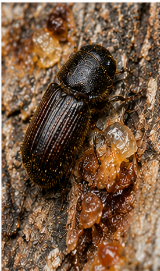
Pine Beetles, often called bark beetles, are small wood-boring insects that attack pine trees and other conifers. They belong mainly to the subfamily Scolytinae within the weevil family Curculionidae. Although individual beetles are tiny, mass attacks can kill large trees and contribute to widespread forest decline. Some of the most important species include the Mountain Pine Beetle (Dendroctonus ponderosae), Southern Pine Beetle (Dendroctonus frontalis), and several engraver beetles in the genus Ips.
Pine Beetles play a natural role in forests by helping break down weak, old, storm-damaged, drought-stressed, or dying trees. Under normal conditions, they recycle nutrients and create habitat for wildlife. However, during outbreaks, they can overwhelm living trees, causing extensive tree mortality across forests, parks, timberlands, and residential landscapes.
Taxonomy and Classification
Pine Beetles are beetles in the order Coleoptera. Most important pine-attacking species are classified in the subfamily Scolytinae, commonly known as bark beetles.
- Order: Coleoptera
- Family: Curculionidae
- Subfamily: Scolytinae
- Common Group: Bark Beetles
- Major Genera: Dendroctonus and Ips
- Primary Hosts: Pine trees and other conifers
Although they are often called beetles, Pine Beetles are technically weevils because bark beetles are placed within Curculionidae. Unlike many familiar weevils, however, they do not have a long obvious snout.
Physical Description
Adult Pine Beetles are small, hard-bodied insects, usually ranging from about 1/8 to 1/4 inch long depending on species. Their compact bodies allow them to bore through bark and move through tight galleries beneath the surface.
- Adult Size: Usually 1/8 to 1/4 inch long
- Color: Brown, reddish-brown, or black
- Body Shape: Cylindrical and compact
- Larvae: Small, white, legless grubs beneath bark
- Damage Sign: Galleries under bark, pitch tubes, boring dust, and fading needles
The beetles themselves are often hard to see. Most infestations are identified by tree symptoms such as pitch tubes, reddish boring dust, loose bark, and needle discoloration. When bark is removed, winding or branching galleries may be visible in the inner bark.
Distribution and Habitat
Pine Beetles occur throughout North America and other pine-growing regions of the world. Different species are associated with different pine hosts, climates, elevations, and forest types.
Common habitats include:
- Pine forests
- Mixed conifer forests
- Timberlands
- Urban pine plantings
- Windbreaks
- Fire-damaged stands
- Drought-stressed landscapes
- Recently cut logs or slash
Outbreaks are often associated with drought, overcrowded forests, storm damage, fire injury, root disease, or warm seasonal conditions that favor beetle survival and reproduction.
Life Cycle and Behavior
Pine Beetles undergo complete metamorphosis with egg, larval, pupal, and adult stages. Adults bore through the bark of host trees and create galleries in the inner bark, where females lay eggs.
After hatching, larvae feed beneath the bark, cutting across the tree’s living tissues. This feeding disrupts the movement of water and nutrients. In many species, the beetles also introduce blue-stain fungi or other associated fungi that further interfere with the tree’s water transport system.
Mass attack is a key behavior. A healthy pine can often resist a few beetles by producing resin that pushes invaders out. However, when many beetles attack at once, the tree’s defenses are overwhelmed. Pheromones released by attacking beetles help attract more beetles to the same tree.
Signs of Pine Beetle Infestation
Early detection is important because infested trees are often difficult to save once beetles are established beneath the bark.
- Pitch Tubes: Small popcorn-like resin masses on the bark.
- Boring Dust: Fine reddish or brown sawdust in bark crevices or around the base.
- Fading Needles: Needles may turn yellow, red, or brown.
- Woodpecker Activity: Birds may strip bark while searching for larvae.
- Galleries: Tunnels visible beneath loosened bark.
- Exit Holes: Small round holes where adult beetles emerged.
- Blue-Stained Wood: Fungal staining visible in cut wood.
Damage and Forest Impact
Pine Beetles can kill individual trees or, during outbreaks, large numbers of trees across entire landscapes. Their effects vary depending on beetle species, tree health, forest density, drought conditions, and climate.
Common impacts include:
- Tree mortality
- Reduced timber value
- Hazard trees near homes, roads, and trails
- Changes in wildlife habitat
- Increased dead fuel in forests
- Loss of ornamental or shade trees
- Altered forest succession and regeneration
Although outbreaks can be destructive, Pine Beetles also have ecological value. By killing weakened trees, they create openings for new growth, provide habitat for cavity-nesting birds, and recycle nutrients through decomposition.
Management and Control
Pine Beetle management focuses on prevention, forest health, early detection, and removal of infested material. Once beetles are established under the bark, direct control is difficult.
| Management Strategy | Description | Purpose |
|---|---|---|
| Forest Thinning | Reduce overcrowding and competition among trees. | Improves tree vigor and resistance. |
| Watering Landscape Pines | Provide deep watering during drought where appropriate. | Helps high-value trees maintain resin defenses. |
| Remove Infested Trees | Cut, remove, chip, burn, or properly process infested material. | Reduces beetle emergence and spread. |
| Sanitation of Slash | Remove or treat fresh pine logs, branches, and debris. | Reduces breeding sites. |
| Preventive Insecticides | Apply registered products to high-value trees before attack. | Protects selected trees when risk is high. |
Preventive insecticide treatments are not usually practical for large forests but may be used on high-value landscape trees before infestation occurs. They are generally ineffective after beetles are already inside the tree.
Prevention Tips
- Maintain proper spacing between pine trees.
- Reduce drought stress where irrigation is practical.
- Avoid unnecessary injury to trunks and roots.
- Remove storm-damaged or declining trees promptly.
- Do not store fresh pine firewood near healthy pines during beetle flight periods.
- Chip, debark, or solarize infested logs when recommended.
- Monitor high-value trees for pitch tubes and boring dust.
Research and Conservation
Pine Beetles are major subjects of forest health research. Scientists study beetle pheromones, fungal partners, climate effects, tree resistance, outbreak forecasting, and landscape-level management. Warmer winters and drought stress can increase beetle survival and allow outbreaks to expand in some regions.
Conservation efforts focus on maintaining resilient forests rather than eliminating Pine Beetles entirely. Healthy forests include natural disturbance, but management may be needed where outbreaks threaten communities, timber resources, recreation areas, or high-value trees.
Conclusion
Pine Beetles are small bark beetles capable of causing major impacts on pine forests and landscape trees. While they naturally help recycle weakened and dying trees, outbreaks can kill large numbers of pines and create economic, ecological, and safety concerns. Effective management depends on forest health practices, early detection, sanitation, removal of infested material, and preventive protection of high-value trees. Understanding their life cycle and signs of attack is essential for reducing damage and maintaining resilient pine ecosystems.