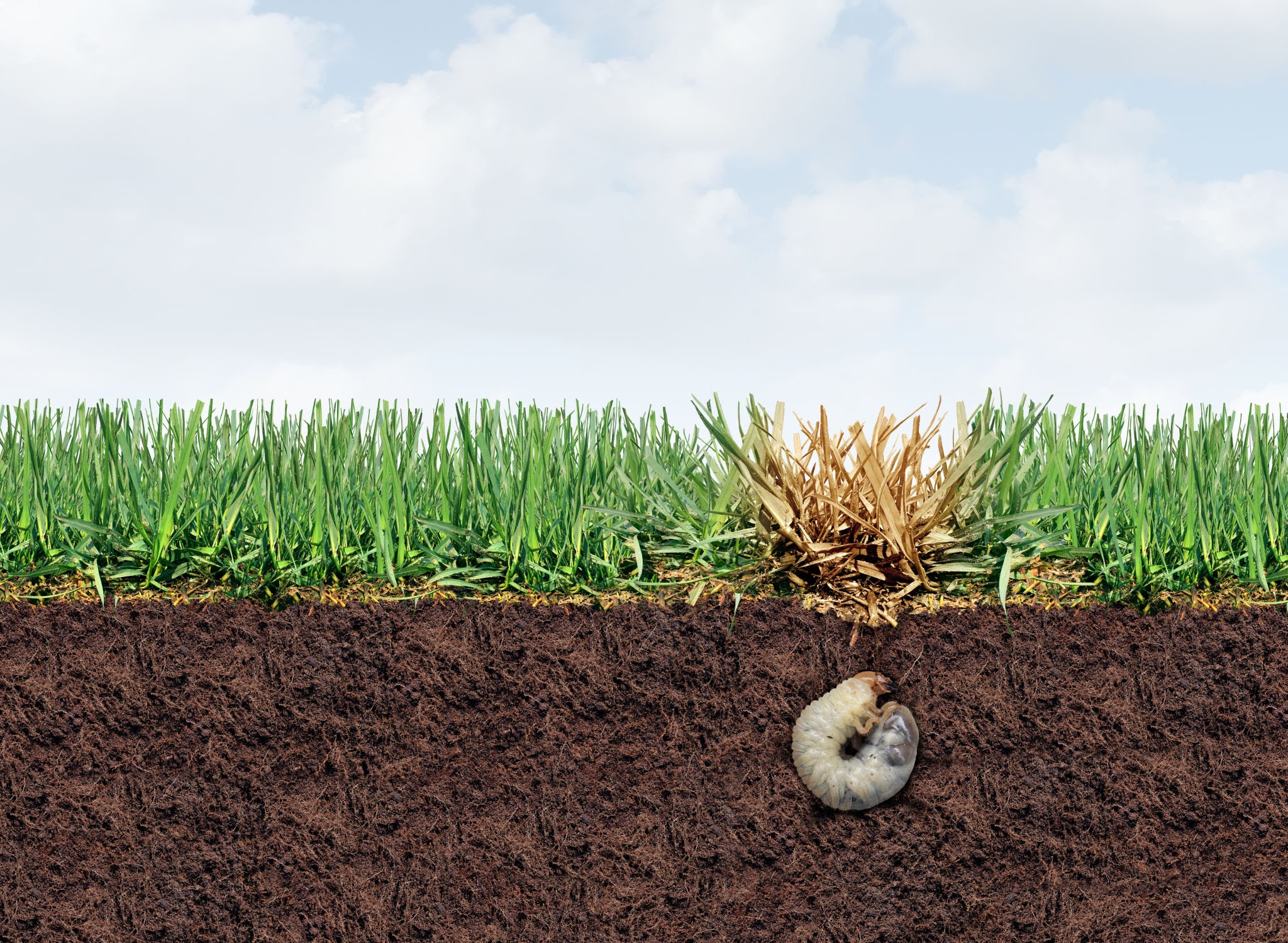
Turf Grubs are the larval stage of several scarab beetles that attack lawns, golf courses, parks, athletic fields, and other turfgrass areas. The most common species responsible for grub damage include the Japanese Beetle (Popillia japonica), European Chafer (Rhizotrogus majalis), Masked Chafers (Cyclocephala species), and other related scarab beetles. These underground pests feed directly on grass roots, disrupting the plant’s ability to absorb water and nutrients. Heavy infestations can destroy large sections of turf, resulting in dead patches that peel away from the soil like a loose carpet. In addition to root damage, Turf Grubs attract skunks, raccoons, birds, and other predators that dig up lawns while searching for food, often causing even greater destruction than the grubs themselves.
Taxonomy and Classification
Turf Grubs belong to the order Coleoptera and the family Scarabaeidae, commonly known as scarab beetles. Although several species may occur in turfgrass, they share similar life cycles and feeding behaviors.
Common Turf Grub species include:
- Japanese Beetle (Popillia japonica)
- European Chafer (Rhizotrogus majalis)
- Northern Masked Chafer (Cyclocephala borealis)
- Southern Masked Chafer (Cyclocephala lurida)
- Oriental Beetle (Anomala orientalis)
- May and June Beetles (Phyllophaga species)
These insects undergo complete metamorphosis consisting of four life stages:
- Egg
- Larva (Grub)
- Pupa
- Adult Beetle
The larval stage is responsible for virtually all turf damage.
Identification
Turf Grubs are relatively easy to recognize because of their distinctive appearance.
- Size: Usually 1/2 to 1 inch long when fully developed.
- Color: Creamy white body with a brown head capsule.
- Shape: Characteristic C-shaped posture when disturbed.
- Legs: Three pairs of well-developed legs near the head.
- Body: Soft and plump with a grayish or darker abdomen caused by visible gut contents.
- Raster Pattern: Unique hair arrangements on the underside of the posterior end help identify species.
Adult beetles vary considerably depending on species. Japanese Beetles are metallic green and copper, while Masked Chafers are light brown and more uniformly colored.
Distribution and Habitat
Turf Grubs are found throughout much of North America, Europe, Asia, and many other regions where turfgrass is maintained.
Common habitats include:
- Residential lawns
- Golf courses
- Sports fields
- Parks
- Cemeteries
- Commercial landscapes
- Sod farms
- School grounds
The larvae live beneath the soil surface, usually within the upper 2 to 6 inches where grass roots are concentrated.
Life Cycle
The life cycle of Turf Grubs follows a seasonal pattern that varies slightly by species and climate.
- Adult Emergence: Adult beetles emerge during late spring or summer.
- Mating and Egg Laying: Females deposit eggs in moist turfgrass soils.
- Larval Development: Newly hatched grubs begin feeding on grass roots.
- Heavy Feeding Period: Feeding intensifies as grubs grow larger during late summer and early fall.
- Overwintering: Mature grubs move deeper into the soil to survive winter.
- Pupation: Grubs return toward the surface and pupate in spring.
- Adult Emergence: New beetles emerge and repeat the cycle.
Most species complete one generation per year, although some May and June Beetles may require multiple years.
Damage and Economic Importance
Turf Grubs are among the most destructive lawn pests because they attack the root system directly.
Common symptoms include:
- Root Loss: Grass roots are consumed by feeding larvae.
- Yellowing Turf: Grass appears drought-stressed despite adequate watering.
- Wilting: Damaged turf cannot absorb sufficient moisture.
- Dead Patches: Large irregular brown areas develop.
- Loose Sod: Turf can be rolled back like a carpet because roots have been destroyed.
- Thinning Grass: Reduced density and vigor throughout affected areas.
Severe infestations may require costly lawn renovation and reseeding.
Secondary Damage from Predators
One of the most recognizable signs of a Turf Grub infestation is damage caused by animals searching for the larvae.
Common predators include:
- Skunks
- Raccoons
- Crows
- Starlings
- Moles
- Armadillos (in some regions)
These animals often tear up large sections of turf while digging for grubs, creating extensive lawn damage overnight.
Behavior and Conflict
The severity of Turf Grub damage depends largely on population density.
- Low Populations: Turf often tolerates feeding with little visible damage.
- Moderate Populations: Grass begins showing stress symptoms.
- High Populations: Widespread root destruction and turf death occur.
Most turf specialists consider treatment necessary when populations exceed approximately 8 to 10 grubs per square foot, although thresholds vary depending on turf health and environmental conditions.
Damage is usually most severe during late summer and early autumn when larvae are largest and feeding aggressively.
Monitoring and Detection
Early detection is critical for successful management.
Inspection methods include:
- Pulling back sections of turf to inspect the root zone.
- Counting grubs within one square foot of soil.
- Monitoring for predator activity.
- Watching for irregular brown patches.
- Checking areas that remain stressed despite irrigation.
Management and Prevention
An Integrated Pest Management (IPM) approach provides the most effective long-term control.
Biological Control
- Entomopathogenic Nematodes: Beneficial nematodes such as Heterorhabditis bacteriophora and Steinernema species attack and kill grubs.
- Milky Spore Disease: Paenibacillus popilliae provides long-term suppression of Japanese Beetle grubs.
- Natural Predators: Birds, ground beetles, and parasitic organisms contribute to population control.
Cultural Practices
- Maintain healthy turf through proper irrigation.
- Avoid excessive nitrogen fertilization.
- Mow at recommended heights.
- Reduce thatch accumulation.
- Encourage deep root development.
Chemical Control
- Preventative Treatments: Products containing chlorantraniliprole are often applied during early summer before significant feeding begins.
- Curative Treatments: Faster-acting products may be applied when active infestations are confirmed.
Timing is critical because young grubs are much easier to control than mature larvae.
Conservation and Research
Turf Grubs remain a major focus of turfgrass research worldwide. Scientists continue to investigate resistant turf varieties, improved biological control agents, predictive monitoring systems, and environmentally responsible management practices.
Research also focuses on reducing pesticide use while maintaining healthy, sustainable turfgrass systems in residential, recreational, and commercial landscapes.