Overview
Tortoise Beetles are a fascinating group of leaf-feeding beetles belonging to the subfamily Cassidinae within the family Chrysomelidae. These insects are named for their distinctive shell-like appearance, which resembles a miniature tortoise. Many species display brilliant metallic gold, bronze, or green coloration, making them some of the most visually striking beetles found in gardens and agricultural landscapes.
Although often admired for their beauty, Tortoise Beetles can become significant plant pests when populations increase. Both adults and larvae feed on leaves, producing characteristic holes, scraped surfaces, and skeletonized foliage. Most species specialize on plants in the morning glory family, including sweet potatoes, bindweed, and ornamental morning glories, while others feed on asters, thistles, and related plants.
In home gardens, infestations are usually minor and primarily cosmetic. However, in commercial sweet potato production and ornamental plant nurseries, heavy feeding can reduce plant vigor, decrease photosynthesis, and lower crop quality. Their unusual appearance, unique larval defenses, and striking coloration have made them popular subjects of scientific study.
Quick Facts
- Common Name: Tortoise Beetles
- Scientific Group: Subfamily Cassidinae
- Order: Coleoptera
- Family: Chrysomelidae
- Diet: Plant foliage
- Primary Hosts: Morning glory, sweet potato, bindweed, asters
- Size: 1/4–1/2 inch
- Distribution: Worldwide
Taxonomy and Classification
Tortoise Beetles belong to the order Coleoptera, the largest insect order, and the family Chrysomelidae, commonly known as leaf beetles. This family contains thousands of species, many of which are important agricultural pests.
- Kingdom: Animalia
- Phylum: Arthropoda
- Class: Insecta
- Order: Coleoptera
- Family: Chrysomelidae
- Subfamily: Cassidinae
There are hundreds of tortoise beetle species worldwide. Some of the most recognizable species include the Golden Tortoise Beetle (Charidotella sexpunctata) and various species associated with sweet potatoes and ornamental morning glories.
Like all beetles, they undergo complete metamorphosis consisting of egg, larva, pupa, and adult stages.
Identification
Adult Tortoise Beetles are small, flattened beetles that typically measure between 1/4 and 1/2 inch in length.
Adult Beetles
- Oval or circular body shape
- Flattened appearance
- Transparent or translucent margins extending beyond the body
- Metallic gold, bronze, green, or brown coloration
- Head and legs concealed beneath the expanded shell margins
Many species can change color depending on moisture levels, age, or stress. The famous Golden Tortoise Beetle often appears metallic gold but may shift to reddish-brown when disturbed.
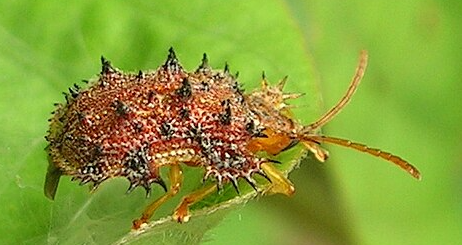
Larvae
- Dark-colored, flattened bodies
- Numerous spines or projections
- Distinctive forked structure at the rear
- Carry a protective “fecal shield” made from waste material and shed skins
The fecal shield is one of the most unusual defensive adaptations in the insect world and helps deter predators such as ants, spiders, and birds.
Distribution and Habitat
Tortoise Beetles occur throughout North America, South America, Europe, Asia, Africa, and Australia. Their highest diversity occurs in tropical and subtropical regions where host plants are abundant year-round.
Common habitats include:
- Gardens
- Agricultural fields
- Roadsides
- Weedy areas
- Woodland edges
- Ornamental landscapes
- Sweet potato plantings
Most species remain closely associated with their preferred host plants throughout their lives.
Life Cycle
Tortoise Beetles undergo complete metamorphosis.
Egg Stage
Females deposit clusters of eggs on the undersides of host plant leaves. Eggs are often covered with protective secretions that help reduce predation.
Larval Stage
Larvae emerge and begin feeding immediately on leaf tissue. During development they construct and carry their characteristic fecal shields.
The larval stage is responsible for much of the feeding damage observed on host plants.
Pupal Stage
Mature larvae attach themselves to leaves or stems and transform into pupae.
Adult Stage
Adults emerge and continue feeding on foliage while seeking mates. Depending on climate conditions, multiple generations may occur annually.
Behavior and Damage
Both adults and larvae feed on plant leaves using chewing mouthparts.
Common symptoms include:
- Small holes in leaves
- Windowpane feeding damage
- Skeletonized foliage
- Irregular feeding scars
- Reduced leaf area
- Decreased photosynthesis
Young larvae often scrape leaf surfaces, leaving transparent patches behind. Older larvae and adults create larger holes and more extensive feeding damage.
Most species exhibit strong host specificity, meaning they attack only a limited range of plants. This specialization helps reduce widespread ecological impacts but can create localized problems where host plants are cultivated extensively.
Economic Importance
While many tortoise beetle species are minor pests, certain species can cause economic damage under favorable conditions.
Important affected plants include:
- Sweet potatoes
- Morning glories
- Bindweed
- Sunflowers
- Thistles
- Various ornamentals
Heavy infestations may reduce crop yields, diminish ornamental value, and weaken young plants. However, severe outbreaks are relatively uncommon compared to many other leaf beetle pests.
Management and Prevention
Integrated Pest Management (IPM) provides the most effective approach for controlling Tortoise Beetles.
Monitoring
- Inspect leaves regularly.
- Look for characteristic feeding holes.
- Search for larvae carrying fecal shields.
- Monitor plant health throughout the growing season.
Hand Removal
Hand-picking remains one of the most effective controls for home gardens.
- Remove adults and larvae.
- Destroy infested leaves when practical.
- Dispose of collected insects in soapy water.
Cultural Controls
- Remove nearby bindweed and wild morning glory hosts.
- Maintain healthy plants through proper irrigation.
- Reduce excessive weed growth.
- Encourage plant diversity.
Biological Control
Natural enemies include:
- Parasitic wasps
- Predatory stink bugs
- Spiders
- Birds
- Ground beetles
Protecting beneficial insects often provides sufficient suppression in most landscapes.
Chemical Control
When populations become severe, labeled insecticides may be used according to local regulations. Treatments are generally most effective against young larvae.
Conservation and Research
Tortoise Beetles are widely studied because of their unique defensive strategies and remarkable coloration. Scientists continue investigating the optical structures responsible for their metallic appearance, as well as the evolutionary advantages provided by fecal shields.
Some species are also being evaluated as potential biological control agents for invasive weeds because of their strong host specificity.
Conclusion
Tortoise Beetles are among the most unusual and attractive leaf beetles found in nature. Although capable of causing feeding damage to sweet potatoes, morning glories, and related plants, they are generally minor pests that rarely threaten healthy plants. Their distinctive shell-like appearance, metallic coloration, and extraordinary larval defenses make them fascinating insects and important subjects of ecological research.