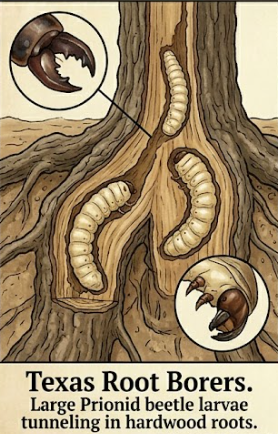
Texas Root Borers (Prionus texanus) are among the most destructive root-feeding beetles found in the southern United States and parts of the Southwest. These large longhorn beetles spend most of their lives underground as larvae, feeding on the roots of trees and woody plants. While adult beetles are impressive in size and often attract attention around outdoor lights, it is the larval stage that causes significant economic and landscape damage. By tunneling through major structural roots, Texas Root Borers weaken trees, disrupt water and nutrient uptake, and may eventually cause entire trees to decline, collapse, or fall during storms.
Because larvae can remain hidden underground for several years, infestations often go undetected until extensive root damage has already occurred. Fruit orchards, pecan groves, vineyards, ornamental landscapes, and shade trees may all be affected by this serious pest.
Taxonomy and Classification
Texas Root Borers belong to the order Coleoptera and the family Cerambycidae, commonly known as longhorn beetles.
- Order: Coleoptera
- Family: Cerambycidae
- Genus: Prionus
- Species: Prionus texanus
Members of the genus Prionus are known for their large size, powerful mandibles, and long larval development periods. Texas Root Borers are among the largest root-feeding beetles found in North America.
Identification
Adult Beetles
- Size: Up to 2.5 inches (60 mm) long.
- Color: Dark brown to reddish-brown.
- Body Shape: Broad, heavy-bodied, and robust.
- Antennae: Distinctively serrated or saw-toothed, especially in males.
- Activity: Primarily nocturnal and attracted to lights.
Adults are frequently mistaken for other large longhorn beetles, but their stockier build and strongly serrated antennae help distinguish them.
Larvae
- Size: Up to 3 inches (75 mm) long.
- Color: Creamy white.
- Head: Dark brown with strong chewing mandibles.
- Shape: Thick, cylindrical, grub-like body.
- Habitat: Deep within root systems and surrounding soil.
The larvae are often compared to oversized scarab grubs and may be discovered when digging around infested trees.
Distribution and Habitat
Texas Root Borers are found throughout much of the southern United States, particularly in arid and semi-arid regions.
They are especially common in:
- Arizona
- Texas
- New Mexico
- Oklahoma
- Northern Mexico
Common habitats include:
- Pecan orchards
- Fruit orchards
- Vineyards
- Urban landscapes
- Parks
- Residential properties
- Native woodlands
Larvae develop underground, feeding on roots hidden from view for several years.
Host Plants
Texas Root Borers attack a variety of woody plants and trees.
Common hosts include:
- Pecan trees
- Peach trees
- Apple trees
- Pear trees
- Plum trees
- Oak trees
- Elm trees
- Grapevines
- Various ornamental trees
Both healthy and stressed trees may be attacked, although weakened trees are often more susceptible.
Life Cycle
Texas Root Borers undergo complete metamorphosis and have one of the longest life cycles among common tree pests.
- Egg Stage: Females lay eggs in soil near host trees.
- Larval Stage: Newly hatched larvae begin feeding on small roots before moving into larger structural roots.
- Extended Development: Larvae remain underground for three to five years.
- Pupal Stage: Mature larvae construct chambers within soil and roots before pupating.
- Adult Stage: Adults emerge during summer, mate, and begin the cycle again.
The lengthy larval stage is responsible for virtually all damage.
Damage and Economic Importance
Texas Root Borers damage plants by tunneling through major roots.
As larvae feed, they create large galleries that weaken the structural integrity of the root system.
Root Damage
- Destruction of feeder roots.
- Hollowing of major structural roots.
- Reduced water absorption.
- Reduced nutrient uptake.
Above-Ground Symptoms
- Yellowing foliage.
- Reduced growth.
- Crown thinning.
- Branch dieback.
- Premature leaf drop.
- General decline.
Symptoms often appear gradually and may be mistaken for drought stress or disease.
Structural Failure and Wind Damage
One of the most serious consequences of Texas Root Borer infestations is structural instability.
As large roots are hollowed out, trees lose their anchoring capacity.
This may result in:
- Leaning trees.
- Root flare damage.
- Tree failure during storms.
- Complete uprooting.
- Property damage.
Many infestations are not discovered until a tree falls and extensive root destruction becomes visible.
Signs of Infestation
Detecting Texas Root Borers can be difficult because most activity occurs underground.
Common indicators include:
- Sudden tree decline.
- Unexplained canopy thinning.
- Large adult beetles around lights.
- Exit holes near the soil line.
- Sawdust-like frass around roots.
- Dead or weakened branches.
Adult activity during summer often provides the first indication of a nearby infestation.
Behavior and Conflict
Several characteristics make Texas Root Borers particularly challenging pests.
- Hidden Development: Larvae remain underground for years.
- Long Life Cycle: Damage accumulates slowly.
- Large Size: Mature larvae consume substantial root tissue.
- Difficult Detection: Symptoms appear late.
- Structural Impact: Trees may become hazardous.
By the time visible decline occurs, significant root damage has often already taken place.
Monitoring and Detection
Monitoring adult beetles provides the most practical detection method.
- Inspect outdoor lights during summer.
- Monitor high-value trees annually.
- Watch for canopy thinning.
- Examine root flare areas for signs of activity.
- Use light traps to monitor adult populations.
Early detection improves management options and may prevent severe structural damage.
Management and Prevention
An Integrated Pest Management (IPM) strategy offers the best long-term protection.
Cultural Controls
- Maintain healthy trees.
- Avoid mechanical root injuries.
- Provide proper irrigation.
- Reduce drought stress.
- Remove severely infested trees.
Physical Controls
- Inspect root zones regularly.
- Remove heavily damaged roots when practical.
- Reduce attractive egg-laying sites.
Biological Control
- Beneficial Nematodes: Certain species can attack young larvae in the soil.
- Natural Predators: Birds and soil-dwelling predators may consume exposed stages.
Beneficial nematodes are generally most effective when applied during periods of adequate soil moisture.
Chemical Control
- Systemic treatments may provide protection in certain situations.
- Soil-applied products target young larvae before they enter major roots.
- Treatments are most effective during early infestation stages.
Once larvae are deep inside large roots, control becomes significantly more difficult.
Conservation and Research
Research on Texas Root Borers focuses on improved monitoring methods, biological control agents, host resistance, and sustainable management practices. Scientists continue evaluating beneficial nematodes and other environmentally responsible approaches for reducing damage in orchards and landscapes.
Early detection, proper tree care, and preventive management remain the most effective strategies for protecting valuable trees from this hidden but highly destructive root-feeding pest. :contentReference[oaicite:0]{index=0}