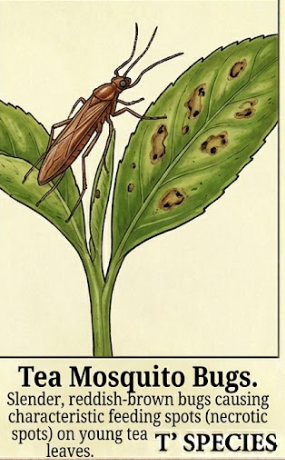
Tea Mosquito Bugs are destructive sap-feeding insects that attack tea plants and numerous other economically important crops, including cashew, cocoa, guava, avocado, and ornamental plants. Despite their common name, they are not mosquitoes but rather true bugs belonging to the family Miridae. These pests are notorious for damaging tender shoots, young leaves, flower buds, stems, and developing fruits. Their feeding activity causes tissue death, shoot dieback, reduced plant vigor, and significant crop losses in regions where they occur.
Tea Mosquito Bugs are particularly damaging because they target the newest and most valuable plant growth. In tea plantations, the young flushes harvested for processing are the exact tissues preferred by these insects. As a result, even relatively small populations can reduce yield, lower product quality, and interfere with the uniform growth needed for efficient harvesting. Their ability to reproduce quickly and move between host plants makes them persistent pests in agricultural and ornamental settings.
Taxonomy and Classification
Tea Mosquito Bugs belong to the order Hemiptera and the family Miridae.
- Order: Hemiptera
- Family: Miridae
- Genus: Helopeltis
- Common Species: Helopeltis theivora, Helopeltis antonii, and related species
Members of the genus Helopeltis are among the most important sucking insect pests of tea and several tropical crops worldwide.
Identification
Tea Mosquito Bugs possess a distinctive appearance that helps separate them from aphids, leafhoppers, and other sap-feeding pests.
Adults
- Size: Approximately 6–8 mm long.
- Body Shape: Slender and elongated.
- Color: Red, orange, green, brown, or black depending on species.
- Legs: Long and delicate.
- Antennae: Long and highly visible.
- Mouthparts: Piercing-sucking beak used for feeding.
Distinctive Feature
- Thoracic Spine: A prominent upright spine projecting from the thorax.
- Knobbed Tip: The spine often ends in a small knob-like structure.
This unique spine is one of the easiest characteristics for identifying Tea Mosquito Bugs.
Nymphs
- Wingless.
- Bright orange, yellow, or reddish.
- Active and fast-moving.
- Typically found on tender shoots and buds.
Distribution and Habitat
Tea Mosquito Bugs occur primarily in tropical and subtropical regions.
Common habitats include:
- Tea plantations
- Cashew orchards
- Cocoa farms
- Fruit orchards
- Greenhouses
- Botanical collections
- Tropical ornamental landscapes
Warm temperatures, high humidity, and continuous production of new plant growth favor population development.
Host Plants
Although tea is the most famous host, these insects attack a wide range of plants.
Common hosts include:
- Tea
- Cashew
- Cocoa
- Guava
- Avocado
- Mango
- Cinchona
- Various ornamental shrubs
- Tropical fruit trees
The broad host range contributes to their persistence across agricultural landscapes.
Life Cycle
Tea Mosquito Bugs undergo incomplete metamorphosis.
- Egg Stage: Females insert eggs into tender stems, shoots, or petioles.
- Nymph Stage: Newly hatched nymphs begin feeding immediately.
- Adult Stage: Mature bugs continue feeding and reproduce.
Several generations may occur each year, particularly in warm climates where host plants continuously produce new growth.
Development speed is strongly influenced by temperature, humidity, and host quality.
Feeding Behavior
Tea Mosquito Bugs feed by piercing plant tissue and injecting saliva before extracting plant fluids.
Preferred feeding sites include:
- Tender shoots
- New leaves
- Flower buds
- Petioles
- Young stems
- Developing fruits
The insects concentrate on actively growing tissues because these areas contain abundant nutrients and moisture.
Damage and Economic Importance
The damage caused by Tea Mosquito Bugs extends beyond simple sap removal.
Necrotic Feeding Injury
- Dark feeding spots.
- Brown lesions.
- Blackened tissue.
- Scab-like marks.
- Localized cell death.
The saliva injected during feeding is toxic to plant tissues and causes visible necrosis around feeding punctures.
Shoot Dieback
- Wilting shoot tips.
- Blackened growing points.
- Reduced branching.
- Stunted growth.
Repeated feeding on developing shoots can significantly alter plant structure and vigor.
Fruit and Flower Damage
- Scarred fruits.
- Premature fruit drop.
- Damaged flower buds.
- Reduced yields.
In commercial crops, even minor feeding injury can lower market value.
Impact on Tea Production
Tea Mosquito Bugs are especially destructive because they target the harvestable flush.
Consequences include:
- Reduced plucking material.
- Lower tea quality.
- Reduced yields.
- Uneven bush growth.
- Delayed recovery after pruning.
Heavy infestations may dramatically reduce profitability in commercial tea production systems.
Secondary Problems
Feeding wounds often serve as entry points for pathogens.
Potential secondary issues include:
- Fungal infections.
- Stem cankers.
- Anthracnose infections.
- Tissue decay.
The combined effects of insect injury and disease frequently exceed the impact of either problem alone.
Signs of Infestation
Common indicators include:
- Black feeding spots.
- Brown lesions on young leaves.
- Wilting shoot tips.
- Dead terminal growth.
- Scarring on stems.
- Distorted foliage.
- Visible adults on tender shoots.
Damage is usually concentrated on the newest growth.
Behavior and Conflict
Several biological traits contribute to their pest status.
- Preference for New Growth: Targets the most valuable plant tissue.
- Toxic Saliva: Causes extensive tissue death.
- Multiple Generations: Allows populations to build rapidly.
- High Mobility: Adults readily disperse.
- Wide Host Range: Supports year-round survival.
These characteristics make Tea Mosquito Bugs persistent and economically important pests.
Monitoring and Detection
Regular scouting is essential for successful management.
- Inspect new shoots frequently.
- Monitor after pruning.
- Examine buds and young leaves.
- Use sticky traps for adult monitoring.
- Track population trends throughout the season.
Early detection greatly improves control success.
Management and Prevention
An Integrated Pest Management (IPM) approach provides the most effective long-term strategy.
Cultural Controls
- Maintain balanced plant nutrition.
- Avoid excessive vegetative growth.
- Remove heavily damaged shoots.
- Manage alternate host plants.
Monitoring and Trapping
- Yellow sticky traps help detect adults.
- Routine scouting identifies infestations early.
Biological Control
- Predatory bugs.
- Assassin bugs.
- Spiders.
- Parasitic insects.
Conserving beneficial predators can reduce population growth.
Organic Controls
- Neem oil.
- Horticultural oils.
- Botanical insecticides.
Applications should focus on tender growth where feeding occurs.
Chemical Control
- Use selective insecticides when necessary.
- Rotate active ingredients.
- Target nymphs and newly established populations.
- Follow all label directions carefully.
Proper timing is critical because the insects concentrate on newly developing plant tissues.
Conservation and Research
Research on Tea Mosquito Bugs focuses on host-plant resistance, biological control agents, monitoring systems, and sustainable management programs. Scientists continue studying population dynamics and plant-insect interactions to improve long-term control strategies while minimizing environmental impacts.
Because these insects attack the most economically valuable portions of host plants, effective monitoring and timely intervention remain essential for protecting crop quality, yield, and ornamental value.