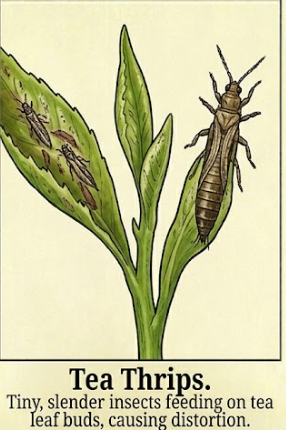
Tea Thrips are tiny sap-feeding insects that attack tea plants and numerous ornamental and agricultural crops. These pests feed by rasping the surface of leaves and extracting cellular contents, causing characteristic silvering, bronzing, scarring, and distortion of young foliage. Because tea production relies on harvesting tender new leaves and flush growth, Tea Thrips can significantly affect both crop quality and yield when populations become established.
Although extremely small, Tea Thrips are capable of causing widespread damage due to their rapid reproductive rate and preference for actively growing plant tissue. Infestations are often difficult to detect during their early stages because the insects hide within developing leaves, buds, and protected plant structures. By the time symptoms become obvious, feeding injury may already be widespread. Their ability to reproduce quickly and exploit favorable environmental conditions makes them among the most important pests of tea-growing regions around the world.
Taxonomy and Classification
Tea Thrips belong to the order Thysanoptera, commonly known as thrips.
- Order: Thysanoptera
- Family: Thripidae
- Common Species: Scirtothrips dorsalis and related species
- Common Name: Tea Thrips
Thrips are unique insects characterized by narrow bodies and fringed wings. Many species are important agricultural pests due to their feeding behavior and ability to damage tender plant tissues.
Identification
Tea Thrips are extremely small insects that often require magnification for accurate identification.
Adults
- Size: Less than 1 mm long.
- Color: Pale yellow, cream, tan, or light brown.
- Shape: Slender and elongated.
- Wings: Narrow wings with distinctive fringes.
- Movement: Fast-moving and highly active when disturbed.
Nymphs
- Wingless.
- Pale yellow to lemon-yellow.
- Smaller than adults.
- Typically concentrated on tender foliage.
Key Signs of Infestation
- Silvery leaf surfaces.
- Bronzed foliage.
- Leaf curling.
- Scarred leaf tissue.
- Roughened leaf surfaces.
- Black specks of frass.
Symptoms often become visible before the insects themselves are noticed.
Distribution and Habitat
Tea Thrips occur throughout tropical, subtropical, and warm temperate regions.
Common habitats include:
- Tea plantations
- Greenhouses
- Nurseries
- Orchards
- Gardens
- Ornamental landscapes
- Agricultural fields
Warm temperatures and abundant new plant growth favor population development.
Host Plants
Although commonly associated with tea, Tea Thrips attack a wide variety of crops and ornamentals.
Common hosts include:
- Tea
- Citrus
- Roses
- Grapes
- Strawberries
- Peppers
- Mango
- Avocado
- Camellias
- Various ornamental shrubs
Their broad host range contributes to their persistence across many agricultural systems.
Life Cycle
Tea Thrips undergo a complex life cycle consisting of several stages.
- Egg Stage: Females insert eggs directly into plant tissue.
- Larval Stage: Young thrips feed actively on foliage and buds.
- Prepupal Stage: Feeding stops as development progresses.
- Pupal Stage: Transformation into the adult form occurs.
- Adult Stage: Mature thrips reproduce and disperse.
Warm weather accelerates development, allowing multiple generations to occur in rapid succession.
Because generations overlap, infestations may contain eggs, larvae, pupae, and adults simultaneously.
Feeding Behavior
Tea Thrips feed using specialized rasping-sucking mouthparts.
Preferred feeding sites include:
- New flush.
- Developing leaves.
- Leaf buds.
- Tender shoots.
- Growing points.
Thrips scrape plant surfaces and extract cellular contents, causing visible injury to leaf tissues.
Damage and Economic Importance
Tea Thrips cause both cosmetic and economic damage.
Leaf Surface Injury
- Silvering.
- Bronzing.
- Scarring.
- Surface roughening.
- Discoloration.
These symptoms result from destruction of surface plant cells.
Leaf Distortion
- Upward leaf curling.
- Twisted growth.
- Misshapen foliage.
- Reduced leaf expansion.
Young leaves are particularly vulnerable because they are still developing when feeding occurs.
Growth Suppression
- Reduced flush production.
- Stunted growth.
- Lower vigor.
- Reduced branching.
Repeated feeding can significantly affect long-term plant performance.
Impact on Tea Production
Tea Thrips are especially damaging because they target the most valuable harvestable tissues.
- Reduced leaf quality.
- Lower harvest yields.
- Scarred flush growth.
- Reduced market value.
- Uneven growth patterns.
Premium tea production depends on healthy, tender leaves, making even moderate infestations economically important.
Signs of Infestation
Growers should monitor for:
- Silvery streaks on leaves.
- Bronzed foliage.
- Curling young leaves.
- Roughened leaf surfaces.
- Dark frass spots.
- Damaged buds.
- Distorted new growth.
Infestations often begin on the newest growth and gradually spread through the canopy.
Behavior and Conflict
Several biological traits contribute to their pest status.
- Rapid Reproduction: Populations increase quickly.
- Hidden Feeding Sites: Difficult to detect early.
- Preference for New Growth: Targets valuable plant tissue.
- Multiple Generations: Continuous population pressure.
- Wide Host Range: Numerous plants support survival.
These characteristics make Tea Thrips persistent pests in both agricultural and ornamental settings.
Monitoring and Detection
Regular scouting is essential.
- Inspect new flush frequently.
- Examine folded leaves.
- Use a hand lens when possible.
- Tap foliage over white paper.
- Monitor for silvering and bronzing.
Early detection provides the greatest opportunity for effective control.
Management and Prevention
An Integrated Pest Management (IPM) approach offers the best long-term results.
Cultural Controls
- Maintain plant vigor.
- Reduce drought stress.
- Remove heavily infested growth.
- Avoid excessive nitrogen fertilization.
Healthy plants are generally more resilient to feeding damage.
Biological Control
- Predatory mites.
- Minute pirate bugs.
- Lacewings.
- Predatory thrips.
Conserving beneficial insects can substantially reduce populations.
Monitoring Traps
- Blue sticky traps.
- Yellow sticky traps.
- Regular scouting programs.
Traps help monitor adult activity and population trends.
Organic Controls
- Neem oil.
- Horticultural oils.
- Spinosad products.
Applications should target feeding sites on tender growth.
Chemical Control
- Use selective insecticides when necessary.
- Rotate active ingredients.
- Target young populations.
- Follow label instructions carefully.
Resistance management is critical because thrips can rapidly develop tolerance to repeated treatments.
Conservation and Research
Research on Tea Thrips focuses on biological control, host plant resistance, monitoring systems, and sustainable management practices. Scientists continue developing integrated strategies that reduce pesticide use while maintaining effective control of economically damaging populations.
Regular monitoring, conservation of natural enemies, proper cultural management, and early intervention remain the most effective methods for preventing severe Tea Thrips infestations and protecting the quality of tea crops and ornamental plantings.