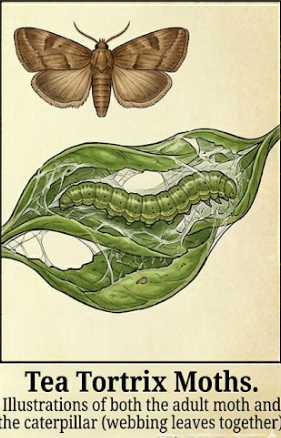
Tea Tortrix Moths are leaf-rolling pests that attack tea plants and a variety of ornamental and agricultural crops. Their larvae are responsible for the damage, feeding within protective shelters created by rolling, folding, or webbing leaves together with silk. This behavior conceals the caterpillars from predators and environmental conditions while allowing them to consume large amounts of foliage. In tea-growing regions, Tea Tortrix Moths are considered significant pests because they damage the tender flushes and young leaves that are harvested for production.
Although the adult moths do not feed on plants, they play an important role in spreading infestations by laying eggs on suitable host plants. Once the eggs hatch, the young caterpillars immediately begin feeding and constructing shelters. Because multiple generations may occur throughout the growing season, populations can build rapidly when environmental conditions are favorable. Heavy infestations reduce plant vigor, interfere with harvesting operations, and lower crop quality.
Taxonomy and Classification
Tea Tortrix Moths belong to the family Tortricidae, a large group of moths commonly known as leafrollers.
- Order: Lepidoptera
- Family: Tortricidae
- Common Species: Homona coffearia, Adoxophyes honmai, and related leafroller species
Members of this family are characterized by the leaf-rolling behavior of their larvae, which create protective feeding shelters using silk.
Identification
Tea Tortrix Moths can be identified by both their adult appearance and the distinctive damage caused by their caterpillars.
Adult Moths
- Wingspan: Approximately 15–20 mm.
- Color: Tan, brown, cinnamon, or mottled brown.
- Shape: Compact body with wings folded roof-like over the back.
- Resting Posture: Characteristic bell-shaped or shield-like silhouette.
Adults are often difficult to notice because their coloration blends well with bark, stems, and dead foliage.
Larvae
- Length: Up to 20 mm when fully grown.
- Color: Bright green to pale green.
- Head: Dark brown or black head capsule.
- Body: Slender and smooth.
When disturbed, larvae frequently drop from foliage on silk threads to escape predators.
Eggs
- Laid in flattened masses.
- Usually yellow-green in color.
- Deposited on leaf surfaces.
- Arranged in overlapping patterns.
Distribution and Habitat
Tea Tortrix Moths are found primarily in tropical and subtropical regions where tea and related host plants are cultivated.
Common habitats include:
- Tea plantations
- Greenhouses
- Nurseries
- Botanical gardens
- Camellia collections
- Ornamental landscapes
- Fruit orchards
Warm temperatures and abundant new growth favor population development.
Host Plants
Although tea plants are the primary host, Tea Tortrix Moths attack a variety of other plants.
Common hosts include:
- Tea
- Camellias
- Azaleas
- Roses
- Citrus
- Fruit trees
- Various ornamental shrubs
Their broad host range helps sustain populations throughout the year.
Life Cycle
Tea Tortrix Moths undergo complete metamorphosis.
- Egg Stage: Females lay eggs on leaves and tender growth.
- Larval Stage: Caterpillars hatch and begin feeding while constructing leaf shelters.
- Pupal Stage: Pupation occurs within the rolled leaf shelter.
- Adult Stage: Moths emerge, mate, and begin a new generation.
Several generations may occur annually, particularly in regions with extended growing seasons and continuous host availability.
Leaf-Rolling Behavior
The most distinctive feature of Tea Tortrix larvae is their ability to manipulate foliage using silk.
Larvae commonly:
- Roll individual leaves.
- Fold leaf edges together.
- Tie multiple leaves into clusters.
- Create enclosed feeding chambers.
These shelters protect caterpillars from predators, weather, and some control measures.
Damage and Economic Importance
The larval stage causes all significant plant damage.
Leaf Feeding
- Skeletonized leaves.
- Chewed foliage.
- Brown feeding patches.
- Reduced photosynthetic area.
Young larvae often feed on leaf surfaces, leaving transparent “window-pane” damage before consuming larger portions of tissue.
Terminal Shoot Damage
- Distorted new growth.
- Stunted shoots.
- Reduced branching.
- Poor flush development.
Terminal buds are especially vulnerable because larvae often incorporate them into their shelters.
Tea Production Losses
- Reduced harvest quality.
- Contaminated leaves.
- Lower yields.
- Reduced market value.
Silk, frass, and feeding injury can make harvested material unsuitable for processing.
Signs of Infestation
Common indicators include:
- Rolled leaves.
- Folded foliage.
- Silken webbing.
- Green caterpillars inside shelters.
- Dark frass deposits.
- Skeletonized leaf tissue.
- Damaged shoot tips.
Opening suspicious leaf rolls often reveals larvae or pupae.
Behavior and Conflict
Several biological characteristics make Tea Tortrix Moths challenging pests.
- Protected Feeding: Larvae remain concealed inside rolled leaves.
- Multiple Generations: Continuous population development.
- Wide Host Range: Numerous host plants support infestations.
- Rapid Reproduction: Populations can increase quickly.
- Flush Preference: Target the most valuable plant tissues.
These characteristics contribute to their economic significance in tea-growing regions.
Monitoring and Detection
Routine scouting is essential for early intervention.
- Inspect new flush regularly.
- Search for rolled leaves.
- Open suspicious shelters.
- Monitor adult moth activity.
- Track seasonal population trends.
Early detection allows treatment before larvae become well protected within leaf rolls.
Management and Prevention
An Integrated Pest Management (IPM) program provides the most effective control.
Physical Control
- Remove infested leaves.
- Prune heavily infested shoots.
- Destroy rolled foliage.
Physical removal can be highly effective in smaller plantings.
Biological Control
- Parasitic wasps.
- Predatory insects.
- Birds.
- Microbial controls.
Natural enemies help suppress populations when conserved.
Microbial Control
- Bacillus thuringiensis (Bt): Highly effective against young larvae.
Applications are most successful before extensive leaf rolling develops.
Organic Controls
- Neem oil.
- Spinosad products.
- Biological insecticides.
Coverage and timing are critical because larvae quickly become protected within shelters.
Pheromone Monitoring
- Detect adult activity.
- Monitor population levels.
- Improve treatment timing.
Pheromone traps are widely used in commercial monitoring programs.
Chemical Control
- Use selective products when necessary.
- Target newly hatched larvae.
- Rotate active ingredients.
- Follow label directions carefully.
Once larvae are fully protected within leaf rolls, control becomes substantially more difficult.
Conservation and Research
Research on Tea Tortrix Moths focuses on pheromone-based monitoring systems, biological control programs, resistant plant varieties, and sustainable pest management techniques. Scientists continue exploring methods that reduce insecticide use while maintaining effective control of economically damaging populations.
Early detection, removal of infested foliage, conservation of beneficial insects, and timely intervention remain the most effective strategies for preventing serious Tea Tortrix infestations and protecting valuable ornamental and agricultural crops.