Overview
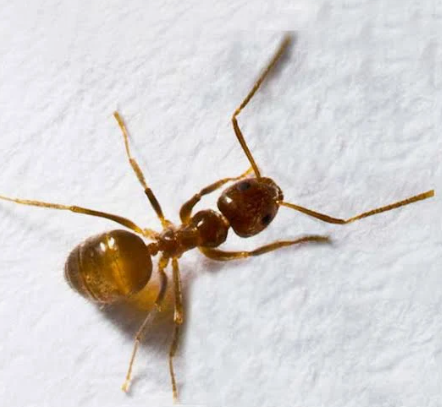
Tawny Crazy Ants (Nylanderia fulva) are one of the most troublesome invasive ant species in the southern United States. Native to South America, these ants have gained notoriety for their explosive population growth, erratic running behavior, and ability to overwhelm entire landscapes. Unlike many common household ants that form a single colony with one queen, Tawny Crazy Ants establish massive interconnected supercolonies containing numerous queens and millions of workers.
Their common name comes from their light brown or tawny coloration and their distinctive movement pattern. Rather than following organized trails like Argentine Ants or Odorous House Ants, Tawny Crazy Ants move rapidly in unpredictable directions, creating a chaotic appearance that is immediately recognizable.
These ants are more than just a nuisance. They invade homes, businesses, and industrial facilities in enormous numbers. They are especially infamous for damaging electrical equipment, where large groups of workers swarm inside junction boxes, air conditioning units, utility panels, and electronic devices. Their presence can lead to costly equipment failures and significant disruption.
In addition to structural issues, Tawny Crazy Ants have become a serious environmental concern because they displace native ant species and alter local ecosystems wherever they become established.
Quick Facts
- Common Name: Tawny Crazy Ant
- Scientific Name: Nylanderia fulva
- Order: Hymenoptera
- Family: Formicidae
- Size: Approximately 1/8 inch
- Color: Tawny brown to reddish-brown
- Primary Threat: Structural invasion and electrical damage
- Distribution: Southern United States and South America
Taxonomy and Classification
Tawny Crazy Ants belong to the family Formicidae and are closely related to other nuisance ant species found throughout North America.
- Kingdom: Animalia
- Phylum: Arthropoda
- Class: Insecta
- Order: Hymenoptera
- Family: Formicidae
- Genus: Nylanderia
- Species: Nylanderia fulva
The species was previously classified as Paratrechina fulva before being reassigned to the genus Nylanderia. They undergo complete metamorphosis consisting of egg, larva, pupa, and adult stages.
Identification
Tawny Crazy Ant workers are small but possess several distinctive characteristics.
- Uniform tawny or reddish-brown coloration
- Long legs compared to most ant species
- Long antennae with twelve segments
- Small body measuring approximately 1/8 inch long
- Dense covering of fine hairs on the body
- Rapid, erratic running behavior
Their movement is often the easiest identification feature. Workers move in seemingly random directions rather than following organized foraging trails.
Winged reproductive males and females are larger than workers and appear during mating periods. Colonies contain numerous queens, contributing to their rapid expansion and persistence.
Distribution and Habitat
Tawny Crazy Ants originated in South America but have successfully invaded numerous regions throughout the southern United States.
Established populations are especially common in:
- Texas
- Florida
- Louisiana
- Mississippi
- Alabama
- Georgia
- Caribbean regions
They thrive in warm, humid environments and are commonly found in:
- Lawns
- Landscape beds
- Mulch
- Wood piles
- Leaf litter
- Compost piles
- Tree cavities
- Building foundations
Unlike many ant species that construct permanent nests, Tawny Crazy Ants frequently relocate their colonies and establish temporary nesting sites wherever moisture and shelter are available.
Life Cycle
Tawny Crazy Ants develop through four stages:
- Egg
- Larva
- Pupa
- Adult
Queens continuously produce eggs throughout favorable weather conditions. Because colonies contain multiple queens, reproduction occurs at an extraordinary rate.
Larvae are cared for by worker ants and develop within protected nesting areas. Under ideal conditions, colonies can expand rapidly and establish new satellite nests throughout the surrounding environment.
Behavior and Ecology
The most remarkable characteristic of Tawny Crazy Ants is their ability to form enormous supercolonies.
Unlike many ant species that aggressively defend territories against neighboring colonies, Tawny Crazy Ant colonies cooperate with one another. This creates massive interconnected populations that may occupy several acres.
Workers forage continuously and consume a wide range of foods, including:
- Honeydew from aphids
- Plant nectar
- Dead insects
- Living arthropods
- Pet food
- Household food scraps
- Sugary substances
One of their most unusual adaptations is their ability to neutralize the venom of Fire Ants. When attacked, they apply formic acid from their abdominal gland to detoxify fire ant venom, allowing them to successfully compete against and displace Fire Ant populations.
Electrical Damage
Tawny Crazy Ants are notorious for damaging electrical systems.
Workers are attracted to electrical equipment and frequently invade:
- Circuit breakers
- Electrical panels
- Air conditioning units
- Transformers
- Computers
- Utility boxes
- Irrigation controllers
When large numbers accumulate inside equipment, they can create electrical shorts and system failures. Dead ants release alarm pheromones that attract even more workers, resulting in a cycle that can rapidly overwhelm sensitive electronics.
This behavior has caused millions of dollars in repair and replacement costs throughout infested regions.
Economic and Environmental Impact
Tawny Crazy Ants create significant challenges for homeowners, businesses, agriculture, and natural ecosystems.
- Home invasions
- Food contamination
- Electrical equipment failures
- Damage to irrigation systems
- Reduced property enjoyment
- Displacement of native ants
- Disruption of ecological food webs
In heavily infested areas, densities can exceed hundreds of thousands of ants per acre, creating persistent nuisance conditions.
Management and Prevention
Effective control requires a comprehensive Integrated Pest Management (IPM) approach.
Exclusion
- Seal cracks and foundation gaps.
- Repair damaged door sweeps.
- Seal utility penetrations.
- Screen vents and openings.
Habitat Reduction
- Remove excessive mulch.
- Reduce leaf litter.
- Eliminate wood debris.
- Trim vegetation touching structures.
- Correct drainage problems.
Baiting Programs
Professional baiting programs often provide the most effective long-term suppression.
- Protein-based baits
- Sugar-based baits
- Granular ant baits
- Liquid bait systems
Because of their enormous colony sizes, repeated applications are usually necessary.
Residual Treatments
Professional perimeter treatments around structures can reduce ant pressure and help prevent indoor invasions.
Conservation and Research
Tawny Crazy Ants are considered a high-priority invasive species rather than a conservation concern. Current research focuses on understanding colony expansion, developing improved bait technologies, identifying biological control agents, and evaluating environmentally responsible management strategies.
Scientists are also investigating fungal pathogens, pheromone-based monitoring systems, and novel toxicants capable of targeting supercolonies more effectively.
Conclusion
Tawny Crazy Ants are among the most challenging invasive ants in North America. Their enormous populations, erratic behavior, ability to damage electrical equipment, and displacement of native species make them a serious structural and environmental pest. Successful management requires early detection, habitat modification, exclusion practices, and often professional treatment programs capable of addressing their massive interconnected colonies.