Overview
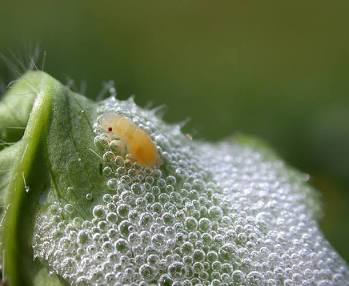
Spittlebugs (families Cercopidae and Aphrophoridae) are small plant-feeding insects best known for the distinctive white, frothy masses produced by their immature stages. These foam-like coverings, commonly called “cuckoo spit” or “frog spit,” protect developing nymphs while they feed on plant sap. Although spittlebugs are often considered minor pests in gardens and landscapes, large populations can cause stunted growth, reduced plant vigor, and economic losses in agricultural crops.
The most common and widely distributed species is the Meadow Spittlebug (Philaenus spumarius), which feeds on hundreds of plant species. While the frothy masses are often alarming to homeowners, the insects themselves are harmless to people and pets. Their primary significance lies in plant damage and their ability to transmit certain plant pathogens.
Taxonomy and Classification
- Kingdom: Animalia
- Phylum: Arthropoda
- Class: Insecta
- Order: Hemiptera
- Infraorder: Cicadomorpha
- Superfamily: Cercopoidea
- Families: Cercopidae and Aphrophoridae
Spittlebugs belong to the group of true bugs that includes leafhoppers, cicadas, and treehoppers. Like their relatives, they possess specialized piercing-sucking mouthparts designed for extracting fluids from plants.
Unlike caterpillars or beetles that chew leaves, spittlebugs feed by inserting their needle-like mouthparts into plant tissues and withdrawing sap.
Physical Description
Adult spittlebugs are small insects measuring approximately 1/4 inch (6–12 mm) in length.
- Shape: Wedge-shaped and compact.
- Color: Brown, tan, gray, mottled, or black depending on species.
- Movement: Strong jumpers similar to leafhoppers.
- Wings: Fully developed in adults.
- Body: Thick-bodied compared to leafhoppers.
Nymphs
The immature stages are soft-bodied and typically pale green, yellow, cream, or brown.
They remain hidden inside the characteristic frothy spittle mass, making direct observation difficult.
Key Identification Signs
- White foamy masses on stems and leaves.
- Small wedge-shaped insects jumping when disturbed.
- Foam clustered around leaf axils or stem joints.
- Presence during spring and early summer.
Distribution and Habitat
Spittlebugs occur throughout North America, Europe, Asia, Africa, and many other regions of the world.
They are highly adaptable and can be found in:
- Gardens
- Lawns
- Meadows
- Agricultural fields
- Roadside vegetation
- Ornamental landscapes
- Pastures
- Greenhouses
Because many species feed on hundreds of host plants, they are among the most widespread sap-feeding insects found in managed landscapes.
Life Cycle
Spittlebugs undergo simple metamorphosis consisting of egg, nymph, and adult stages.
Egg Stage
Females lay eggs in stems, leaf sheaths, or plant debris during late summer and fall.
Eggs typically overwinter and hatch the following spring.
Nymph Stage
Young nymphs immediately begin feeding on plant sap.
As they feed, they excrete excess fluid and mix it with air bubbles produced from abdominal movements.
This process creates the protective foam that gives spittlebugs their common name.
The foam serves several functions:
- Prevents dehydration.
- Protects against predators.
- Insulates against temperature extremes.
- Conceals nymphs from view.
Adult Stage
After several molts, nymphs emerge as winged adults.
Adults leave the spittle mass and disperse among host plants.
Most species complete one generation annually, although multiple generations may occur in warmer climates.
Behavior and Feeding Habits
Spittlebugs feed primarily on xylem fluid, which contains water and dissolved minerals.
Because xylem sap contains relatively few nutrients, spittlebugs must process enormous quantities of fluid to obtain sufficient nourishment.
The excess fluid is expelled and converted into foam.
This unusual feeding strategy distinguishes them from aphids and other sap-feeding pests that primarily consume nutrient-rich phloem sap.
Damage and Economic Importance
For most homeowners, spittlebug damage is largely cosmetic. However, significant infestations can reduce plant health and agricultural productivity.
Plant Damage
- Stunted growth
- Wilted stems
- Distorted new growth
- Reduced vigor
- Smaller flowers
- Lower fruit production
Agricultural Impact
Spittlebugs can become important pests in:
- Strawberries
- Alfalfa
- Clover
- Forage crops
- Ornamental nurseries
- Certain vineyard systems
Heavy infestations may reduce yields and lower crop quality.
Disease Transmission
Some species have gained attention as vectors of Xylella fastidiosa, a bacterium responsible for several serious plant diseases.
These diseases include:
- Pierce’s Disease of grapes
- Olive Quick Decline Syndrome
- Leaf scorch diseases
- Various ornamental plant disorders
The role of spittlebugs as disease vectors has increased their economic significance in many agricultural regions.
Management and Control (IPM)
Integrated Pest Management (IPM) focuses on monitoring and non-chemical control whenever possible.
Physical Removal
For gardens and landscape plants, simple physical removal is often sufficient.
- Water Spray: Use a strong stream of water to wash away foam and nymphs.
- Manual Removal: Wipe or crush spittle masses by hand while wearing gloves.
- Pruning: Remove heavily infested stems when practical.
Cultural Control
- Control weeds around susceptible plants.
- Maintain proper plant spacing.
- Avoid excessive nitrogen fertilization.
- Promote healthy plant growth.
Many species initially develop on weeds before moving to ornamental or crop plants.
Biological Control
Numerous natural enemies help suppress spittlebug populations.
- Birds
- Predatory bugs
- Spiders
- Parasitic wasps
- Ground beetles
Encouraging beneficial insects often provides effective long-term suppression.
Chemical Control
Chemical treatment is rarely necessary in residential landscapes.
In commercial agriculture, insecticides may be used when populations exceed economic thresholds.
Treatments are generally most effective against adults after they emerge from the protective foam stage.
Interesting Facts
- The foam produced by nymphs can contain hundreds of tiny air bubbles.
- Spittlebug nymphs can remain hidden for weeks inside their protective froth.
- The Meadow Spittlebug feeds on more than 400 plant species.
- Adults can jump many times their body length.
- Some species are important vectors of economically damaging plant diseases.
Research and Conservation
Research on spittlebugs focuses largely on disease transmission and sustainable pest management.
Current areas of study include:
- Control of Xylella fastidiosa vectors.
- Biological control programs.
- Host plant resistance.
- Monitoring technologies.
- Climate impacts on population dynamics.
Understanding spittlebug ecology is becoming increasingly important as agricultural industries seek alternatives to broad-spectrum insecticides.
Conclusion
Spittlebugs are unique sap-feeding insects recognized by the frothy protective masses created by their nymphs. While often considered minor or cosmetic pests in gardens, large populations can cause stunted growth, reduced yields, and, in some cases, contribute to the spread of serious plant diseases. Early detection, physical removal, habitat management, and conservation of natural enemies provide effective and environmentally responsible methods for managing these unusual insects.