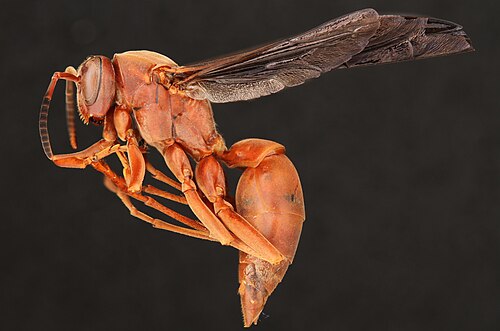
Red Paper Wasps (Polistes spp.), particularly species such as Polistes carolina and Polistes rubiginosus, are large, social wasps commonly found throughout the southern United States. These striking reddish-brown insects are well known for constructing open, umbrella-shaped paper nests beneath eaves, porches, and other protected structures. Although they are valuable predators that help control caterpillars and other insect pests, red paper wasps are also significant public health pests because they aggressively defend their nests and can inflict multiple painful stings.
Red paper wasps are especially common in warm climates, including the Southeast, Gulf Coast states, and much of the Southwest. Their colonies are annual, with each nest founded by a queen in spring and abandoned in autumn.
Taxonomy and Classification
Red paper wasps belong to the order Hymenoptera, which includes ants, bees, and wasps. They are members of the family Vespidae, commonly known as vespid wasps.
- Kingdom: Animalia
- Phylum: Arthropoda
- Class: Insecta
- Order: Hymenoptera
- Family: Vespidae
- Subfamily: Polistinae
- Genus: Polistes
Unlike yellowjackets, paper wasps build exposed nests rather than enclosed paper nests hidden underground or inside cavities.
Physical Description
Adult red paper wasps typically measure between 15 and 25 millimeters (0.6 to 1 inch) in length, making them among the larger paper wasp species.
- Adult (Key ID): Slender body with a very narrow waist and long dangling legs visible during flight.
- Coloration: Usually reddish-brown to dark reddish-orange with varying black or yellow markings depending on species.
- Wings: Smoky amber or dark brown wings folded lengthwise when at rest.
- Nest (Key ID): Open, gray paper comb attached by a single stalk (pedicel) to a protected surface.
- Sting ID: Capable of delivering repeated, painful stings.
- Conflict: Public Health, Nuisance.
Their long legs, slender bodies, and characteristic flight posture help distinguish them from yellowjackets and hornets.
Distribution and Habitat
Red paper wasps occur throughout much of North America, particularly in warm and humid regions. They are especially abundant in the southeastern United States but may also be found in portions of the Midwest, Southwest, and Mexico.
Common nesting locations include:
- Roof eaves
- Porch ceilings
- Decks and patios
- Window and door frames
- Attics and sheds
- Garage overhangs
- Tree branches
- Dense shrubs
- Play equipment
Nests are usually constructed in sheltered locations protected from direct rainfall and excessive sunlight.
Life Cycle
Red paper wasps undergo complete metamorphosis consisting of egg, larva, pupa, and adult stages.
Spring Colony Founding
Overwintered queens emerge during early spring and begin constructing small paper nests from weathered wood fibers mixed with saliva.
Egg Stage
The queen lays a single egg inside each hexagonal nest cell.
Larval Stage
Larvae hatch within several days and remain inside the nest cells. Workers or the queen feed them chewed insects and caterpillars.
Pupal Stage
Mature larvae seal themselves within their cells and pupate.
Adult Stage
New adults emerge as workers and assume colony duties, including nest expansion, brood care, and foraging. Colonies typically reach peak size during late summer.
By autumn, colonies produce reproductive males and future queens. Most colony members die with the onset of cold weather, while newly mated queens seek sheltered overwintering sites.
Behavior and Conflict
Red paper wasps are beneficial predators but become problematic when nesting near human activity.
- Predatory Feeding: Adults capture caterpillars, flies, beetle larvae, and other insects to feed developing larvae.
- Nectar Feeding: Adults also consume nectar, fruit juices, and honeydew.
- Nest Defense: Colonies aggressively defend their brood when disturbed.
- Repeated Stinging: Unlike honey bees, paper wasps can sting multiple times.
- Vibration Sensitivity: Lawn mowers, doors, and nearby movement can trigger defensive behavior.
Most stinging incidents occur when people accidentally approach, disturb, or unknowingly contact nests.
Medical Importance
Red paper wasp stings are extremely painful and can produce localized swelling, redness, and burning sensations.
Common symptoms include:
- Immediate sharp pain
- Redness and swelling
- Itching around the sting site
- Warmth and tenderness
- Localized inflammation
Individuals sensitive to wasp venom may experience severe allergic reactions, including:
- Difficulty breathing
- Facial or throat swelling
- Dizziness
- Rapid heartbeat
- Anaphylaxis
Severe reactions require immediate medical attention.
Nest Construction
Red paper wasps create nests by scraping weathered wood fibers from fences, decks, and dead plants. The fibers are mixed with saliva to produce a paper-like material.
Nests consist of:
- A single exposed comb of hexagonal cells
- A narrow attachment stalk called a pedicel
- No outer paper envelope
Large mature nests may contain dozens to hundreds of individuals.
Management and Prevention
Management focuses on preventing nest establishment and safely removing colonies located near human activity.
Exclusion
- Seal gaps and openings around structures.
- Repair damaged screens and soffits.
- Reduce sheltered nesting sites.
- Inspect eaves and porches regularly during spring.
Early Nest Removal
Small, newly established nests can often be removed safely before colonies become large.
- Inspect structures frequently during spring.
- Remove very small nests before workers emerge.
- Use caution and protective clothing.
Chemical Control
Nests located near entrances, patios, or heavily used areas may require treatment.
- Apply aerosol wasp sprays directly to nests after dark when all wasps are present.
- Use insecticidal dusts for nests in voids or inaccessible areas.
- Always follow label instructions carefully.
Large or difficult-to-access infestations should be handled by licensed pest management professionals.
Ecological Importance
Despite their reputation, red paper wasps provide valuable ecosystem services.
- Help suppress caterpillar populations.
- Reduce numbers of agricultural pests.
- Serve as pollinators while feeding on nectar.
- Contribute to natural biological control programs.
Whenever possible, nests located away from human activity should be left undisturbed.
Research and Future Management
Research on paper wasps focuses on colony communication, venom chemistry, social behavior, and their role in biological control. Scientists continue to study ways to minimize human-wasp conflicts while conserving their important ecological benefits.
Conclusion
Red Paper Wasps are beneficial predators and important components of many ecosystems. However, their tendency to nest on buildings and aggressively defend colonies can create significant public health concerns. Early detection, exclusion, and careful nest management are essential for reducing stinging risks while preserving their valuable role as natural pest controllers.