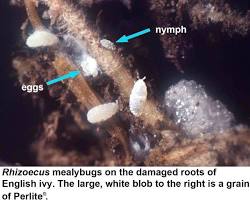
Ground mealybugs, also called root mealybugs, are small, wax-covered insects that live in soil and feed on plant roots and basal stems. Unlike the more familiar mealybugs found on leaves and branches, ground mealybugs remain hidden in potting media or soil. Infestations are therefore difficult to detect until plants become stunted, yellow, wilted, or generally unhealthy.
Ground mealybugs attack houseplants, greenhouse crops, nursery plants, ornamental grasses, landscape plants, and some field crops. African violets, chrysanthemums, anemones, gladiolus, iris, sedum, palms, hibiscus, bamboo, and alfalfa are among the many reported hosts.
Taxonomy and Classification
- Common name: Ground mealybug or root mealybug
- Primary genus: Rhizoecus
- Order: Hemiptera
- Infraorder: Coccomorpha
- Family: Rhizoecidae
- Type: Underground sap-feeding insect
Modern classifications generally place ground mealybugs in the family Rhizoecidae, although older references may list them with other mealybugs in Pseudococcidae. They are closely related to scale insects and possess specialized piercing-sucking mouthparts.
Common Ground Mealybug Species
- Ground mealybug (Rhizoecus falcifer): A widespread root pest of ornamentals, grasses, and some field crops.
- Pritchard’s mealybug (Rhizoecus pritchardi): A significant pest of African violets, sedum, and other ornamental plants.
- Hibiscus root mealybug (Rhizoecus hibisci): An underground pest with a broad ornamental host range.
- Kondo mealybug (Rhizoecus kondonis): A root-feeding species found on food and ornamental crops in parts of the western United States.
- Trinity ground mealybug (Rhizoecus bicirculus): Another difficult-to-distinguish species associated with nursery and crop plants.
Species identification usually requires microscopic examination. For routine plant care, confirming that root mealybugs are present is often more important than identifying the exact species. Regulatory or commercial nursery situations may require diagnosis by an entomologist or plant-health laboratory.
Identification
Adult female ground mealybugs generally measure approximately 1/16 to 3/16 inch long. They are oval or elongated, slightly flattened, and covered with a thin layer of white, bluish-white, or grayish wax. Body segmentation may remain visible beneath the wax.
Unlike many foliage-feeding mealybugs, ground mealybugs usually lack long wax filaments around the body margin. Some species produce fine strands that form loose netting over individual insects or root surfaces. Heavy infestations may give the potting media a bluish or powdery appearance.
Ground mealybugs have adapted to an underground environment. Their eyes may be extremely small or absent, and their antennae are relatively short. Females are wingless. Adult males, when present, are small, delicate, and winged, but they are rarely noticed.
Eggs and Crawlers
Females may place eggs within loose, white wax deposits in the soil. Some species can give birth to live young instead. The newly emerged nymphs are called crawlers because they are the most mobile life stage.
Crawlers move through potting media, across greenhouse benches, between touching containers, and through drainage holes. They may also be transported in irrigation water, contaminated soil, reused pots, propagation tools, or on workers’ hands and clothing.
Nymphs resemble miniature adult females. After finding a suitable root, they insert their mouthparts and begin feeding. They molt through several increasingly larger stages before becoming adults.
Where Ground Mealybugs Hide
In container-grown plants, ground mealybugs frequently concentrate near the outside of the root ball, between the roots and the inner wall of the pot. They may also gather around drainage holes, on the bottom of containers, along thick roots, or near the crown at the soil line.
Infestations can occur throughout the potting media, making a quick surface inspection unreliable. In field crops, the insects may be found several inches below the soil surface. Alfalfa infestations can develop in expanding circular patches as mealybugs move gradually from affected plants to neighboring roots.
Life Cycle
Ground mealybugs undergo incomplete metamorphosis with egg, nymph, and adult stages. Eggs may hatch soon after they are deposited, while species that produce live young begin with active crawlers. The complete development from crawler to adult can require approximately two to four months under common soil temperatures.
Adult females may live for one to two months. Overlapping generations are common in heated greenhouses, indoor plant collections, and other protected environments. Eggs, crawlers, older nymphs, and adults may all be present within the same root ball.
Temperature, soil moisture, host quality, and species affect the speed of reproduction. Because several life stages can remain protected in the soil, a plant that appears improved after treatment may still contain surviving mealybugs.
Plant Damage
Ground mealybugs insert their mouthparts into roots and remove plant fluids. Continued feeding interferes with root function and reduces the plant’s ability to obtain water and nutrients. Fine root hairs may be particularly vulnerable.
Aboveground symptoms are not specific to mealybugs. Infested plants may grow slowly, develop pale or yellow leaves, wilt despite adequate moisture, drop foliage, or produce fewer flowers. Severe infestations can cause root decline and plant death.
Damage is often greatest when plants are also stressed by heat, drought, poor drainage, nutrient problems, root disease, or improper potting conditions. In alfalfa, feeding may produce substantial yield loss and patches of weak plants, especially during stressful summer weather.
Signs of Ground Mealybugs
- White or bluish powder around roots
- Small, slow-moving white insects in potting media
- Wax deposits along the inner wall of a plant container
- White insects or residue around drainage holes
- Stunted plant growth
- Yellowing, wilting, or premature leaf drop
- Reduced flowering or failure to thrive
- Ant activity around the soil line or root ball
- Circular patches of declining plants in a field
- New plants declining after being placed near an infested specimen
Ground Mealybugs vs. Similar Pests
Ground mealybugs may resemble springtails because both can appear as small white organisms in potting media. Springtails move rapidly and can jump, while root mealybugs crawl slowly and cannot jump. Springtails mainly consume fungi and decaying organic material and usually do not cause the root symptoms associated with heavy mealybug feeding.
Root aphids can also produce wax and feed beneath the soil. Aphids are generally pear-shaped and may have small tube-like structures called cornicles near the rear of the abdomen. Accurate separation may require magnification.
White fungal growth, mineral deposits, and particles of perlite can be mistaken for mealybug wax. Unlike an insect colony, these materials do not contain slow-moving organisms. Inspecting the roots with a hand lens helps confirm the cause.
Monitoring and Early Detection
Inspect new plants before placing them near established specimens. Slide the plant carefully from its container and examine the outside of the root ball, drainage openings, lower stem, and pot interior. Look for white wax and slow-moving insects.
Roots should also be examined whenever a plant declines without an obvious explanation. Checking only the leaves may result in a missed diagnosis because ground mealybugs can complete their entire life cycle without becoming visible above the soil.
Management and Control
Isolate Infested Plants
Move suspect plants away from healthy ones immediately. Avoid placing their pots on shared capillary mats or surfaces where irrigation water flows into neighboring containers. Inspect every plant that was touching or positioned near the infestation.
Discard Severely Infested Plants
Disposal is often the most reliable option for a heavily infested, easily replaced houseplant. Seal the plant, potting media, and visible insects in a bag before removal. Do not reuse contaminated media or place it in a compost pile intended for potting plants.
Clean Containers and Work Areas
Remove soil and organic debris from reusable pots, trays, tools, and benches before cleaning and disinfecting them with an appropriate product. Crawlers can survive outside a pot long enough to reach nearby plants. Workers should wash their hands and avoid using the same tools on infested and clean plants without sanitation.
Repotting
Repotting may reduce a light infestation, but it does not guarantee elimination. The old media should be removed carefully, and the roots should be inspected for remaining insects and wax. Damaging too many roots can further weaken an already stressed plant. Use a clean container and fresh, pest-free potting mix.
Chemical and Biological Options
Ordinary foliar sprays are usually ineffective because they do not reach pests inside the root ball. Products used as soil drenches, dips, granules, or systemic treatments may provide better contact or uptake when specifically labeled for the plant and root mealybugs.
Follow all label directions concerning dosage, application site, edible crops, indoor use, protective equipment, and reentry. A product labeled only for outdoor landscape plants must not be used on indoor plants unless the label permits it. Systemic treatments may also require precautions when plants flower and attract pollinators.
Commercial growers may incorporate predatory soil organisms, entomopathogenic fungi, nematodes, or reduced-risk drenches into a larger IPM program. Results depend on the species, crop, temperature, media, and treatment timing, so growers should consult current Extension or professional recommendations.
Preventing Ground Mealybugs
- Inspect roots before purchasing or accepting new plants.
- Quarantine new plants before adding them to a collection.
- Use clean pots and pest-free growing media.
- Do not reuse contaminated soil.
- Prevent irrigation runoff from moving between containers.
- Clean tools, benches, trays, and propagation equipment.
- Avoid placing pots so closely that crawlers can move between them.
- Investigate unexplained yellowing or wilting promptly.
- Examine drainage holes and root-ball edges during routine care.
Conclusion
Ground mealybugs are concealed root-feeding pests that can weaken houseplants, nursery stock, ornamentals, and field crops. Their white wax, slow movement, and location around roots and drainage holes help distinguish them from springtails and other soil organisms. Early detection is essential because established populations spread through contaminated plants, media, containers, tools, and irrigation water. Quarantine, sanitation, careful root inspection, disposal of severe infestations, and correctly labeled soil treatments provide the strongest management approach.