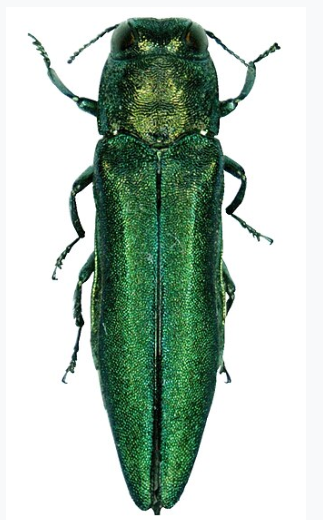
Emerald Ash Borers (Agrilus planipennis) are highly destructive invasive beetles responsible for the widespread loss of ash trees (Fraxinus species) across North America. Native to Asia, this pest has caused the death of hundreds of millions of trees since its introduction. The larvae feed beneath the bark, disrupting the tree’s ability to transport water and nutrients, ultimately causing rapid decline and death—often within just 2 to 4 years.
Taxonomy and Classification
Emerald Ash Borers belong to the family Buprestidae (metallic wood-boring beetles) in the order Coleoptera. They undergo complete metamorphosis with egg, larval, pupal, and adult stages. First detected in North America in 2002 near Detroit, Michigan, they were likely introduced through infested wood packing materials. While relatively harmless in their native range due to natural predators and resistant host trees, they are extremely lethal to North American ash species.
Physical Description
Adult Emerald Ash Borers are slender, elongated beetles measuring about 1/2 inch in length. They are easily recognized by their bright, metallic emerald-green coloration, although they may appear darker in flight or shaded conditions. Their bodies are narrow and bullet-shaped, with a flattened head and pointed wing tips.
The larvae are the most damaging stage. They are creamy white, legless grubs with a flattened body and distinct segmented appearance often described as resembling stacked coins. Mature larvae can reach over 1 inch in length. When adults emerge from the tree, they leave behind a characteristic D-shaped exit hole in the bark.
Distribution and Habitat
Emerald Ash Borers are now widespread throughout much of the United States and Canada, particularly in the Midwest, Northeast, and expanding into western regions. Their habitat is restricted to ash trees, where larvae live beneath the bark in the cambium layer. Adults emerge in late spring and early summer, dispersing to locate new host trees.
Behavior and Life Cycle
The life cycle typically takes one to two years depending on climate conditions. Adult beetles feed lightly on ash leaves before laying eggs in bark crevices. After hatching, larvae bore into the tree and begin feeding beneath the bark.
As larvae feed, they create distinctive, winding S-shaped galleries packed with frass (a mixture of wood particles and waste). These tunnels disrupt the tree’s vascular system, preventing the movement of water and nutrients.
Common signs of infestation include:
- Canopy dieback: Thinning leaves and branch death starting at the top
- Epicormic shoots: New growth from the trunk or base of the tree
- Woodpecker activity: Increased feeding damage as birds search for larvae
- D-shaped exit holes: Visible on bark surfaces
Feeding and Damage
The larval feeding stage causes severe internal damage by effectively girdling the tree. This prevents the flow of essential nutrients and water, leading to rapid tree decline. Unlike many other pests, Emerald Ash Borers readily attack healthy trees, making them particularly destructive.
Large-scale infestations can result in the complete loss of ash tree populations in affected areas, significantly impacting urban landscapes, forests, and ecosystems.
Management and Prevention
Managing Emerald Ash Borers requires early detection and a combination of treatment strategies.
- Systemic Insecticides: Preventative trunk injections or soil treatments can protect high-value trees when applied early.
- Tree Removal: Severely infested trees must be removed and properly disposed of to prevent further spread.
- Quarantine Measures: Restrictions on moving firewood and ash materials help slow the spread of the pest.
- Biological Control: Parasitic wasps have been introduced in some regions to naturally reduce EAB populations over time.
Conservation and Research
Emerald Ash Borers are the focus of extensive research efforts aimed at preserving ash tree populations and restoring affected ecosystems. Scientists are studying resistant ash varieties, improving biological control programs, and developing more effective long-term management strategies to reduce the impact of this invasive pest.