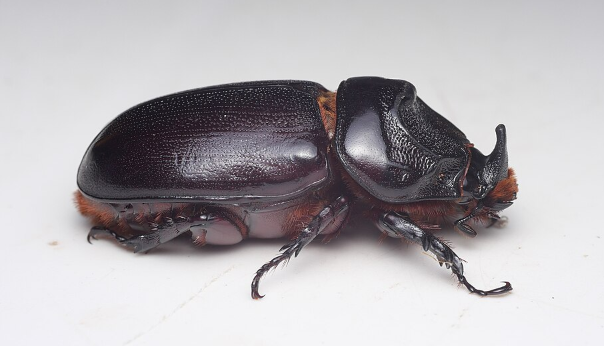
The Coconut Rhinoceros Beetle (Oryctes rhinoceros) is one of the most destructive insect pests of coconut palms and other palm species in tropical and subtropical regions. This large scarab beetle is especially damaging because the adults bore directly into the crown and growing point of palms, where they feed on tender developing tissue. Repeated attacks can deform new fronds, reduce fruit production, weaken mature palms, and kill young trees entirely.
The Coconut Rhinoceros Beetle is also an important invasive species. Its spread has been strongly linked to the movement of infested plant material, compost, mulch, dead palm wood, and other organic debris. Once established, it can be difficult to eliminate because the larvae develop in decomposing material while the adults disperse and attack living palms.
Taxonomy and Classification
Coconut Rhinoceros Beetles belong to the order Coleoptera, family Scarabaeidae, and subfamily Dynastinae. Their scientific name is Oryctes rhinoceros. Like other beetles, they undergo complete metamorphosis, progressing through egg, larval, pupal, and adult stages.
The larval and adult stages have very different feeding habits. Larvae are primarily associated with decaying organic matter and generally do not cause direct damage to healthy palms. The adults are responsible for the serious plant injury associated with the species.
Physical Description
Adult Coconut Rhinoceros Beetles are large, robust insects, usually measuring about 30 to 50 mm long. Their heavy bodies and prominent horns give them the classic rhinoceros beetle appearance.
- Color: Dark brown to nearly black and often glossy.
- Horn: Adults have a horn-like projection on the head. Males generally have a larger horn than females.
- Body: Thick, rounded, and heavily built.
- Larvae: Large, creamy-white, C-shaped grubs with reddish-brown heads.
- Legs: Strong, spiny legs adapted for gripping and moving through organic material.
The larvae may resemble other large scarab grubs, so the location where they are found is important for identification. Coconut Rhinoceros Beetle larvae commonly develop in compost, mulch, manure, rotting palm trunks, sawdust, and decomposing vegetation.
Distribution and Habitat
The Coconut Rhinoceros Beetle is native to parts of tropical Asia but has spread to many Pacific islands and other tropical regions. It is particularly important in places where coconut palms are commercially or culturally significant.
The beetle is associated with Hawaii, Guam, and other Pacific locations, where invasive populations are closely monitored and managed. Suitable habitat includes coconut plantations, landscaped areas with ornamental palms, resorts, nurseries, agricultural land, and residential properties containing susceptible palm species.
Life Cycle
Female Coconut Rhinoceros Beetles lay their eggs in moist, decomposing organic material. Suitable breeding sites include dead palm logs, compost piles, manure, green waste, wood chips, and other decaying plant matter.
After hatching, the larvae feed on the decomposing material and grow through several stages. Mature grubs eventually create a protected pupal chamber before transforming into adults.
Adults emerge from the breeding site and fly in search of suitable palms. They are primarily nocturnal and can disperse considerable distances. Once they locate a palm, they bore into the crown to feed.
The Characteristic V-Shaped Damage
One of the most recognizable signs of Coconut Rhinoceros Beetle activity is the appearance of V-shaped cuts or notches in newly opened palm fronds.
The adult beetle causes this damage while the leaf is still tightly folded inside the crown. As the beetle chews through the developing tissue, several layers of the folded leaf may be damaged at once. When the frond eventually opens, the feeding injury appears as symmetrical cuts or wedge-shaped sections missing from the leaf.
- V-Shaped Notches: Triangular or wedge-shaped sections missing from newly opened fronds.
- Bore Holes: Large entry holes may be visible around the base of palm fronds.
- Shredded Fibers: Chewed palm tissue and fibrous debris may accumulate around feeding sites.
- Distorted Growth: New fronds may emerge torn, broken, or misshapen.
- Crown Decline: Repeated attacks can leave the entire crown sparse and weakened.
Damage and Impact
The most serious damage occurs when feeding reaches the apical meristem, or central growing point of the palm. Because palms rely on this single growing point to produce new foliage, its destruction can be fatal.
Young palms are particularly vulnerable. A single severe attack may permanently damage the growing point. Mature palms can survive individual attacks but may decline when repeatedly infested.
- Reduced Growth: Loss of developing foliage slows palm development.
- Reduced Yield: Coconut and other productive palms may produce fewer fruits.
- Tree Mortality: Destruction of the central growing point can kill the palm.
- Landscape Damage: Ornamental palms may become permanently disfigured.
- Secondary Rot: Feeding wounds may allow moisture and decay organisms to enter crown tissue.
Signs of an Infestation
Regular inspection is important because adults often remain hidden deep within the crown while feeding.
- Fresh V-shaped cuts in new fronds.
- Large holes near the bases of leaves.
- Chewed fibers or plant debris around the crown.
- Damaged or collapsed central growth.
- Large dark beetles inside or around palm crowns.
- Large white grubs in rotting palm material or compost.
Management and Control
Coconut Rhinoceros Beetle management requires an Integrated Pest Management (IPM) program that targets both the adults attacking palms and the breeding material where larvae develop.
Breeding Site Removal
Sanitation is one of the most important control measures. Remove or properly manage dead palm trunks, rotting logs, unmanaged compost, large mulch piles, manure, and accumulated green waste. These materials can support large numbers of developing larvae.
Simply treating damaged palms without addressing nearby breeding sites may provide only temporary control because new adults can continue emerging.
Pheromone Trapping
Pheromone-baited traps are widely used to monitor Coconut Rhinoceros Beetle populations. Traps can help identify areas of adult activity and provide valuable information for management and eradication programs.
Trapping alone usually does not eliminate a large established population, but it can be an important component of surveillance and integrated control.
Palm Monitoring
Inspect susceptible palms regularly for bore holes, V-shaped damage, shredded tissue, and abnormal new growth. Newly planted palms and high-value landscape specimens should receive particularly close attention.
Biological Control
Biological control has played an important role in some regions. Pathogens and other natural enemies of Coconut Rhinoceros Beetles can reduce populations, although effectiveness varies among locations and beetle populations.
Biological control works best when combined with sanitation, monitoring, and other management practices rather than being used as the only strategy.
Preventing the Spread
Human movement of organic material is one of the most important ways Coconut Rhinoceros Beetles spread into new areas. Larvae, pupae, or adults may be hidden inside mulch, compost, soil, dead palm material, nursery stock, or green waste.
Residents, landscapers, nurseries, and agricultural operations in affected regions should follow all local quarantine and disposal requirements. Suspicious beetles or characteristic palm damage in an area where the pest is not known to occur should be reported to the appropriate agricultural or invasive-species authority.
Conservation and Research
The Coconut Rhinoceros Beetle is a major focus of invasive-species research because of the enormous economic, ecological, and cultural importance of palms. Research focuses on improved pheromone lures, biological control, rapid detection, breeding-site management, resistant palm varieties, and methods of preventing accidental transportation.
For growers and homeowners, the most effective strategy is a combination of early detection, sanitation, regular palm inspection, and rapid response. Recognizing V-shaped frond damage early and eliminating nearby breeding habitat can significantly reduce the risk of severe or permanent palm loss.