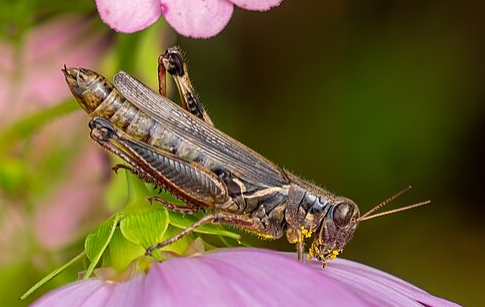
Aztec Spur-throat Grasshopper (Aidemona azteca) is a species of grasshopper in the family Acrididae, commonly known as short-horned grasshoppers. Native to parts of North America, including the southwestern United States and Mexico, this species is typically found in grasslands, scrublands, and agricultural areas. Like other spur-throated grasshoppers, it is characterized by a small projection (spur) between the front legs.
The Aztec Spur-throat Grasshopper is primarily a plant-feeding insect and may occasionally be considered a minor pest when populations are high, particularly in rangeland and agricultural settings.
Taxonomy and Classification
- Common Name: Aztec Spur-throat Grasshopper
- Scientific Name: Aidemona azteca
- Order: Orthoptera
- Family: Acrididae
- Type: Herbivorous grasshopper
The family Acrididae includes many grasshopper species, some of which are economically significant due to their feeding habits.
Identification and Physical Description
The Aztec Spur-throat Grasshopper is a medium-sized grasshopper, typically measuring 1 to 1.5 inches in length. It has a robust body adapted for jumping and feeding on vegetation.
Key identifying features include:
- Brown, tan, or green coloration for camouflage
- Short antennae characteristic of short-horned grasshoppers
- Pronounced spur located between the front legs
- Strong hind legs adapted for jumping
The coloration often blends with surrounding vegetation, making it difficult to spot in natural habitats.
Nymphs resemble smaller versions of adults but lack fully developed wings.
Life Cycle
The Aztec Spur-throat Grasshopper undergoes incomplete metamorphosis, progressing through egg, nymph, and adult stages.
Females lay eggs in the soil, often in clusters called egg pods. These eggs may overwinter and hatch in spring or early summer.
Nymphs emerge and begin feeding immediately, growing through several molts as they develop into adults.
Most species have one generation per year, though this can vary with environmental conditions.
Habitat and Distribution
The Aztec Spur-throat Grasshopper is found in parts of the southwestern United States and Mexico. It is commonly associated with:
- Grasslands and rangelands
- Desert scrub habitats
- Agricultural fields
- Open, dry environments
Its distribution reflects its adaptation to warm, semi-arid climates.
Behavior and Ecology
This species is primarily active during the day and is often seen jumping or flying short distances when disturbed.
It feeds on a variety of plants and may move in response to food availability and environmental conditions.
In natural ecosystems, grasshoppers serve as an important food source for birds, reptiles, and other predators.
Population levels can fluctuate, and under certain conditions, outbreaks may occur.
Diet
The Aztec Spur-throat Grasshopper is herbivorous and feeds on:
- Grasses
- Herbaceous plants
- Agricultural crops (in some cases)
This feeding behavior can impact vegetation when populations are high.
Damage and Economic Importance
Damage is typically limited but may include:
- Chewed leaves and stems
- Reduced plant vigor
- Crop damage during high population outbreaks
While not usually a major pest, localized infestations can affect agricultural productivity.
Management and Control
Management may be necessary when populations reach damaging levels:
- Monitoring: Regularly inspect fields and vegetation
- Cultural practices: Maintain healthy plant communities
- Biological control: Encourage natural predators such as birds
- Targeted treatments: Use insecticides if thresholds are exceeded
Integrated pest management strategies are recommended.
Prevention
Preventative measures include:
- Managing vegetation to reduce breeding sites
- Encouraging natural predators
- Monitoring for early signs of population increases
Early intervention can help prevent outbreaks.
Human Interaction and Risks
The Aztec Spur-throat Grasshopper is harmless to humans. It does not bite or sting and poses no health risks.
Its impact is limited to plant feeding.
Related Articles
Conclusion
The Aztec Spur-throat Grasshopper is a common herbivorous insect adapted to warm, dry environments. While typically not a major pest, it can cause localized plant damage when populations increase.
With proper monitoring and management, its impact can be minimized while recognizing its role in natural ecosystems as both a consumer and a food source for other animals.