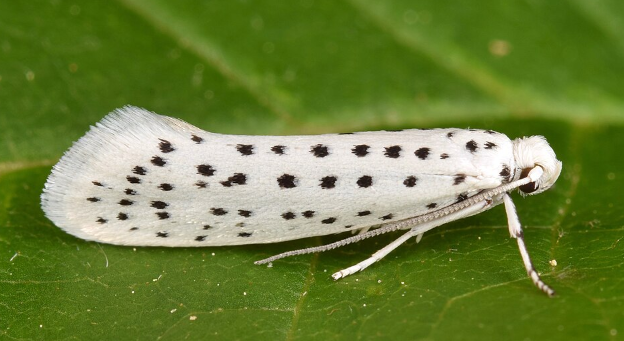
American Ermine Moth (Yponomeuta multipunctella) is a species of small moth in the family Yponomeutidae, commonly referred to as ermine moths. Native to North America, this species is known for its striking white wings marked with numerous black spots and its larval habit of forming dense silken webs on host plants. It is most commonly associated with trees in the genus Prunus, such as chokecherry and related species.
While infestations can appear dramatic due to extensive webbing, the American Ermine Moth is typically not considered a serious long-term threat to healthy trees. Its ecological role includes herbivory and serving as prey for a variety of natural predators.
Taxonomy and Classification
- Common Name: American Ermine Moth
- Scientific Name: Yponomeuta multipunctella
- Order: Lepidoptera
- Family: Yponomeutidae
- Type: Web-forming moth
The genus Yponomeuta includes several species known for their communal webbing behavior during the larval stage. These moths are often noticed due to the conspicuous silk structures they create on host plants.
Identification and Physical Description
Adult American Ermine Moths are small, with a wingspan typically ranging from 3/4 to 1 inch. Their most distinctive feature is their white forewings covered with numerous black spots, giving them a speckled appearance.
The hindwings are usually gray or light-colored with fringed edges. When at rest, the moth holds its wings folded tightly along its body, creating a slender profile.
Larvae are small caterpillars that are pale yellow to gray with black spots along their bodies. They are often found in groups within silken webs.
Life Cycle
The American Ermine Moth undergoes complete metamorphosis, progressing through egg, larva, pupa, and adult stages.
Females lay eggs on the bark or twigs of host plants. Eggs overwinter and hatch in early spring, coinciding with the emergence of new leaves.
Larvae feed communally within protective silken webs, expanding these webs as they grow. This stage lasts several weeks and is the most visible phase of the life cycle.
When fully developed, larvae pupate within the webbing or nearby plant material. Adults emerge in early to mid-summer to reproduce and lay eggs, completing the cycle.
There is typically one generation per year.
Host Plants
The primary host plants of the American Ermine Moth are species in the Prunus genus, including:
- Chokecherry
- Wild cherry
- Plum trees
- Other related species
These plants provide both food and habitat for the developing larvae.
Damage and Symptoms
Larval feeding can result in noticeable damage, particularly during outbreaks. Common symptoms include:
- Extensive silken webbing covering branches and leaves
- Skeletonized or consumed leaves
- Temporary defoliation of host plants
While the appearance of infestation can be alarming, most healthy trees recover once feeding ceases. Long-term damage is uncommon.
Habitat and Distribution
The American Ermine Moth is found across much of North America, particularly in areas where host plants are abundant. It is commonly encountered in:
- Woodlands and forest edges
- Hedgerows and natural thickets
- Urban and suburban landscapes
- Areas with wild or cultivated cherry species
Its distribution is closely tied to the presence of suitable host plants.
Behavior and Ecology
One of the most notable behaviors of this species is the communal webbing created by larvae. These silk structures protect caterpillars from predators and environmental conditions while they feed.
Adult moths are nocturnal and are attracted to light sources. During the day, they rest on vegetation or surfaces where their coloration provides camouflage.
As part of the ecosystem, American Ermine Moths serve as a food source for birds, insects, and other predators, contributing to ecological balance.
Management and Control
Management is generally not required unless infestations are severe or affect ornamental plants.
- Manual removal: Prune and remove webbing and larvae when feasible.
- Encourage natural predators: Birds and beneficial insects help control populations.
- Monitor early: Inspect plants in early spring for emerging larvae.
Chemical control is rarely necessary and should be used cautiously to avoid harming beneficial organisms.
Prevention
Preventative measures focus on maintaining plant health and early detection.
- Regularly inspect host plants for signs of webbing
- Remove infested branches promptly
- Promote biodiversity to support natural predators
Healthy plants are better able to recover from temporary defoliation.
Related Articles
Conclusion
The American Ermine Moth is a visually distinctive species known for its spotted wings and communal webbing behavior during the larval stage. While infestations can appear severe, they rarely cause lasting harm to healthy trees.
Understanding its life cycle and ecological role helps place its activity in context. With minimal intervention required, this species remains a natural part of North American ecosystems.