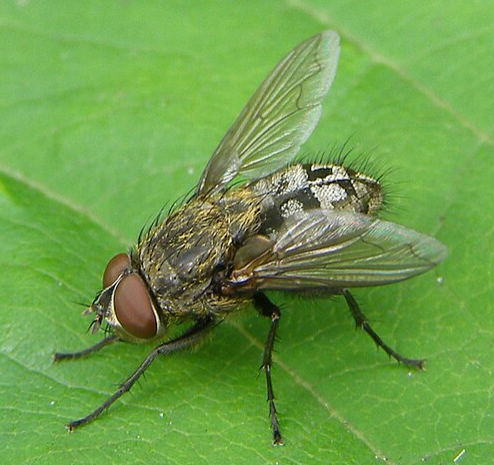
Cluster Flies (Pollenia spp.), most notably Pollenia rudis, are a group of flies commonly found in homes and buildings during the fall and winter months. They are named for their habit of clustering together in large numbers while seeking shelter from cold weather.
Although cluster flies can become a nuisance due to their presence indoors, they are not considered dangerous. They do not bite, sting, or transmit diseases, and they do not cause structural damage.
Taxonomy and Classification
Cluster flies belong to the order Diptera, which includes all true flies, and are part of the family Calliphoridae, commonly known as blow flies.
- Common Name: Cluster Flies
- Scientific Group: Pollenia spp.
- Order: Diptera
- Family: Calliphoridae
- Type: Overwintering nuisance pest
The most common species encountered in homes is Pollenia rudis, often referred to as the common cluster fly.
Identification and Physical Description
Cluster flies are medium-sized flies, typically measuring 0.3 to 0.4 inches (8 to 10 mm) in length. They have a more robust and hairy appearance than typical house flies.
Key identifying features include:
- Dull gray or olive-gray coloration
- Non-metallic body
- Golden or yellowish hairs on the thorax
- Dark gray abdomen with irregular patterns
- Wings that overlap slightly when at rest
One of the most noticeable characteristics is their tendency to gather in large clusters on walls, ceilings, or windows, especially indoors.
Distribution and Habitat
Cluster flies are found throughout temperate regions worldwide, including North America, Europe, and parts of Asia.
Outdoors, they are typically associated with:
- Fields and meadows
- Lawns and grassy areas
- Woodland edges
Indoors, they are commonly found in:
- Attics
- Wall voids
- Crawl spaces
- Window frames and light fixtures
They enter structures primarily to overwinter during colder months.
Behavior and Life Cycle
Cluster flies undergo complete metamorphosis, progressing through egg, larva, pupa, and adult stages.
Unlike many other flies, cluster fly larvae develop as parasitoids of earthworms. Eggs are laid in soil, and the larvae feed on earthworms as they grow.
Adults emerge during warmer months and remain outdoors until late summer or early fall. As temperatures drop, they seek shelter in buildings, where they gather in large groups to overwinter.
They become active again on warm winter days or in early spring, often appearing around windows as they attempt to exit.
Interaction with Humans
Cluster flies are primarily a nuisance pest. Their presence indoors can be bothersome, especially when large numbers emerge at once.
However, they do not:
- Bite or sting
- Reproduce indoors
- Transmit diseases
- Damage structures
Their slow movement and tendency to gather in visible clusters make them noticeable but relatively harmless.
Management and Prevention
Control of cluster flies focuses on preventing their entry into buildings and managing overwintering populations.
- Exclusion: Seal cracks and gaps around windows, doors, siding, and rooflines.
- Screening: Install or repair window screens and vents.
- Vacuuming: Remove indoor flies using a vacuum to avoid crushing and odor release.
- Exterior Treatments: Apply insecticides to building exteriors before fall if infestations are severe.
Because they do not reproduce indoors, eliminating entry points is the most effective long-term solution.
Prevention
Preventative strategies include:
- Sealing entry points before fall
- Reducing outdoor lighting near entryways
- Maintaining tight-fitting doors and windows
- Inspecting structures for gaps and cracks
Early prevention can significantly reduce overwintering populations.
Conservation and Ecological Role
Cluster flies are not a conservation concern and are widely distributed. In natural ecosystems, they play a role as parasitoids of earthworms, contributing to soil ecology and nutrient cycling.
Despite their nuisance indoors, they are part of natural biological processes outdoors.
Related Articles
Conclusion
Cluster flies are common overwintering insects that can become a nuisance in homes and buildings. While their presence can be frustrating, they are harmless and do not pose health or structural risks.
Effective management focuses on exclusion and prevention. By sealing entry points and maintaining building integrity, homeowners can significantly reduce cluster fly infestations.