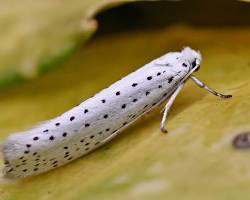
Yponomeuta leaf skeletonizers are the caterpillars of small ermine moths in the genus Yponomeuta. These social caterpillars feed together beneath sheets of silk, skeletonizing leaves and sometimes covering entire shrubs or small trees with dense webbing. Heavy infestations can partially or completely defoliate susceptible plants.
Several Yponomeuta species occur in North America, including introduced species associated with apples, crabapples, euonymus, and related woody plants. Accurate identification is important because individual species often have narrow host preferences.
Taxonomy and Classification
- Order: Lepidoptera
- Family: Yponomeutidae
- Genus: Yponomeuta
- Common names: Leaf skeletonizers, ermine moths, webbing caterpillars, and spindle moths
- Damaging stage: Caterpillar
- Feeding type: Leaf skeletonizer and defoliator
Important members of the genus include the apple ermine moth, Yponomeuta malinellus; spindle ermine moth, Yponomeuta cagnagella; orchard ermine moth, Yponomeuta padella; and willow ermine moth, Yponomeuta rorrella. These species look similar as adults, and identification may require examination of the host plant, larvae, wing markings, or reproductive structures.
Identification
Young larvae may initially appear pale yellow, cream, gray, or greenish. As they grow, many species develop dark heads and rows of black spots along their sides. Mature caterpillars are generally around 1/2 to 3/4 inch long.
The caterpillars live and feed in groups inside conspicuous silken webs. These webs contain leaves, shed skins, droppings, and numerous larvae. Unlike spiders, the caterpillars use their silk for protection, movement, and access to fresh foliage rather than for trapping prey.
Adult ermine moths are small and slender, with narrow white or silvery-white forewings marked by rows of black dots. Their hindwings are gray with fringed edges. Most have a wingspan of approximately 3/4 to 1 inch. At rest, the wings wrap closely around the body, giving the moth a narrow, tube-like appearance.
Host Plants
Host preferences vary among Yponomeuta species. Frequently attacked plants include:
- Apple and crabapple
- European spindle tree and ornamental euonymus
- Hawthorn
- Blackthorn and plum
- Willow
- Cherry and related trees
- Other members of the rose and bittersweet families
The apple ermine moth primarily attacks apple and crabapple trees. The spindle ermine moth is most strongly associated with European spindle tree, Euonymus europaeus. Finding the host plant is therefore one of the most useful first steps in identifying an infestation.
Life Cycle
Most Yponomeuta leaf skeletonizers complete one generation per year. Adult moths emerge and mate during summer. Females deposit groups of eggs on young twigs, branches, or bark near buds. The egg mass is covered with a protective secretion that gradually hardens and becomes difficult to see.
Young larvae may hatch before winter but remain protected beneath the covering of the egg mass. In spring, they emerge as host plants begin producing new foliage. The earliest larvae may mine inside young leaves or buds before beginning their more noticeable communal feeding.
As the caterpillars grow, they produce expanding sheets of silk over leaves and branch tips. Colonies move outward as available foliage is consumed. The webbing protects them from weather and makes it more difficult for some predators and insecticide sprays to reach them.
Mature larvae pupate in clusters of closely packed, white, spindle-shaped cocoons inside or near the web. Adult moths emerge later in the season and begin the cycle again.
Leaf and Tree Damage
Young caterpillars scrape soft tissue from leaves, creating pale or transparent patches. Older larvae consume larger portions of the leaves, sometimes leaving only the veins. This feeding pattern produces the skeletonized appearance associated with their common name.
Signs of an infestation include:
- Leaves with transparent or window-like patches
- Foliage reduced to veins or midribs
- Silken sheets surrounding leaves and branch tips
- Groups of spotted caterpillars inside the web
- White cocoons packed together within webbing
- Large quantities of caterpillar droppings
- Partial or complete plant defoliation
- Silk extending onto nearby plants, grass, or objects
A healthy, established tree may survive a single episode of spring defoliation and produce replacement leaves. Repeated infestations can reduce growth, weaken branches, lower fruit production, and increase vulnerability to drought or disease. Young trees, recently transplanted ornamentals, and plants already under stress are at greater risk.
Yponomeuta Webs Versus Tent Caterpillar Webs
Yponomeuta infestations may be confused with eastern tent caterpillars or fall webworms. Tent caterpillars build compact tents in branch forks and leave the tent to feed. Fall webworms enclose foliage near the ends of branches and are usually most noticeable during late summer.
Yponomeuta caterpillars commonly create extensive sheets of silk directly over the foliage on which they are feeding. The host plant, season, caterpillar markings, and appearance of the adult moth can help confirm the identification.
Monitoring
Inspect susceptible trees and shrubs as buds open in spring. Look for mined leaves, fine strands of silk, and small groups of young larvae. Early colonies are easier to remove and control than mature infestations covering multiple branches.
Commercial apple growers may use species-specific pheromone traps to detect adult apple ermine moths. These traps help identify adult activity and distribution but do not eliminate an established population.
Management and Control
Management should begin while colonies are small. Once an entire tree is covered with webbing, physical removal and spray coverage become considerably more difficult.
- Prune small colonies: Clip out webbed branch tips when doing so will not disfigure the plant. Seal the material in a bag before disposal.
- Remove caterpillars manually: On small plants, pull away webs with a stick or gloved hand and place the larvae in soapy water.
- Use a strong water spray: Water can break apart light webbing and dislodge young larvae from sturdy ornamental plants.
- Inspect during winter: Look for flattened egg masses on young twigs and prune them out when practical.
- Support plant recovery: Water valuable trees during dry periods and avoid unnecessary pruning, root injury, or excessive fertilizer.
- Protect natural enemies: Birds, spiders, predatory insects, parasitic flies, and parasitic wasps help suppress caterpillars.
Bacillus thuringiensis var. kurstaki, commonly called Btk, may control young caterpillars when they consume treated foliage. It is most effective before heavy webbing develops. Spinosad and other products labeled for leaf-feeding caterpillars may also be available, but applications must thoroughly reach foliage around active colonies.
Do not burn webs from the tree with a torch. Fire can seriously injure bark and branches while creating an unnecessary safety hazard. Always identify the pest and follow the pesticide label before treating ornamental or fruit-producing plants.
Are Yponomeuta Leaf Skeletonizers Dangerous?
Yponomeuta caterpillars do not infest houses, bite people, or damage structural wood. They are not generally associated with the irritating hairs found on some tussock moth caterpillars. Their principal concern is defoliation and the unsightly webbing they create on host plants.
Conclusion
Yponomeuta leaf skeletonizers are communal caterpillars that cover apple, euonymus, willow, and other host plants with silk while consuming their leaves. A single infestation may be primarily cosmetic on a healthy tree, but repeated or severe defoliation can weaken valuable plants. Early inspection, removal of small webs, preservation of natural enemies, and properly timed caterpillar treatments provide the most effective management.