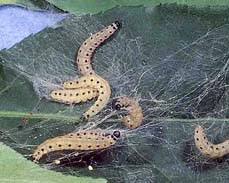
Yponomeuta webworms are the communal caterpillars of small ermine moths in the genus Yponomeuta. They produce sheets of silk around leaves and branches while feeding on apple, crabapple, euonymus, willow, hawthorn, and other woody plants. Large colonies can cover entire shrubs or small trees with webbing and remove nearly all their foliage.
Although the term “webworm” is often associated with fall webworms, Yponomeuta species form a separate group. Their host plants, seasonal activity, caterpillar markings, and adult moths help distinguish them from other web-producing insects.
Taxonomy and Classification
- Order: Lepidoptera
- Family: Yponomeutidae
- Genus: Yponomeuta
- Common names: Yponomeuta webworms, ermine moth caterpillars, and webbing caterpillars
- Damaging stage: Larva or caterpillar
- Feeding type: Leaf skeletonizer and defoliator
The genus contains numerous species, many of which are difficult to separate by appearance alone. Important species include the apple ermine moth (Yponomeuta malinellus), spindle ermine moth (Yponomeuta cagnagella), orchard ermine moth (Yponomeuta padella), and willow ermine moth (Yponomeuta rorrella).
Identification
Yponomeuta caterpillars are generally cream, pale gray, yellowish, or greenish-gray. Many have dark heads and two rows of distinct black spots running along the body. Mature caterpillars usually reach approximately 1/2 to 3/4 inch in length.
The easiest way to recognize an infestation is by its communal webbing. Dozens or even hundreds of caterpillars may feed together beneath sheets of silk. The web becomes filled with damaged leaves, droppings, shed skins, and pale caterpillars.
Adult Yponomeuta moths are small and narrow-bodied. Their forewings are usually white or silvery white with rows of tiny black dots. The hindwings are gray and fringed with long scales. When resting, the moth folds its wings closely around its body, producing a slender, almost cylindrical appearance.
Host Plants
Individual Yponomeuta webworm species tend to feed on a limited group of related plants. Common hosts include:
- Apple and crabapple
- European spindle tree
- Ornamental euonymus
- Hawthorn
- Blackthorn
- Plum and cherry
- Willow
- Other related shrubs and trees
The host plant provides an important identification clue. For example, apple ermine moth caterpillars feed mainly on apple and crabapple, while spindle ermine moth caterpillars are most commonly associated with European spindle tree and certain ornamental euonymus plants.
Distribution and Habitat
Yponomeuta moths are most diverse in Europe and Asia, but several species have become established in parts of North America. They may occur in orchards, nurseries, parks, residential landscapes, hedgerows, woodland edges, and areas containing wild host plants.
Introduced species may have localized or expanding distributions. Unusual webbing on apple or ornamental trees, particularly where a Yponomeuta species has not previously been reported, should be shown to a local extension office or state agriculture department for identification.
Life Cycle
Most Yponomeuta webworms complete one generation annually. Adult moths emerge during summer, mate, and deposit flattened clusters of eggs on young twigs or branches. Females cover the eggs with a protective secretion that hardens and gradually blends with the bark.
The eggs hatch into small caterpillars, which commonly remain beneath the protective egg covering through winter. These sheltered groups are difficult to notice during dormant-season inspections.
When host plants begin producing new growth in spring, the young larvae emerge. They may initially mine inside buds or young leaves. As the caterpillars grow, they move onto exposed foliage and begin constructing communal webs.
The colony enlarges its web as nearby leaves are consumed. Mature caterpillars eventually spin white, spindle-shaped cocoons. Numerous cocoons may be arranged side by side inside the web. Adult moths later emerge, and the cycle begins again.
Damage Caused by Yponomeuta Webworms
Young caterpillars remove soft tissue from inside or along the surface of leaves. Older larvae consume most of the leaf blade, often leaving veins, midribs, or skeletonized foliage behind.
Common signs of an infestation include:
- Fine silk surrounding newly opening leaves
- Leaves with translucent or scraped patches
- Groups of pale, black-spotted caterpillars
- Expanding webs around branch tips
- Leaves reduced to veins or midribs
- Clusters of white cocoons inside the silk
- Webbing extending onto nearby plants or grass
- Partial or complete defoliation
A healthy, mature tree can often survive one episode of spring defoliation and may produce replacement leaves. However, complete or repeated defoliation can reduce growth, fruit production, and stored energy. Young, recently transplanted, drought-stressed, or diseased plants are more likely to suffer lasting damage.
Yponomeuta Webworms Versus Fall Webworms
Yponomeuta webworms are generally active during spring and early summer. Their caterpillars are relatively slender and frequently have rows of black spots. Adults are white moths with small black markings.
Fall webworms usually become conspicuous during summer and fall. Their webs surround foliage at the ends of branches and continue expanding as the larvae feed. Fall webworms also attack a much wider range of deciduous trees.
Eastern tent caterpillars differ from both groups because they construct a compact silk tent in a branch fork. The caterpillars leave this tent to feed elsewhere on the tree.
Monitoring
Inspect susceptible trees and shrubs as soon as buds open in spring. Look closely for mined leaves, groups of tiny caterpillars, or fine strands of silk between adjacent leaves. Treating or removing colonies at this stage is considerably easier than managing mature webs.
Check plants that experienced infestations during previous years. Egg masses may remain attached to small twigs throughout winter. Commercial orchards may use species-specific pheromone traps to monitor adult moth activity, but traps alone will not prevent larval feeding.
Management and Control
Small populations on established trees may not require treatment. Management is most appropriate when colonies threaten young trees, valuable ornamentals, orchard production, or most of a plant’s foliage.
- Prune small webs: Remove infested branch tips while colonies are still limited. Avoid excessive pruning that could further weaken the tree.
- Remove caterpillars: Pull accessible webs from small plants with a stick or gloved hand and place the material in soapy water.
- Use water pressure: A strong stream of water can break light webbing and dislodge young caterpillars from sturdy plants.
- Inspect dormant twigs: Prune out visible egg masses during winter when practical.
- Maintain plant health: Provide appropriate irrigation and mulch while avoiding root injury and excessive nitrogen fertilizer.
- Protect natural enemies: Birds, spiders, predatory insects, parasitic flies, and parasitic wasps help limit webworm populations.
Bacillus thuringiensis var. kurstaki, or Btk, can control young caterpillars when they consume treated leaves. It works best before dense silk protects the colony. Spinosad and other insecticides labeled for leaf-feeding caterpillars may also be effective when applied early.
Sprays must reach active feeding areas and may perform poorly after heavy webbing develops. Always confirm that a product is labeled for the host plant and intended site. Follow all application, pollinator-protection, and harvest instructions.
Do not use fire to burn webs from trees. A torch can damage bark, kill branches, ignite dry vegetation, and create a greater problem than the caterpillars themselves.
Are Yponomeuta Webworms Dangerous?
Yponomeuta webworms do not bite, sting, infest buildings, or damage structural wood. They are not typically associated with the irritating hairs found on certain tussock moth caterpillars. Their principal effects are plant defoliation and unsightly webbing.
Conclusion
Yponomeuta webworms are social caterpillars that feed beneath expanding sheets of silk on apple, euonymus, willow, and other woody plants. Healthy trees may tolerate limited feeding, but large or recurring colonies can weaken plants and reduce fruit or ornamental quality. Early detection, physical removal, plant care, natural enemies, and properly timed caterpillar treatments provide the best control.