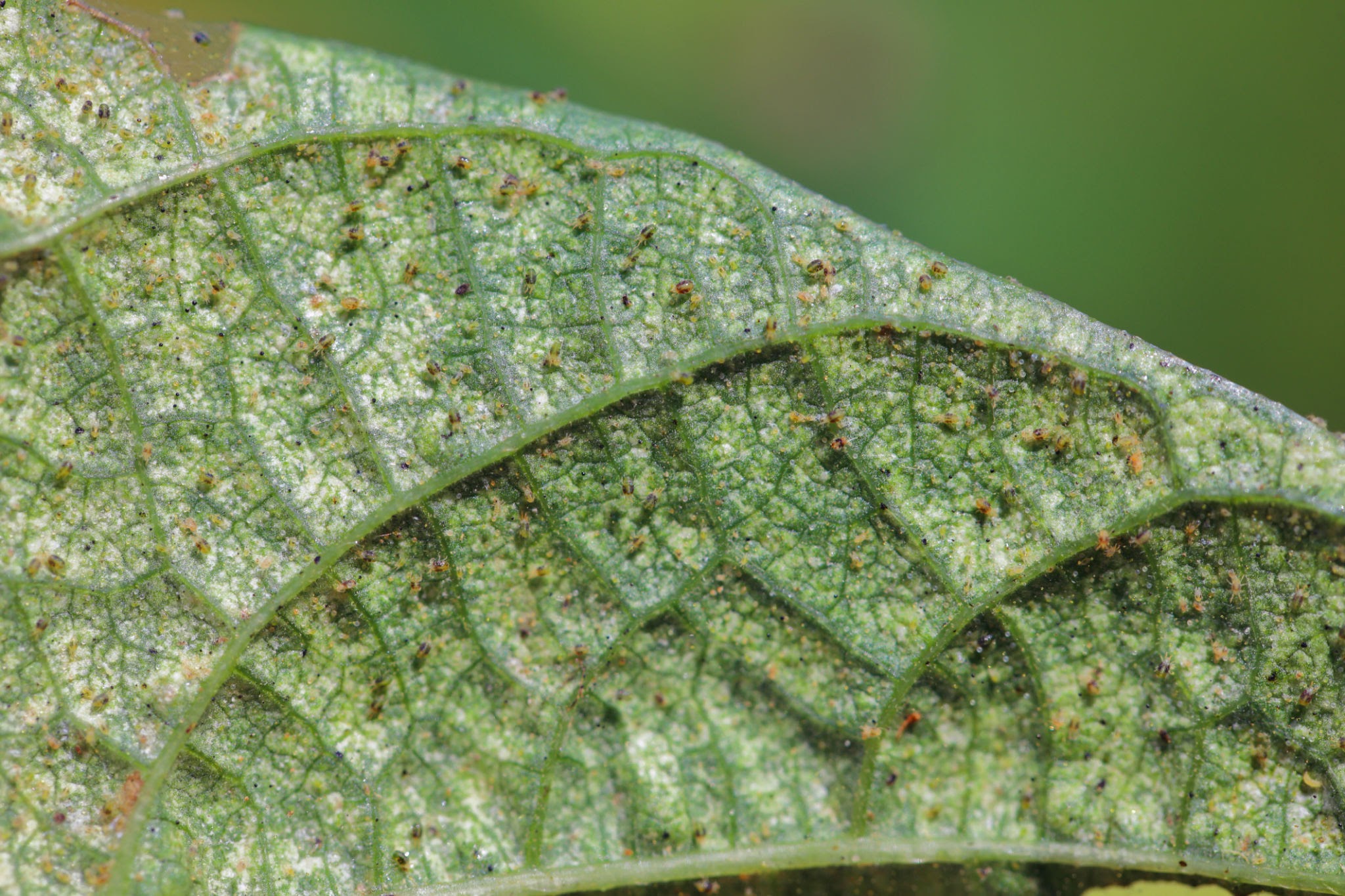
Two-Spotted Spider Mites (Tetranychus urticae) are among the most widespread and destructive plant-feeding mites in the world. These tiny arachnids attack hundreds of plant species, including vegetables, fruit trees, strawberries, beans, peppers, ornamentals, greenhouse crops, and field crops. Despite their microscopic size, large populations can rapidly weaken plants by removing chlorophyll-containing cell contents, causing leaves to become stippled, yellow, bronzed, and eventually dead. Two-Spotted Spider Mites thrive in hot, dry conditions and can reproduce explosively during summer months, making them a major pest in gardens, greenhouses, landscapes, and commercial agriculture.
Taxonomy and Classification
Two-Spotted Spider Mites belong to the class Arachnida and the subclass Acari, making them more closely related to ticks and spiders than to insects.
- Class: Arachnida
- Subclass: Acari
- Family: Tetranychidae
- Genus: Tetranychus
- Species: Tetranychus urticae
Members of the spider mite family are known for producing fine silk webbing and feeding by piercing plant cells with specialized mouthparts. Their rapid reproductive capacity allows infestations to develop quickly under favorable environmental conditions.
Identification
Two-Spotted Spider Mites are extremely small and often go unnoticed until plant damage becomes visible.
- Size: Less than 0.5 millimeters long.
- Color: Usually pale green, yellowish, or translucent.
- Body Markings: Two distinctive dark spots visible through the body wall.
- Shape: Oval-shaped with eight legs in adult stages.
- Overwintering Females: May appear orange, red, or reddish-brown.
The easiest field identification method is the “paper test.” Hold a white sheet of paper beneath suspect foliage and tap the leaf sharply. Tiny moving specks crawling across the paper are often spider mites.
Distribution and Habitat
Two-Spotted Spider Mites are found worldwide and occur in nearly every agricultural and horticultural production region.
Common habitats include:
- Vegetable gardens
- Greenhouses
- Fruit orchards
- Strawberry fields
- Landscape ornamentals
- Nurseries
- Field crops
- Houseplants
They thrive in hot, dry environments where low humidity and elevated temperatures accelerate reproduction and reduce natural disease pressure.
Host Plants
Two-Spotted Spider Mites attack an exceptionally wide range of plants.
Common hosts include:
- Tomatoes
- Peppers
- Beans
- Strawberries
- Cucumbers
- Melons
- Roses
- Marigolds
- Fruit trees
- Cotton
- Soybeans
- Many greenhouse ornamentals
Their broad host range allows populations to survive year-round in many environments.
Life Cycle
Two-Spotted Spider Mites undergo several developmental stages.
- Egg Stage: Females deposit tiny spherical eggs on leaf undersides.
- Larval Stage: Newly hatched larvae possess six legs.
- Protonymph Stage: Developing mites acquire eight legs.
- Deutonymph Stage: Continued growth and feeding occur.
- Adult Stage: Mature mites reproduce and establish new colonies.
Under warm conditions, the entire life cycle may be completed in as little as 7 to 10 days. This rapid development allows populations to increase dramatically during summer.
Damage and Symptoms
Spider mites damage plants by piercing individual plant cells and extracting their contents.
Early symptoms include:
- Stippling: Tiny yellow or white speckles on leaves.
- Chlorosis: General yellowing of foliage.
- Reduced Vigor: Slower plant growth.
As infestations worsen, symptoms become more severe.
- Bronzing: Leaves develop a rusty or bronze appearance.
- Brittle Foliage: Damaged leaves become dry and fragile.
- Premature Leaf Drop: Severe infestations cause defoliation.
- Webbing: Fine silk covers leaves, stems, flowers, and growing points.
- Plant Decline: Growth slows significantly and yields may decrease.
Heavy infestations can cause substantial crop losses and severely reduce ornamental plant quality.
Webbing Production
One of the defining characteristics of spider mites is their ability to produce silk.
Webbing serves several important functions:
- Protects mites from predators.
- Provides shelter from environmental conditions.
- Facilitates movement between leaves.
- Protects eggs and immature stages.
Visible webbing is often an indication that an infestation has become severe.
Behavior and Conflict
Several biological traits make Two-Spotted Spider Mites difficult to manage.
- Rapid Reproduction: Populations can double within days.
- Short Generation Time: Multiple generations occur each season.
- Wide Host Range: Numerous plants support infestations.
- Resistance Development: Populations frequently develop resistance to pesticides.
- Environmental Adaptation: Hot, dry conditions strongly favor outbreaks.
Spider mites are often secondary pests that become problematic after broad-spectrum insecticides eliminate beneficial predators.
Monitoring and Detection
Regular scouting is essential for early intervention.
- Inspect leaf undersides frequently.
- Look for stippling and discoloration.
- Watch for fine webbing.
- Perform the white paper tap test.
- Monitor susceptible plants during hot weather.
Early detection significantly improves control success.
Management and Prevention
Integrated Pest Management (IPM) provides the most effective long-term control strategy.
Cultural Controls
- Maintain adequate irrigation.
- Reduce drought stress.
- Avoid excessive nitrogen fertilization.
- Minimize dust accumulation on plants.
- Remove heavily infested plant material.
Physical Control
- Water Sprays: Strong streams of water can dislodge mites and increase humidity.
- Pruning: Remove heavily infested leaves and stems.
Biological Control
- Predatory Mites: Phytoseiulus persimilis is one of the most effective natural enemies.
- Lacewings: Feed on spider mite populations.
- Minute Pirate Bugs: Consume mites and eggs.
- Lady Beetles: Provide supplemental control.
Organic Controls
- Neem Oil: Suppresses adults, nymphs, and eggs.
- Horticultural Oils: Smother mites and reduce populations.
- Insecticidal Soaps: Effective when thorough coverage is achieved.
Applications should focus on leaf undersides where mites are concentrated.
Chemical Control
When infestations become severe, miticides may be required.
- Rotate products to prevent resistance.
- Follow label instructions carefully.
- Target populations before extensive webbing develops.
Conservation and Research
Two-Spotted Spider Mites remain one of the most extensively studied mite pests in agriculture. Current research focuses on biological control programs, resistance management, improved monitoring techniques, and sustainable pest management strategies.
Scientists continue developing integrated approaches that reduce pesticide dependence while maintaining effective suppression of spider mite populations in both agricultural and ornamental production systems.