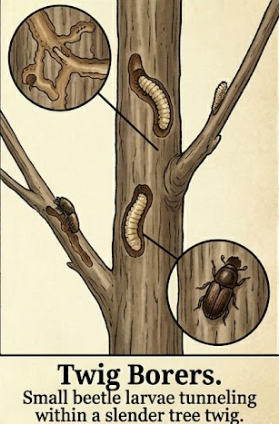
Twig Borers are a broad group of insects whose larvae tunnel into small branches, twigs, shoots, and stem tips of trees, shrubs, and woody ornamentals. Although the exact species involved varies by region and host plant, the pattern of damage is generally the same: larvae bore into tender or semi-woody stems, feed internally, and weaken the affected portion of the plant. This feeding often causes wilted shoot tips, dead twigs, branch dieback, and distorted growth. In orchards, nurseries, landscapes, and home gardens, Twig Borers can create significant economic and aesthetic losses.
These pests are particularly challenging because most of their destructive activity occurs hidden inside plant tissue. By the time symptoms become visible, the larva is usually protected deep within the stem. In fruit trees, Twig Borers may reduce productivity by damaging fruiting wood and creating entry points for secondary diseases. In ornamental plants, repeated infestations can produce uneven growth, thinning canopies, and an unattractive appearance. Young trees and shrubs are especially vulnerable because the loss of even a few shoots can significantly impact their development.
Taxonomy and Classification
Twig Borers are not a single insect species but rather a category of insects that share a similar feeding habit. Species may belong to several different insect families and orders.
- Order: Lepidoptera (Moths)
- Order: Coleoptera (Beetles)
- Common Examples: Peach Twig Borers, Twig Girdlers, Branch Borers, and various wood-boring beetles
Most Twig Borers undergo complete metamorphosis consisting of egg, larval, pupal, and adult stages. The larval stage is responsible for all significant damage.
Identification
Identification often depends more on plant symptoms than on directly observing the insect.
Larvae
- Appearance: Cream-colored caterpillars or grubs.
- Size: Typically 1/4 to 1/2 inch long, depending on species.
- Habitat: Hidden inside twigs, shoots, and small branches.
- Behavior: Feed internally within plant tissue.
Adults
- May be small moths or beetles.
- Often active during specific seasons.
- Frequently difficult to observe because of their short lifespan.
Key Signs of Infestation
- Wilted shoot tips.
- Dead terminal growth.
- Small holes in twigs.
- Sawdust-like frass.
- Gumming on fruit trees.
- Twigs that snap easily.
- Flagging or browning branch tips.
Cutting open affected stems often reveals tunnels and feeding galleries.
Distribution and Habitat
Twig Borers occur throughout North America and around the world wherever suitable host plants are available.
They are commonly found in:
- Fruit orchards
- Residential landscapes
- Nurseries
- Parks
- Woodlots
- Shelterbelts
- Commercial tree farms
Many species prefer young, actively growing shoots, although some attack mature woody growth.
Host Plants
Host plants vary considerably depending on the species.
Common hosts include:
- Peach trees
- Apricot trees
- Nectarines
- Almond trees
- Cherry trees
- Apple trees
- Pear trees
- Ornamental shrubs
- Shade trees
- Conifers
Some species specialize on a narrow range of hosts, while others attack numerous woody plants.
Life Cycle
Most Twig Borers undergo complete metamorphosis.
- Egg Stage: Females deposit eggs on bark, twigs, wounds, or tender shoots.
- Larval Stage: Newly hatched larvae bore into plant tissue and begin feeding.
- Pupal Stage: Development occurs within the stem or a protected location.
- Adult Stage: Adults emerge, mate, and seek new hosts.
Depending on species and climate, there may be one or multiple generations each year.
Damage and Economic Importance
Twig Borers damage plants by destroying vascular tissue inside shoots and branches.
Primary Damage
- Disruption of water transport.
- Disruption of nutrient movement.
- Death of shoot tips.
- Reduced growth.
- Loss of flowering sites.
- Reduced fruit production.
The characteristic symptom is often “flagging,” where the tip of a branch suddenly wilts and turns brown while remaining attached.
Structural Damage
- Weakening of twigs.
- Branch breakage.
- Canopy thinning.
- Distorted plant shape.
Young trees are particularly susceptible because each damaged shoot represents a larger portion of the overall canopy.
Secondary Problems
Twig Borer injury frequently creates entry points for plant pathogens.
Common secondary issues include:
- Fungal infections.
- Bacterial diseases.
- Canker development.
- Wood decay organisms.
The combined effects of insect damage and disease often exceed the impact of either problem alone.
Signs of Infestation
Homeowners and growers should watch for:
- Brown shoot tips.
- Wilted new growth.
- Small entry holes.
- Accumulations of frass.
- Gummy sap exudates.
- Broken or weakened twigs.
- Dead branch terminals.
These symptoms are often most noticeable during spring and early summer when plants are actively growing.
Behavior and Conflict
Several biological characteristics make Twig Borers difficult pests to manage.
- Concealed Feeding: Larvae remain protected inside plant tissue.
- Early Damage: Injury begins before symptoms become visible.
- Seasonal Activity: Timing varies among species.
- Host Preferences: Different species attack different plants.
- Stress Attraction: Some species target weakened plants.
Because larvae are hidden, treatments applied after tunneling begins are often ineffective.
Monitoring and Detection
Regular inspections are essential for early detection.
- Examine new shoots for wilting.
- Look for flagging branch tips.
- Inspect stems for entry holes.
- Check for frass accumulation.
- Monitor susceptible plants during active growth periods.
Prompt identification greatly improves management success.
Management and Prevention
An Integrated Pest Management (IPM) program provides the most effective control.
Pruning and Sanitation
- Remove infested twigs immediately.
- Prune below visible tunneling.
- Destroy removed plant material.
- Remove dead branches.
Sanitation reduces the number of larvae that can complete development.
Cultural Controls
- Maintain proper irrigation.
- Apply mulch appropriately.
- Provide balanced fertility.
- Reduce plant stress.
- Avoid unnecessary injuries.
Healthy plants are generally more resistant to attack.
Monitoring Adults
- Use pheromone traps where available.
- Track seasonal adult emergence.
- Monitor susceptible host plants closely.
Timing treatments against adults or newly hatched larvae is often critical.
Biological Control
- Parasitic wasps.
- Predatory insects.
- Birds.
- Naturally occurring pathogens.
Natural enemies can help suppress populations in many landscapes.
Chemical Control
- Apply treatments before larvae enter stems.
- Target egg hatch periods.
- Follow label directions carefully.
- Avoid unnecessary broad-spectrum applications.
Once larvae are deep within the twig, insecticides become far less effective.
Conservation and Research
Research on Twig Borers focuses on improved monitoring techniques, pheromone-based detection systems, biological control agents, and host plant resistance. Scientists continue developing sustainable management strategies that emphasize early detection and targeted intervention while minimizing impacts on beneficial insects.
Regular inspection, prompt pruning of infested material, and maintaining healthy plants remain the most effective long-term defenses against Twig Borer infestations in orchards, nurseries, and residential landscapes.