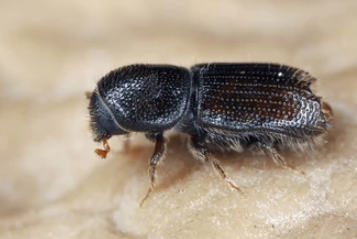
Quince bark borers are wood-boring insects that attack quince trees and other fruit-bearing species by tunneling beneath the bark. These pests are particularly problematic in orchards and home gardens where fruit trees are grown intensively. While often considered secondary invaders, they can cause severe damage when trees are stressed due to drought, disease, or improper care.
The larvae of bark borers feed on the cambium layer, the vital tissue responsible for transporting nutrients and water throughout the tree. As they tunnel through this layer, they disrupt the tree’s vascular system, leading to reduced vigor, dieback, and in severe cases, tree death. Infestations often go unnoticed until symptoms become advanced, making early detection essential.
Quince bark borers are especially active during warm months when adult beetles emerge to lay eggs. Trees that are weakened or damaged are more susceptible to infestation, as they emit chemical signals that attract these insects.
The Hidden Tunneler: Quince Bark Borers
The Quince Bark Borer (primarily the Roundheaded Apple Tree Borer, Saperda candida, and the Synanthedon clearwing moths) is a “noxious” wood-boring pest that targets pome fruits, including Quince, Apple, and Pear. In the United States, these are considered “orchard killers.” Unlike aphids that nibble leaves, borers attack the structural and vascular “heart” of the tree. Because Quince trees are often smaller and more “shrub-like” than modern apple cultivars, a single borer larva can completely girdle and kill a young tree in a single season.
Identification: The “Sawdust” Signal
Because the larvae live entirely inside the wood, you must look for the “waste” they push out of the tree. For Pestipedia.com users, identifying Quince Borers is a matter of inspecting the bottom 24 inches of the trunk:
- Orange Frass: Look for a distinct, moist, orange-to-reddish “sawdust” (frass) collecting in the crevices of the bark or in small piles at the soil line. This is the most reliable sign of an active “tenant.”
- Sap Oozing: The tree will often “bleed” a dark, sticky sap from a small, circular entry hole as it tries to drown the larva.
- The Adult Beetle: The Saperda adult is a striking “Longhorned Beetle” (about 1 inch long) with two bold white stripes running down its brown back and antennae longer than its body.
- The “Clearwing” Moth: Some Quince borers are actually the larvae of moths that look like wasps. You may find their empty, papery brown pupal cases sticking out of the bark in mid-summer.
The “Girdling” Death
The damage caused by Quince Bark Borers is a slow-motion structural collapse. For Pestipedia.com, the “noxious” status is due to the larval feeding path:
- Cambium Mining: First-year larvae feed on the inner bark (cambium). If they travel horizontally around the trunk, they “girdle” the tree, cutting off the flow of nutrients from the leaves to the roots.
- Heartwood Weakening: In their second year, larvae tunnel into the solid heartwood. This makes the Quince tree highly susceptible to snapping during Arizona’s monsoon winds or heavy snow loads in the Northeast.
- Yellowing Canopy: A tree with a borer will often show “early autumn” colors on just one or two branches, or the entire canopy may look thin and pale despite regular watering.
U.S. Orchard and Heritage Tree Management
In the United States, managing borers is about Prevention and Physical Extraction. Once a larva is deep in the heartwood, chemical sprays are largely ineffective.
- The “Wire Probe” Method: For gardeners with just a few trees, the most effective control is manual. Locate the hole where frass is exiting, and insert a flexible, sharpened wire. Push it upward or downward until you “feel” the larva. This is the gold standard for organic borer control.
- The “White Paint” Barrier: A common U.S. orchard practice is painting the bottom 2 feet of the trunk with a 50/50 mix of white interior latex paint and water. This makes it difficult for the female beetles to find a “crevice” to lay eggs and allows you to spot fresh orange frass much more easily.
- Avoid “Mulch Volcanoes”: Never pile mulch against the bark of your Quince tree. This creates a moist, soft environment that invites borer beetles to lay eggs at the soil line. Keep mulch 6 inches away from the trunk.
- Entomopathogenic Nematodes: In the U.S., organic growers use “beneficial worms” (Steinernema feltiae). You can use a syringe to inject a water-nematode mix directly into the borer holes. The nematodes “hunt” the larvae inside the tunnels.
Identification
Adult bark borers are small beetles, often dark brown or black. Larvae are white, legless grubs found beneath the bark. Signs of infestation include small exit holes, frass accumulation, and peeling bark.
Life Cycle
Eggs are laid in cracks or crevices in the bark. After hatching, larvae bore into the tree and feed internally. Pupation occurs within the tree, and adults emerge to continue the cycle. Depending on environmental conditions, one or more generations may occur annually.
Damage and Impact
Damage includes disrupted nutrient flow, branch dieback, and structural weakening. In severe infestations, entire trees may die. Fruit production is often reduced before visible structural damage occurs.
Prevention and Control
Maintaining tree health is the most effective prevention strategy. Proper watering, fertilization, and pruning reduce susceptibility. Infested branches should be removed and destroyed. Preventative insecticide treatments may be applied during peak egg-laying periods.