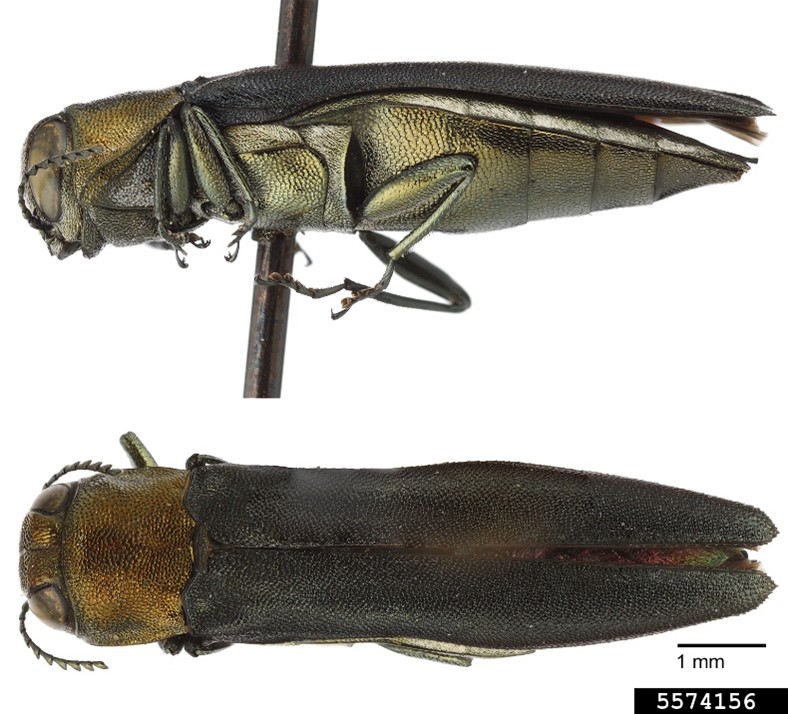
Quercus bark borers are wood-boring insects that attack oak trees by tunneling beneath the bark. These pests are particularly problematic in stressed or weakened trees, where they can accelerate decline and contribute to mortality. Bark borers are often secondary pests, meaning they infest trees that are already compromised by drought, disease, or injury.
Once inside the tree, larvae feed on the cambium layer, disrupting the flow of nutrients and water. This can lead to dieback, canopy thinning, and eventual tree death if infestations are severe.
The Structural Saboteur: Quercus Bark Borers
The Quercus Bark Borer (primarily the Red Oak Borer, Enaphalodes rufulus, and the Carpenterworm) is a group of beetles and moths whose larvae tunnel deep into the heartwood of Oak trees. Unlike leaf-eating pests, these borers are “noxious” because they degrade the structural integrity of the tree and ruin the value of timber. In the United States, they are a major concern for the forestry industry in the Ozarks and the Appalachian regions, as well as for homeowners with “legacy” Oaks in their yards.
Identification: The “Bleeding” Trunk
Identifying Quercus Bark Borers is an exercise in “tree forensics.” Because the larvae are hidden deep inside the wood for up to two years, you must look for the external evidence they leave behind on the bark:
- Sap Bleeding: One of the first signs of an active borer is “oozing” or “bleeding” sap from a small hole in the trunk. This is the tree’s natural defense attempt to drown the invading larva.
- Coarse Frass: Unlike the fine “powder” of powderpost beetles, Quercus borers produce large, wood-colored pellets of “frass” (sawdust mixed with waste) that collect in the crevices of the bark or at the base of the tree.
- Exit Holes: When the adults emerge, they leave behind large, perfectly circular or slightly oval holes about 1/4 to 1/2 inch in diameter.
- The “Carpenterworm” Moth: In some cases, the “borer” is actually a large, mottled grey moth. You may find the empty, brown pupal cases sticking halfway out of the bark after the moth has emerged.
The “Heartwood” Damage
While some borers only attack the inner bark (phloem), the Quercus Bark Borer is a “true” wood-borer that penetrates the xylem and heartwood:
- Structural Weakening: Large larvae create galleries the size of a human finger. In high-wind areas like the Midwest or during Arizona’s monsoon season, infested trees are significantly more likely to snap or lose large limbs.
- Timber Degradation: For the U.S. lumber industry, borer galleries cause “dark heart” or “honeycomb” defects, rendering high-value Oak timber useless for furniture or flooring.
- Vascular Interruption: While they don’t girdle the tree as quickly as Emerald Ash Borers, a heavy infestation can eventually “choke” the tree’s ability to move water, leading to “Oak Decline.”
U.S. Forest and Urban Management
In the United States, managing Quercus Bark Borers is difficult because the larvae are “armored” by inches of solid oak. Control strategies focus on Prevention and Systemic Protection:
- The “Vigor” Defense: Borers are highly attracted to trees that are stressed by drought, compaction, or previous storm damage. Keeping your Oaks well-mulched and deeply watered during dry spells is the #1 deterrent.
- Avoid Wounding: Adult beetles are attracted to the smell of fresh sap. Avoid pruning your Oaks during the peak flight season (typically late spring through mid-summer) to prevent inviting females to lay eggs in the fresh cuts.
- Trunk Sprays: For high-value landscape trees, professional arborists apply “residual” insecticides (like Permethrin or Bifenthrin) to the bark surface just as the eggs are hatching. This kills the tiny larvae before they can “drill” into the safety of the wood.
- Woodpecker Activity: If you see Woodpeckers (like the Downy or Hairy Woodpecker) obsessively drilling into a specific part of your Oak trunk, they are likely hunting for borer larvae. While the birds cause cosmetic damage, they are a sign of an underlying pest issue.
Identification
Adults are small beetles, while larvae are white, legless grubs found beneath bark. Signs include exit holes and frass.
Life Cycle
Eggs are laid in bark crevices. Larvae tunnel beneath bark before pupating.
Damage
Disrupted nutrient flow, branch dieback, and tree mortality.
Control
Maintain tree health, remove infested wood, and apply preventative treatments.