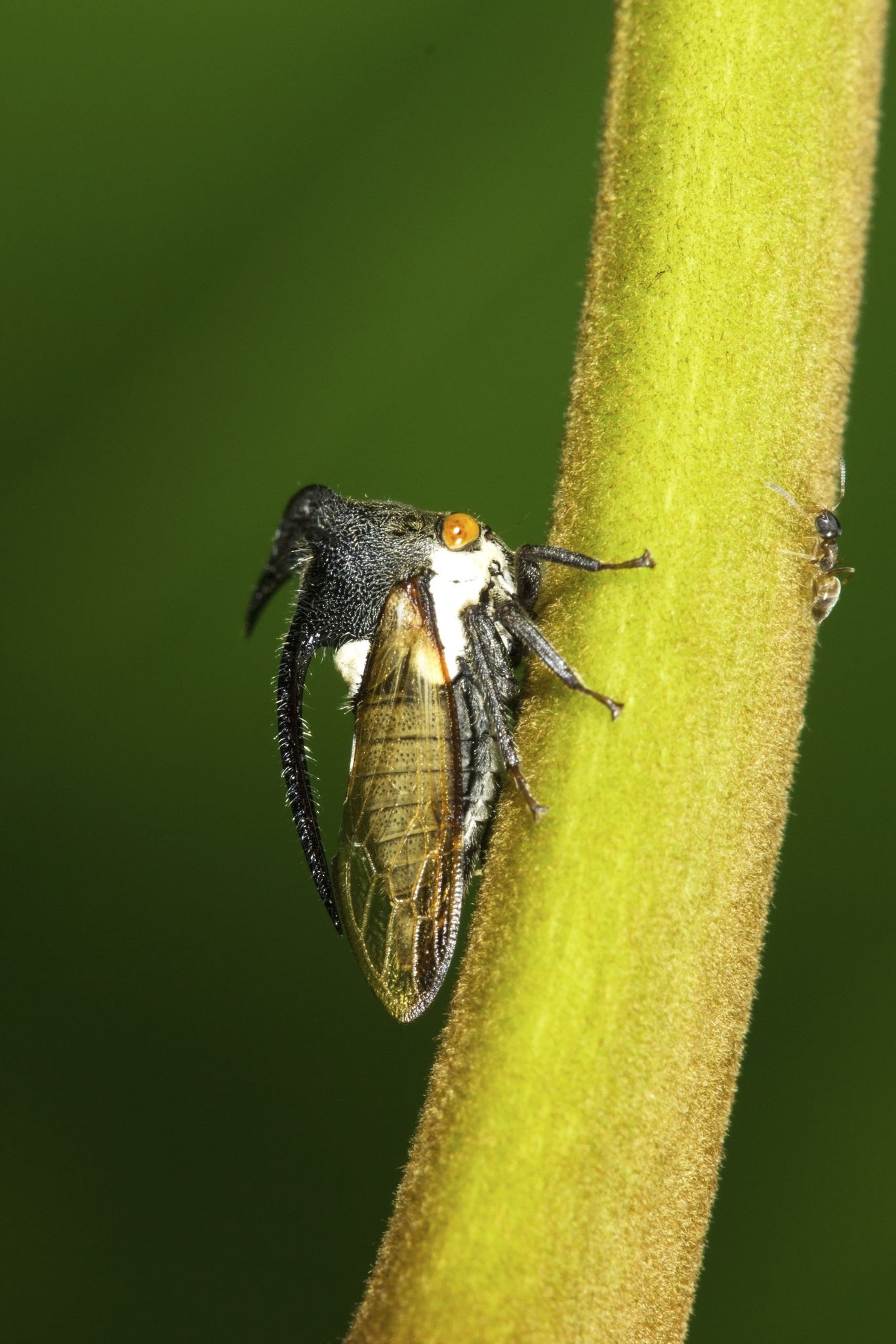
Treehopper Bugs are a distinctive group of sap-feeding insects belonging to the family Membracidae. These unusual insects are famous for their remarkable body shapes, many of which resemble thorns, leaves, plant buds, or other natural structures. Their enlarged pronotum forms elaborate humps, horns, spikes, and shield-like projections that help camouflage them from predators. Although many treehopper species cause only minor plant injury, larger populations can become significant pests of ornamental plants, fruit trees, shrubs, nursery stock, and agricultural crops.
Treehoppers feed by inserting piercing-sucking mouthparts into stems, petioles, and tender plant tissue to extract sap. Continuous feeding weakens plants, reduces vigor, and may cause stunted growth or shoot distortion. Many species also produce honeydew, a sticky waste product that promotes the growth of black sooty mold and attracts ants. Because they often gather in colonies on stems and branches, localized infestations can result in concentrated plant damage that becomes increasingly noticeable over time.
Taxonomy and Classification
Treehopper Bugs belong to the order Hemiptera, commonly known as the true bugs.
- Order: Hemiptera
- Suborder: Auchenorrhyncha
- Family: Membracidae
- Common Name: Treehopper Bugs
Treehoppers are closely related to leafhoppers, planthoppers, and cicadas. More than 3,000 species have been described worldwide, with hundreds occurring throughout North America.
Identification
Treehopper Bugs are among the most unusual-looking insects found in gardens and landscapes.
Adults
- Size: Approximately 1/4 to 1/2 inch long.
- Shape: Triangular, hump-backed, thorn-like, or horned.
- Color: Green, brown, black, gray, or mottled.
- Pronotum: Enlarged shield-like structure extending over the body.
- Wings: Transparent wings folded over the back.
- Movement: Quick jumping ability similar to leafhoppers.
Nymphs
- Appearance: Wingless and often covered with spines or projections.
- Color: White, green, brown, or black.
- Behavior: Typically found clustered on stems and young growth.
Nymphs often appear bizarre or “alien-like” because of their unusual spines and body projections.
Distribution and Habitat
Treehopper Bugs occur throughout much of the world and are especially common in temperate and tropical environments.
Common habitats include:
- Ornamental landscapes
- Fruit orchards
- Gardens
- Woodlands
- Nurseries
- Shrub borders
- Agricultural fields
- Roadside vegetation
Most species prefer areas containing woody plants, shrubs, or vigorous herbaceous growth.
Host Plants
Treehopper Bugs feed on a wide variety of plants.
Common hosts include:
- Citrus trees
- Oak trees
- Maples
- Mesquite
- Fruit trees
- Rose bushes
- Grapevines
- Bean crops
- Shrubs
- Various ornamental plants
Some species are highly specialized while others feed on numerous host plants.
Life Cycle
Treehopper Bugs undergo incomplete metamorphosis.
- Egg Stage: Females insert eggs into stems, bark, or plant tissue.
- Nymph Stage: Young treehoppers hatch and begin feeding immediately.
- Adult Stage: Mature insects develop wings and disperse to new hosts.
Unlike butterflies or beetles, there is no pupal stage. Nymphs gradually molt several times before reaching adulthood.
Depending on species and climate, one or more generations may occur annually.
Feeding Behavior
Treehopper Bugs feed using specialized piercing-sucking mouthparts.
They commonly feed on:
- Young stems
- Petioles
- Leaf veins
- Tender shoots
- Developing branches
By removing plant sap, they reduce the availability of nutrients and water needed for healthy growth.
Damage and Economic Importance
Treehopper Bugs can affect both plant health and appearance.
Direct Feeding Damage
- Reduced plant vigor.
- Yellowing foliage.
- Shoot distortion.
- Stunted growth.
- Reduced flowering.
- Reduced fruit production.
Young plants are generally more susceptible than established specimens.
Egg-Laying Injury
Female treehoppers often create slits in stems or bark when depositing eggs.
This may result in:
- Stem scarring.
- Shoot dieback.
- Branch weakening.
- Growth abnormalities.
Repeated oviposition injury can be particularly damaging on young woody plants.
Honeydew and Sooty Mold
Many Treehopper Bugs produce large amounts of honeydew.
This sugary substance creates several secondary problems:
- Sticky plant surfaces.
- Attraction of ants.
- Growth of black sooty mold fungi.
- Reduced photosynthesis.
Sooty mold often becomes more noticeable than the insects themselves and can significantly reduce ornamental value.
Ant Relationships
Treehopper Bugs frequently form mutualistic relationships with ants.
In exchange for honeydew:
- Ants protect treehoppers from predators.
- Ants defend colonies from parasitoids.
- Treehopper survival rates increase.
This relationship can make infestations more persistent because natural enemies are less effective.
Signs of Infestation
Common indicators include:
- Thorn-like insects attached to stems.
- Clusters of nymphs on branches.
- Sticky honeydew deposits.
- Black sooty mold.
- Increased ant activity.
- Distorted shoots.
- Reduced plant vigor.
Because of their camouflage, infestations often go unnoticed until honeydew or sooty mold becomes visible.
Behavior and Conflict
Several biological characteristics contribute to their pest status.
- Excellent Camouflage: Difficult to detect early.
- Colony Formation: Multiple individuals may feed together.
- Honeydew Production: Creates secondary problems.
- Ant Protection: Reduces natural enemy effectiveness.
- Rapid Escape: Adults jump quickly when disturbed.
Most serious infestations occur on stressed plants or where natural predators are absent.
Management and Prevention
An Integrated Pest Management (IPM) program provides the most effective control.
Monitoring
- Inspect stems and petioles regularly.
- Look for nymph clusters.
- Monitor ant activity.
- Check for honeydew accumulation.
Physical Control
- Prune heavily infested stems.
- Remove visible colonies by hand.
- Wash plants with water.
Small infestations can often be controlled through simple physical removal.
Biological Control
- Lacewings.
- Lady beetles.
- Parasitic wasps.
- Spiders.
- Predatory bugs.
Natural enemies frequently provide substantial population suppression.
Ant Management
- Reduce ant access to host plants.
- Use sticky barriers on trunks.
- Control nearby ant colonies when necessary.
Managing ants often dramatically improves biological control success.
Organic Controls
- Neem oil.
- Horticultural oils.
- Insecticidal soaps.
These products are most effective against exposed nymphs.
Chemical Control
- Use selective insecticides when necessary.
- Target young nymphs.
- Avoid harming beneficial insects.
- Follow all label instructions carefully.
Broad-spectrum insecticides are rarely necessary unless infestations become severe.
Conservation and Research
Treehopper Bugs continue to attract scientific interest because of their extraordinary body shapes, complex behaviors, and interactions with ants. Researchers study their camouflage adaptations, parental care behaviors, communication systems, and ecological relationships within plant communities.
Although many species cause only minor injury, Treehopper Bugs can become significant pests when populations grow large. Early detection, ant management, conservation of beneficial insects, and maintaining healthy plants remain the most effective long-term strategies for minimizing damage.