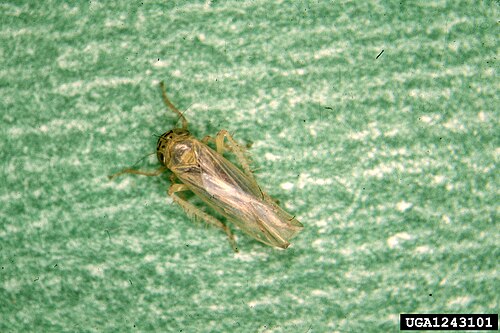
Quadrilineatus leafhoppers are sap-feeding insects that belong to a large and diverse group of plant pests. They are known for their ability to transmit plant diseases, making them particularly damaging in agricultural systems.
The “Four-Lined” Vector: Quadrilineatus Leafhoppers
The Quadrilineatus Leafhopper (Macrosiphum quadrilineatus, often referred to in U.S. agricultural circles as the Four-Lined Leafhopper) is a small but high-impact hemipteran found throughout the Eastern and Midwestern United States. While many leafhoppers are merely “nuisance” pests that cause minor stippling on garden plants, the Quadrilineatus species is a notorious vector for phytoplasmas, including the devastating Aster Yellows disease, which can ruin entire crops of lettuce, carrots, and ornamental flowers.
Identification: The “Racing Stripe” Specialist
Leafhoppers are famous for their “wedge-shaped” bodies and their ability to jump or fly instantly when disturbed. Identifying the Quadrilineatus species requires looking for specific geometric markings on the head and thorax:
- The Four Lines: As the name suggests, the defining characteristic is a set of four dark, longitudinal lines or spots located on the “vertex” (the top of the head between the eyes).
- Coloration: They are typically pale green to yellowish-tan, allowing them to blend perfectly with the veins on the underside of leaves.
- Size: Adults are tiny, usually measuring between 3mm and 4mm. They have a distinct “hunched” appearance when viewed from the side.
- The “Sideways” Scuttle: Like most leafhoppers, if they don’t jump, they will scuttle sideways to the other side of a stem to hide from a predator (or a curious gardener).
The “Aster Yellows” Threat
For Pestipedia.com users, the primary concern isn’t the physical feeding of the leafhopper, but the microscopic bacteria-like organisms they carry. When the leafhopper pierces a plant to suck out the sap, it injects Phytoplasma:
- Phyllody: This is a bizarre symptom where floral parts turn into leaf-like structures. A marigold or daisy infected by a Quadrilineatus leafhopper will grow green, leafy tufts instead of colorful petals.
- Witches’ Broom: The plant may develop a dense, stunted cluster of yellowed branches that look like a broom.
- Economic Ruin: In commercial carrot production, the “yellows” cause the roots to become bitter, hairy, and woody, making them completely unmarketable.
U.S. Agricultural and Garden Management
In the United States, managing these leafhoppers is a challenge because they are highly mobile and often migrate into gardens and fields on wind currents from the South. Management focuses on interference and exclusion:
- Reflective Mulches: In U.S. vegetable production, silver or aluminum-colored plastic mulches are used. The reflected UV light disorients the leafhoppers as they fly, preventing them from landing on the crop.
- Floating Row Covers: For home gardeners, covering susceptible plants like lettuce or asters with a fine “spun-bond” fabric (row cover) is the only 100% effective way to prevent the leafhoppers from transmitting disease.
- Weed Reservoir Removal: Many “noxious” leafhoppers overwinter or feed on common weeds like thistle and wild carrot. Removing these “reservoir hosts” from around the garden perimeter in early spring reduces the local population.
- Yellow Sticky Traps: While not a control method, placing bright yellow sticky cards at canopy level is the standard U.S. way to monitor for the arrival of the first migratory adults.
Identification
Small, wedge-shaped insects with distinct striping patterns.
Life Cycle
Eggs are inserted into plant tissue, and nymphs develop on leaves.
Damage
Leaf discoloration, stunted growth, and disease transmission.
Control
Monitoring, insecticides, and resistant plant varieties.