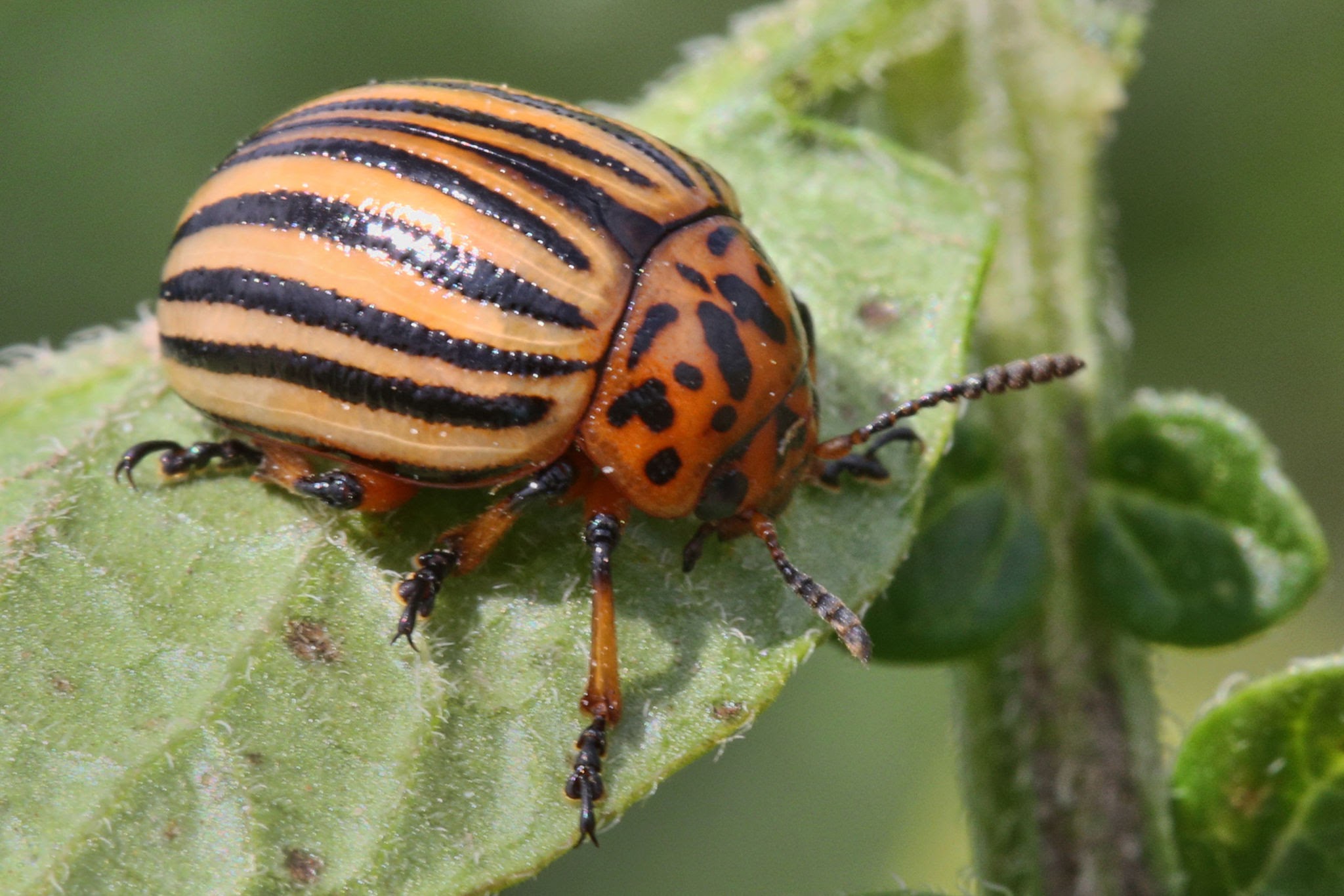
Three-Lined Potato Beetles (Lema daturaphila) are foliage-feeding beetles that primarily attack plants within the nightshade family (Solanaceae). Despite their common name, these insects are often more frequently associated with tomatillos, ground cherries, husk cherries, and related plants than with cultivated potatoes. Both adults and larvae feed on leaves, creating holes, skeletonized foliage, and significant defoliation when populations become large. In home gardens and specialty crop plantings, Three-Lined Potato Beetles can reduce plant vigor, decrease fruit production, and negatively impact ornamental quality. One of the most distinctive characteristics of this species is its unusual larval behavior—young larvae carry a covering of their own excrement and debris on their backs, creating a protective shield against predators.
Taxonomy and Classification
Three-Lined Potato Beetles belong to the order Coleoptera and the family Chrysomelidae, commonly known as leaf beetles.
- Order: Coleoptera
- Family: Chrysomelidae
- Genus: Lema
- Species: Lema daturaphila
As members of the leaf beetle family, both adults and larvae feed externally on plant foliage. They undergo complete metamorphosis consisting of egg, larva, pupa, and adult stages.
Identification
Three-Lined Potato Beetles are among the most visually distinctive beetles found on solanaceous plants.
Adult Beetles
- Size: Approximately 7–8 mm long.
- Body Shape: Slender and elongated.
- Wing Covers: Bright yellow to yellow-orange with three bold black longitudinal stripes.
- Thorax: Orange to reddish with small black markings.
- Legs: Dark colored and relatively long.
Larvae
- Color: Grayish-yellow or pale orange.
- Shape: Soft-bodied and hump-backed.
- Defensive Covering: Carry a shield of moist fecal material and plant debris on their backs.
- Appearance: Often resemble dark sticky blobs rather than typical beetle larvae.
Eggs
- Color: Bright yellow to orange.
- Shape: Elongated and cylindrical.
- Location: Deposited in clusters on leaf undersides.
Distribution and Habitat
Three-Lined Potato Beetles are found throughout much of North America, particularly in regions where host plants are abundant.
Common habitats include:
- Vegetable gardens
- Tomatillo plantings
- Ground cherry patches
- Agricultural fields
- Roadside vegetation
- Ornamental gardens
- Weedy areas containing nightshade plants
Populations often develop where host plants grow continuously throughout the season.
Host Plants
Three-Lined Potato Beetles specialize on members of the nightshade family.
Preferred hosts include:
- Tomatillos
- Ground Cherries
- Husk Cherries
- Jimsonweed
- Sacred Datura
- Potatoes
- Various wild nightshades
Tomatillos are often among the most heavily attacked cultivated plants.
Life Cycle
Three-Lined Potato Beetles undergo complete metamorphosis.
- Egg Stage: Females lay clusters of orange-yellow eggs on leaf undersides.
- Larval Stage: Newly hatched larvae begin feeding immediately and develop their characteristic fecal shields.
- Pupal Stage: Mature larvae drop to the soil and pupate in protected locations.
- Adult Stage: New adults emerge and begin feeding and reproduction.
Depending on climate, multiple generations may occur during a single growing season.
Damage and Symptoms
Both larvae and adults feed directly on leaf tissue.
Adult Feeding Damage
- Irregular holes through leaves.
- Chewed leaf margins.
- Reduced leaf surface area.
Larval Feeding Damage
- Skeletonized foliage.
- Large areas of missing leaf tissue.
- Progressive defoliation.
Young larvae frequently feed in groups, beginning at leaf edges and moving inward.
Heavy infestations may result in:
- Reduced photosynthesis.
- Stunted growth.
- Smaller fruit production.
- Delayed flowering.
- Severe defoliation.
- Reduced crop yields.
The Fecal Shield Defense
One of the most fascinating characteristics of Three-Lined Potato Beetle larvae is their use of a fecal shield.
As larvae feed, they accumulate excrement and plant debris on specialized structures located on their backs.
This unusual defense provides several benefits:
- Discourages predators.
- Masks the larva’s scent.
- Makes identification more difficult.
- Provides some protection from environmental conditions.
The shield often causes larvae to resemble bits of debris rather than living insects.
Behavior and Conflict
Several factors contribute to the pest status of Three-Lined Potato Beetles.
- Group Feeding: Larvae frequently feed in clusters.
- Rapid Defoliation: Populations can strip foliage quickly.
- Host Specialization: Certain crops receive concentrated pressure.
- Multiple Generations: Repeated infestations may occur throughout the season.
- Concealed Larvae: Fecal shields make early detection more difficult.
Young plants are particularly vulnerable because they possess limited foliage reserves.
Monitoring and Detection
Regular scouting is the most effective way to detect infestations before significant damage occurs.
- Inspect leaf undersides for egg clusters.
- Look for striped adult beetles.
- Check for fecal-shielded larvae.
- Monitor for leaf holes and skeletonization.
- Watch susceptible host plants closely during warm weather.
Early intervention can greatly reduce damage.
Management and Prevention
An Integrated Pest Management (IPM) approach provides the most reliable control.
Cultural Controls
- Remove nearby nightshade weeds.
- Rotate crops when practical.
- Destroy crop debris after harvest.
- Maintain healthy plant growth.
Physical Controls
- Hand Removal: Remove adults, larvae, and egg masses.
- Soapy Water: Dispose of collected insects in soapy water.
- Regular Inspection: Prevent population buildup.
Biological Control
- Predatory insects.
- Parasitic wasps.
- Birds.
- Generalist predators.
Natural enemies often help suppress small populations.
Organic Controls
- Neem Oil: Effective against young larvae.
- Insecticidal Soap: May suppress immature stages.
- Diatomaceous Earth: Can reduce larval survival.
- Spinosad: Provides excellent control when properly applied.
Treatments are generally most effective against newly hatched larvae before extensive feeding occurs.
Conservation and Research
Research on Three-Lined Potato Beetles focuses on host-plant relationships, biological control agents, and sustainable management techniques. Scientists continue investigating environmentally friendly approaches that minimize pesticide use while protecting vegetable crops and beneficial insects.
Regular monitoring, weed management, and early intervention remain the most effective methods for preventing damaging infestations in gardens and specialty crop plantings.