Overview
Sunflower Beetles (Zygogramma exclamationis) are among the most important defoliating pests of cultivated and wild sunflowers throughout North America. Both adults and larvae feed extensively on foliage, reducing the plant’s ability to photosynthesize and produce healthy flowers and seeds. Heavy infestations can strip plants of leaves, weaken growth, reduce oil content, and significantly lower yields in commercial sunflower production.
These beetles are particularly problematic across the Great Plains and western sunflower-growing regions, but they can also become serious pests in home gardens and specialty sunflower plantings. Because both life stages feed openly on leaves, infestations can develop rapidly and cause extensive damage before growers realize the severity of the problem.
Unlike root-feeding pests or stem borers that attack hidden plant tissues, sunflower beetles directly remove leaf tissue. This visible feeding injury reduces the plant’s energy production and can impact flowering, seed development, and drought tolerance.
Taxonomy and Classification
Sunflower Beetles belong to the order Coleoptera and the family Chrysomelidae, commonly known as leaf beetles.
- Kingdom: Animalia
- Phylum: Arthropoda
- Class: Insecta
- Order: Coleoptera
- Family: Chrysomelidae
- Genus: Zygogramma
- Species: Zygogramma exclamationis
Sunflower beetles undergo complete metamorphosis with egg, larval, pupal, and adult stages.
Physical Description
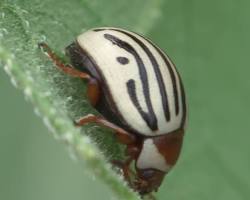
Adult sunflower beetles are easily recognized by their distinctive coloration and markings.
- Adult (Key ID): Oval-shaped beetles measuring 6–8 mm long. Wing covers are pale yellow to cream-colored with four longitudinal brown stripes.
- Exclamation Mark Pattern: The outer stripe often appears broken, creating a small isolated spot that resembles an exclamation point, giving the species its scientific name.
- Larva (Key ID): Hump-backed, soft-bodied grubs that are yellow-green with brown heads and rows of darker spots along the body.
- Eggs: Small yellow-orange eggs deposited in clusters on the undersides of sunflower leaves.
- Conflict: Defoliation, reduced seed production, lower oil content, and weakened plant vigor.
Distribution and Habitat
Sunflower Beetles are native to North America and occur wherever sunflowers are grown.
They are particularly common in:
- North Dakota
- South Dakota
- Minnesota
- Montana
- Nebraska
- Kansas
- Colorado
- Arizona
- Western Canada
Their habitat is closely associated with cultivated sunflowers and wild sunflower species. Adults overwinter in soil and crop residue near previous sunflower plantings.
Life Cycle
Sunflower Beetles generally complete one generation per year.
Overwintering Stage
Adults spend winter hidden in soil, plant debris, and other protected locations.
Spring Emergence
As temperatures warm, adults emerge and begin feeding on newly developing sunflower plants.
Females deposit clusters of eggs on leaf undersides shortly after feeding begins.
Larval Stage
Larvae hatch and begin feeding aggressively on leaves.
This stage causes the majority of plant damage.
Larval development typically lasts several weeks.
Pupal Stage
Mature larvae drop to the soil and pupate underground.
Adult Stage
New adults emerge later in the growing season and continue feeding before seeking overwintering sites.
Damage and Symptoms
Both adults and larvae consume sunflower foliage.
Shot-Hole Feeding
Adults chew numerous small holes through leaves.
This feeding creates a characteristic “shot-hole” appearance.
Skeletonization
Larvae consume soft leaf tissue while leaving major veins intact.
Leaves often appear lacy or skeletonized.
Terminal Bud Damage
Larvae frequently attack developing buds.
This can result in:
- Deformed flower heads
- Reduced flowering
- Poor seed production
- Blind heads with little or no seed formation
Yield Reduction
Heavy defoliation decreases photosynthesis and limits energy available for seed fill.
Commercial fields may experience:
- Reduced seed weight
- Lower oil content
- Smaller flower heads
- Reduced harvest value
Behavior and Ecology
Sunflower Beetles are highly specialized feeders.
- Host Specificity: They primarily feed on cultivated and wild sunflowers.
- Larval Feeding: Larvae often concentrate on younger leaves and developing buds.
- Adult Feeding: Adults feed openly during daylight hours.
- Aggregation: Large numbers can develop on individual plants, causing rapid defoliation.
- Drought Stress Interaction: Damage becomes more severe when plants are already stressed by heat or limited moisture.
Economic Importance
Sunflower Beetles are considered major agricultural pests in many sunflower-producing regions.
Economic losses occur through:
- Reduced photosynthesis
- Lower seed yields
- Reduced oil production
- Delayed plant development
- Increased production costs
Young plants are especially vulnerable because severe early-season feeding can stunt growth and delay flowering.
Management and Control (IPM)
Integrated Pest Management combines monitoring, cultural controls, biological conservation, and targeted treatments.
Monitoring
- Inspect seedlings regularly.
- Look for feeding holes and skeletonized leaves.
- Check leaf undersides for egg clusters.
- Monitor larval populations throughout the growing season.
Cultural Controls
- Rotate crops when possible.
- Destroy post-harvest residue.
- Use appropriate planting dates.
- Promote vigorous plant growth.
Biological Control
Natural enemies help suppress populations.
- Predatory insects
- Ground beetles
- Spiders
- Birds
- Parasitic wasps
Preserving beneficial insects can significantly reduce outbreaks.
Chemical Control
When economic thresholds are exceeded, insecticides may be warranted.
- Treat early larval stages when possible.
- Follow local extension recommendations.
- Avoid applications during peak pollinator activity.
- Use products labeled for sunflower beetle control.
Prevention
- Scout fields regularly.
- Maintain good field sanitation.
- Remove volunteer sunflower plants.
- Preserve natural enemies.
- Monitor for early spring adult emergence.
- Apply controls before severe defoliation occurs.
Research and Conservation
Research continues to focus on economic thresholds, resistant sunflower varieties, biological control agents, and improved integrated pest management strategies. Scientists are also studying how climate variability influences beetle populations and outbreak severity.
Conclusion
Sunflower Beetles are significant defoliating pests capable of reducing sunflower yields through extensive foliage feeding and bud damage. While healthy plants can tolerate moderate feeding, severe infestations can substantially reduce seed production and oil content. Regular scouting, preservation of beneficial insects, and timely management remain the most effective strategies for protecting sunflower crops.