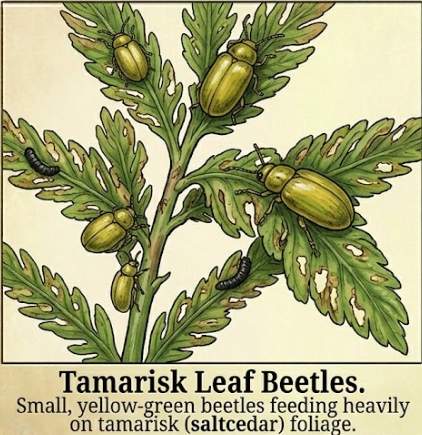
Tamarisk leaf beetles are defoliating insects associated primarily with tamarisk, also known as saltcedar. Depending on the context, they may be viewed either as pests of ornamental or managed tamarisk plantings or as biological control agents where invasive tamarisk is being intentionally suppressed. From a pest-profile standpoint, these beetles are important because they can rapidly remove foliage, reduce plant vigor, and alter the appearance and survival of host shrubs and trees. In settings where tamarisk is desired as an ornamental, windbreak, or stabilizing plant, heavy beetle activity can be highly undesirable.
The significance of tamarisk leaf beetles depends heavily on geography and management goals. In some western landscapes, tamarisk has been widely regarded as invasive, and related beetles have been used as classical biological control agents. In other locations or managed landscapes, however, the same feeding behavior is treated as damage because it strips foliage and weakens the plant. This dual role makes them unusual among the insect groups commonly discussed in pest management.
Where host plants are abundant, beetle populations may build quickly and produce repeated waves of defoliation. Recurrent foliage loss forces the plant to expend energy on regrowth, which over time can reduce survival and resilience. This is especially important in hot dry environments where recovery from defoliation may already be limited by drought stress.
The “Saltcedar-Stripper”: Tamarisk Leaf Beetles
The Tamarisk Leaf Beetle (primarily Diorhabda elongata and Diorhabda carinulata) is a “noxious” and highly specialized “O” bio-control agent that has become a permanent resident of the Southwestern United States. Originally introduced by the U.S. Department of Agriculture to combat invasive Saltcedar (Tamarisk) trees, they are a high-priority “O” concern for land managers and users. These beetles are “monophagous”—they eat *only* Tamarisk. While they are a “hero” species for restoring Arizona riverbanks, they present a complex challenge in the Southwest because they defoliate massive stands of saltcedar, which may be the only remaining nesting habitat for the endangered Southwestern Willow Flycatcher.
Identification: The “Dull-Stripe” Specialist
Identifying Tamarisk Leaf Beetles requires looking for their “flattened” appearance and their specific host-plant preference. For Pestipedia.com users, the yellowish-green color and the two dark stripes are the primary diagnostic keys:
- The Adult: A medium-sized (5mm to 6mm), oblong, yellowish-green beetle. The most identifying feature is two dark brown stripes running down the length of each wing cover (elytra).
- The “Lace-Leaf” Clue: Look for Tamarisk trees in the area that appear “scorched” or “browned-out” in mid-summer. If you shake a branch, hundreds of these small, striped beetles will tumble out.
- The Larva: A caterpillar-like grub (up to 10mm). Young larvae are black, but as they mature, they turn a dark olive-green with a bright yellow stripe down each side. They are usually found in clusters on the fine, needle-like Tamarisk leaves.
- The “Aggregation” Habit: These beetles use powerful aggregation pheromones. In the Arizona desert, you will rarely find just one; you will find thousands concentrated on a single tree, stripping it bare before moving to the next.
The “Scorched-Earth” and “Habitat-Shift” Damage
The “noxious” impact of the Tamarisk Leaf Beetle is the rapid, mechanical defoliation of its host:
- Leaf Skeletonization: Both adults and larvae “scrape” the green tissue from the Tamarisk needles. This causes the needles to turn yellow and then a crispy reddish-brown, giving the tree a “fire-damaged” look in the Southwest sun.
- Resource Depletion: Repeated defoliations (2–3 times per Arizona season) eventually kill the Tamarisk by exhausting its root reserves. This is the goal for riparian restoration but a “noxious” event for those who use Tamarisk as a windbreak.
- Habitat Instability: In the Southwest, the sudden browning of thousands of acres of Saltcedar creates a fire hazard. Dead, dry Tamarisk wood is highly flammable in the Arizona summer, posing a risk to nearby residential properties.
U.S. Bio-Control and “Landscape-Shift” Management
In the United States, managing Tamarisk Leaf Beetles is less about “killing the bug” and more about managing the ecosystem shift they cause. They are protected and promoted in some Arizona areas and considered a nuisance in others.
- The “Succession” Strategy: For Pestipedia.com users, the #1 U.S. management tip is Replanting. If the beetles are stripping the Tamarisk on your property, you must plant Native Willows, Cottonwoods, or Mesquites to take their place. If you don’t, the “O” status void will simply be filled by other invasive weeds like Buffelgrass.
- The “Fire-Break” Audit: If you live near a wash in Arizona with heavy Tamarisk growth, monitor for beetle activity. Once the trees turn brown and “crispy,” they are a major fire risk. Clear a 30-foot “defensible space” around your home to protect against potential “flash-fires” in the dead brush.
- Diatomaceous Earth (The “Garden-Shield”): If you have a specimen Tamarisk tree you wish to save for shade in your Southwest yard, applying Food-Grade DE to the foliage can help deter the larvae. However, the sheer volume of beetles in an Arizona “surge” year often makes chemical control futile.
- Monitoring the “Flycatcher” Window: In the U.S., land managers use Satellite Imagery to track beetle migration. In Arizona, if beetles arrive too early in the spring, they can destroy the nesting canopy for migratory birds, triggering federal “O” status intervention.
- The “Winter-Kill” Myth: Many residents believe the desert cold will kill the beetles. In reality, they are highly cold-hardy and overwinter in the leaf litter beneath the trees, emerging as soon as the Arizona spring hits 60°F.
Identification
Adult tamarisk leaf beetles are small, oval beetles typically yellowish, tan, or brown with darker markings depending on species and maturity. Larvae are smaller, soft-bodied, and often darker with a slightly elongated shape. Eggs may be laid in clusters on tamarisk foliage or nearby tender growth.
The most obvious field sign is defoliation. Affected tamarisk plants may appear thinned, browned, or stripped of their fine foliage. Closer inspection may reveal adults and larvae feeding on the leaves. Frass and ragged-looking foliage may also be present when infestations are active. Repeated defoliation often gives host plants a stressed or scorched look.
Because tamarisk foliage is fine-textured, injury can progress visually very quickly once feeding intensifies. A plant that looks full one week may look sparse or bronzed soon after during peak beetle activity.
Life Cycle
Tamarisk leaf beetles undergo complete metamorphosis through egg, larval, pupal, and adult stages. Females lay eggs on host foliage. Larvae hatch and begin feeding on leaves, progressively consuming more tissue as they grow. Pupation occurs in protected sites, often in litter or around the base of the plant depending on local conditions. Adults emerge and continue the cycle.
Several generations may occur each year in warm climates, particularly where tamarisk remains abundant and environmental conditions are favorable. This repeated generation pattern is what allows beetle populations to create multiple episodes of defoliation across a season. Over time, these repeated attacks can significantly reduce host vigor.
Because adults can disperse between host stands, local management may be complicated if nearby tamarisk remains available and beetle populations are regionally established.
Damage and Impact
The primary injury is defoliation. Larvae and adults feed on foliage, reducing the plant’s ability to photosynthesize and forcing it to draw on stored reserves for regrowth. One episode of defoliation may not kill a large established plant, but repeated seasons of heavy feeding can weaken it substantially. In ornamental or functional plantings, this means loss of screening, reduced aesthetic value, dieback, and possible mortality.
Defoliation may also alter local shade, habitat structure, and moisture dynamics around the plant. In managed landscapes, the visual change can be dramatic. Plants that once provided dense foliage may become thin, brown, and unattractive during active beetle periods.
Where the plant is intentionally maintained, the beetle is clearly a pest. Where the plant is considered invasive, the same injury may be viewed as beneficial. This management context is central to how tamarisk leaf beetles are handled.
Prevention and Control
Control decisions depend heavily on whether the host plant is desired. In ornamental or managed windbreak settings, close monitoring is important during the active season. Small localized infestations may sometimes be reduced through physical removal of heavily infested growth, though this is often impractical on large shrubs or stands.
If chemical protection is justified, treatment timing must target feeding stages before widespread defoliation has occurred. However, such intervention may not be practical or desirable in all regions, especially where beetles are part of broader land management programs. Maintaining overall plant health may improve recovery after feeding, but it will not prevent beetle establishment by itself.
Integrated management includes evaluating whether control is truly necessary in the local ecological context. Where tamarisk is intentionally retained, early monitoring and site-specific protection may be warranted. Where it is invasive, suppression may be accepted or even encouraged.