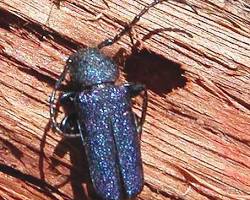
Juniper Wood Borers are destructive wood-boring insects that attack juniper trees and shrubs by tunneling deep into woody tissue. These pests are capable of causing severe structural damage that weakens branches, disrupts nutrient transport, and eventually leads to canopy decline or complete plant death. Several different beetle species may infest junipers, but the most common are longhorned beetles in the family Cerambycidae, particularly species such as Semanotus juniperi.
Unlike bark beetles that feed just beneath the bark, juniper wood borers excavate extensive tunnels deep inside the sapwood and heartwood. Their hidden feeding habits make infestations difficult to detect until visible symptoms appear. Mature ornamental junipers, drought-stressed trees, and aging landscape plants are especially vulnerable to attack.
In dry climates such as the southwestern United States, juniper wood borers are increasingly common in urban landscapes where heat stress, compacted soils, poor irrigation, and pruning injuries weaken host plants. Once larvae establish themselves deep inside the wood, control becomes difficult because the insects are physically protected from most treatments.
Quick Facts
- Common Name: Juniper Wood Borers
- Main Species: Semanotus juniperi
- Family: Cerambycidae
- Main Hosts: Juniper, cedar, cypress
- Primary Damage: Internal wood tunneling
- Key Indicators: Exit holes, frass, dieback
- Risk Factor: Environmental stress
Taxonomy and Classification
Juniper wood borers belong primarily to the beetle family Cerambycidae, commonly known as longhorned beetles.
Scientific Classification
- Kingdom: Animalia
- Phylum: Arthropoda
- Class: Insecta
- Order: Coleoptera
- Family: Cerambycidae
Some additional wood-boring species associated with junipers may also belong to related beetle families such as:
- Buprestidae (metallic wood borers)
- Curculionidae (wood-boring weevils)
Longhorned beetles are named for their unusually long antennae, which can exceed the length of their body in some species.
Physical Description
Adult Beetles
Adult juniper wood borers are medium-sized beetles with elongated bodies and prominent antennae.
- Dark brown or black coloration
- Long segmented antennae
- Hard wing covers
- Subtle gray or pale markings
- Typically 1/2 to 1 inch long
Adults are active flyers and are most commonly seen during spring and early summer.
Larvae
The larval stage causes nearly all structural damage.
- Cream-colored body
- Legless grub appearance
- Rounded body shape
- Dark brown head capsule
- Strong chewing mandibles
Unlike flatheaded borers, these larvae have a more cylindrical or “roundheaded” appearance.
Distribution and Habitat
Juniper wood borers are found throughout regions where junipers and related conifers grow.
Typical Habitats
- Desert landscapes
- Urban ornamental plantings
- Forests
- Parks
- Windbreaks
- Nurseries
They are especially common in:
- Drought-prone areas
- Heat-stressed landscapes
- Overcrowded plantings
- Aging ornamental trees
Preferred Host Plants
- Juniper
- Cedar
- Cypress
- Arborvitae
- Incense cedar
Life Cycle
The life cycle generally takes one to several years depending on environmental conditions and host quality.
Egg Stage
Females lay eggs:
- In bark cracks
- Near pruning wounds
- On stressed branches
- In damaged bark tissue
Fresh injuries strongly attract egg-laying adults.
Larval Development
After hatching, larvae bore deeply into the wood.
As they tunnel, they create:
- Large oval galleries
- Internal chambers
- Extensive structural weakening
The larvae feed continuously on wood tissue while pushing coarse frass outward through cracks and openings.
Pupal Stage
Pupation occurs inside chambers within the wood.
Adult Emergence
Adults chew outward through the bark, creating visible exit holes before beginning the next reproductive cycle.
Behavior and Ecology
Juniper wood borers are considered secondary pests because they most often attack stressed or weakened trees.
Stress Attraction
Adult beetles are highly attracted to:
- Drought stress
- Transplant shock
- Sunscald injury
- Mechanical wounds
- Storm damage
- Poor irrigation
Environmental stress chemicals emitted by weakened trees help guide adult beetles to vulnerable hosts.
Internal Feeding
The larvae remain protected deep inside the wood throughout development. This concealed behavior makes infestations difficult to detect during early stages.
Because they tunnel extensively through structural wood:
- Branches weaken internally
- Nutrient movement declines
- Water transport is interrupted
- Structural stability decreases
Damage and Impact
Juniper wood borers can cause severe and long-lasting injury to ornamental and native trees.
Structural Damage
- Internal tunneling
- Weakened limbs
- Sudden branch failure
- Canopy thinning
- Trunk instability
Physiological Damage
Feeding disrupts the vascular system responsible for:
- Water transport
- Nutrient movement
- Energy storage
As damage progresses:
- Foliage turns brown
- Growth slows
- Entire limbs die back
- The tree becomes vulnerable to secondary pests and disease
Economic Impact
Infestations can lead to:
- Landscape replacement costs
- Loss of mature ornamental trees
- Hazardous branch failures
- Reduced nursery stock value
Signs of Infestation
Visible symptoms often appear only after internal damage becomes extensive.
Common Warning Signs
- Round or oval exit holes
- Accumulations of coarse frass
- Bark cracking
- Sudden branch dieback
- Thinning canopy
- Brown foliage patches
- Loose bark
Frass may accumulate:
- At the base of the tree
- In branch crotches
- Along bark crevices
Woodpecker activity can also indicate hidden larvae inside the tree.
Prevention and Control
Prevention is the most effective management strategy because larvae are protected deep inside wood.
Maintain Tree Health
- Provide deep, consistent watering
- Avoid drought stress
- Mulch properly
- Reduce soil compaction
- Maintain root health
Avoid Tree Injury
Prevent:
- Mechanical bark damage
- Heavy pruning during beetle flight periods
- Construction-related root injury
- Sunscald exposure
Pruning and Sanitation
- Remove heavily infested limbs
- Dispose of infested wood promptly
- Destroy severely damaged branches
Chemical Control
Preventative insecticide treatments may help protect high-value trees when timed before egg laying.
However:
- Systemic insecticides often have limited penetration
- Larvae deep inside wood are difficult to reach
- Late-stage infestations are rarely treatable
Interesting Facts
- Longhorned beetles are named for their exceptionally long antennae.
- Larvae may live inside wood for several years.
- Some species can detect stressed trees using heat and chemical signals.
- Heavy infestations may cause sudden limb drop during storms.
- Wood-boring larvae are important food sources for woodpeckers.
Conservation and Research
Research involving juniper wood borers focuses on:
- Drought-related pest outbreaks
- Improved preventative treatments
- Tree resistance mechanisms
- Biological control methods
- Urban forestry management
Scientists continue studying how climate stress and prolonged drought increase the vulnerability of ornamental junipers to wood-boring beetles.