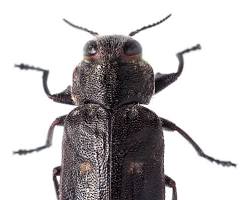
Juniper Flatheaded Borers are destructive wood-boring beetles that attack stressed, injured, or weakened juniper trees and shrubs. These insects belong to the metallic wood-boring beetle family and are closely related to other highly damaging borers that infest ornamental and forest trees throughout North America. Their larvae tunnel beneath the bark and deep into the cambium layer, disrupting the flow of water and nutrients and eventually causing branch dieback, canopy thinning, and even complete plant death.
Several species may infest junipers, but the most commonly associated are species in the genus Chrysobothris, including Chrysobothris sylvania and Chrysobothris texana. These beetles are particularly problematic in dry climates where drought stress weakens landscape plants. In places such as Arizona and the southwestern United States, juniper flatheaded borers are considered major secondary pests that often attack trees already compromised by environmental stress, improper watering, construction injury, or transplant shock.
Although the adult beetles are attractive and metallic in appearance, the larval stage causes severe internal damage that is difficult to detect until symptoms become advanced. Because the larvae remain hidden beneath the bark, infestations frequently go unnoticed until significant structural injury has occurred.
Quick Facts
- Common Name: Juniper Flatheaded Borers
- Scientific Group: Chrysobothris species
- Family: Buprestidae
- Main Hosts: Juniper, cypress, arborvitae
- Primary Damage: Internal wood tunneling
- Key Indicator: D-shaped exit holes
- Risk Factor: Drought-stressed plants
Taxonomy and Classification
Juniper flatheaded borers belong to the family Buprestidae, commonly known as metallic wood-boring beetles or jewel beetles.
Scientific Classification
- Kingdom: Animalia
- Phylum: Arthropoda
- Class: Insecta
- Order: Coleoptera
- Family: Buprestidae
The family contains many important forestry and ornamental pests, including the notorious Emerald Ash Borer. Juniper flatheaded borers are considered opportunistic pests because they usually target weakened trees rather than healthy, vigorous specimens.
Physical Description
The adult beetles are elongated, hard-bodied insects with a distinctive metallic sheen.
Adult Appearance
- Metallic bronze, copper, green, or black coloration
- Flattened, elongated body shape
- Typically 1/4 to 3/4 inch long
- Strong flying ability
- Active during warm daylight hours
Adults are often difficult to notice because they blend into bark and foliage.
Larval Appearance
The larvae are the destructive stage.
- Cream-colored body
- Legless
- Flattened and widened thoracic segment behind the head
- Soft-bodied wood-boring grub
This enlarged flattened area gives the larvae their common name: flatheaded borers.
Distribution and Habitat
Juniper flatheaded borers are commonly found throughout dry and semi-arid regions of North America.
Preferred Habitats
- Desert landscapes
- Urban ornamental plantings
- Drought-stressed forests
- Nurseries
- Golf courses
- Residential landscapes
They are especially problematic in:
- Hot climates
- Areas experiencing drought
- Poorly irrigated landscapes
- Sites with compacted soil
- Plants suffering transplant shock
Host Plants
- Juniper
- Cypress
- Arborvitae
- Cedar
- Other ornamental conifers
Life Cycle
The life cycle typically requires one year, although development may vary depending on climate and host condition.
Egg Stage
Adult females lay eggs in:
- Bark crevices
- Wounded areas
- Sun-scalded bark
- Stress-damaged tissue
Stressed trees emit chemical and thermal signals that attract egg-laying females.
Larval Stage
After hatching, larvae immediately bore into the cambium layer beneath the bark.
Larvae excavate winding galleries packed with:
- Fine frass
- Sawdust-like debris
- Excrement
These tunnels interrupt nutrient and moisture transport throughout the tree.
Pupal Stage
Pupation occurs inside chambers within the wood.
Adult Emergence
Adults chew outward through the bark, creating the characteristic:
- D-shaped exit holes
These exit holes are one of the most important diagnostic signs of infestation.
Behavior and Ecology
Juniper flatheaded borers are often called stress-seekers because they preferentially attack weakened hosts.
Host Detection
Research suggests adult beetles may use:
- Infrared detection
- Chemical stress signals
- Heat signatures
- Volatile compounds from injured wood
These abilities help them locate vulnerable trees from considerable distances.
Internal Feeding
The larvae remain hidden beneath bark throughout development, making infestations difficult to detect and treat.
As galleries expand:
- Water transport is disrupted
- Nutrient flow declines
- Branches become girdled
- Tree stress intensifies
Damage and Impact
Juniper flatheaded borers can cause severe structural injury and plant decline.
Physical Damage
- Branch dieback
- Canopy thinning
- Browning foliage
- Tree decline
- Complete plant death
Gallery Damage
The internal galleries:
- Disrupt cambium tissue
- Prevent nutrient movement
- Reduce water transport
- Weaken structural integrity
Economic Impact
Infestations can result in:
- Loss of ornamental trees
- Expensive landscape replacement
- Reduced nursery value
- Increased maintenance costs
Signs of Infestation
Early detection is difficult because larvae remain hidden inside wood.
Common Indicators
- D-shaped exit holes
- Oozing sap or pitch
- Sudden branch browning
- Canopy thinning
- Loose or cracked bark
- Sawdust-like frass
- Flagging branches turning brown
Woodpecker activity may also increase because birds feed on the larvae beneath the bark.
Prevention and Control
Management focuses heavily on prevention because larvae are protected deep within the wood.
Maintain Plant Health
Healthy trees are far less attractive to borers.
- Deep water during dry periods
- Avoid overwatering
- Prevent root stress
- Mulch appropriately
- Reduce soil compaction
Avoid Mechanical Injury
Prevent:
- String trimmer damage
- Lawn mower wounds
- Construction injury
- Sunscald damage
Fresh injuries strongly attract egg-laying females.
Pruning and Sanitation
- Remove heavily infested branches
- Dispose of infested wood promptly
- Avoid storing weakened wood nearby
Chemical Treatments
Preventative insecticide treatments may help protect valuable trees when timed properly.
Applications are generally most effective:
- Before egg laying
- During adult flight periods
Once larvae are deep inside wood, chemical control becomes much less effective.
Interesting Facts
- Flatheaded borers belong to the jewel beetle family.
- Adults often have metallic, iridescent coloration.
- The larvae create winding S-shaped galleries beneath bark.
- D-shaped exit holes are a classic identification feature.
- Stressed trees are far more vulnerable than healthy trees.
Conservation and Research
Research involving juniper flatheaded borers focuses on:
- Tree stress detection
- Climate-related outbreak patterns
- Improved preventative treatments
- Biological control methods
- Host resistance mechanisms
Scientists continue studying how drought stress and rising temperatures influence borer outbreaks in urban and natural landscapes.