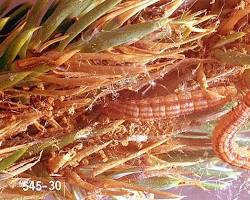
Juniper Root Borers are destructive wood-boring insects that attack the underground root systems of juniper trees and shrubs. Unlike many other pests that damage foliage or branches above ground, root borers remain hidden beneath the soil surface, feeding internally within roots where they may go undetected for long periods. By the time visible symptoms appear, the host plant is often already severely weakened.
Several species of beetles may be classified as juniper root borers, including members of the families Cerambycidae (longhorned beetles) and Buprestidae (metallic wood-boring beetles). The larvae tunnel through woody roots and lower trunks, disrupting the plant’s ability to absorb and transport water and nutrients. In severe infestations, entire shrubs or mature trees may suddenly collapse or die.
These pests are especially problematic in dry and semi-arid climates where junipers already face environmental stress from drought, heat, compacted soils, and poor irrigation practices. Stressed plants are significantly more attractive to egg-laying adult beetles, making preventative care one of the most important management strategies.
Quick Facts
- Common Name: Juniper Root Borers
- Main Groups: Longhorned and metallic wood borers
- Order: Coleoptera
- Primary Hosts: Juniper species
- Main Damage: Root tunneling and vascular disruption
- Key Risk: Drought-stressed plants
- Detection Difficulty: Very high due to underground feeding
Taxonomy and Classification
Juniper root borers belong to several groups of wood-boring beetles.
Scientific Classification
- Kingdom: Animalia
- Phylum: Arthropoda
- Class: Insecta
- Order: Coleoptera
- Families: Cerambycidae / Buprestidae
Depending on the species involved, root borers may be:
- Longhorned beetles with elongated bodies and long antennae
- Metallic wood-boring beetles with iridescent coloration
Although adults differ greatly in appearance, the larval stage is responsible for nearly all plant damage.
Physical Description
Adult Beetles
Adult root borers vary depending on species but generally share several features:
- Elongated beetle body shape
- Brown, black, bronze, or metallic coloration
- Strong flying ability
- Hard wing covers
- Medium-sized appearance
Some species are highly noticeable due to metallic coloration, while others blend into bark and soil environments.
Larvae
Larvae are the destructive stage and remain hidden underground.
- Creamy white body
- Legless grub form
- Brown head capsule
- Strong chewing mandibles
- Soft segmented body
Larvae are rarely observed unless:
- Roots are excavated
- Infested plants are removed
- Severe damage exposes root tissue
Distribution and Habitat
Juniper root borers are found wherever junipers grow, particularly in dry and semi-arid regions.
Common Habitats
- Residential landscapes
- Urban parks
- Natural desert environments
- Commercial landscapes
- Golf courses
- Nurseries
These pests are especially common in:
- Drought-prone climates
- Poorly irrigated landscapes
- Compacted soils
- Overheated root zones
- Stressed ornamental plantings
Host Plants
- Juniper shrubs
- Juniper trees
- Cypress relatives
- Other ornamental conifers
Life Cycle
The life cycle may require one to several years depending on species and environmental conditions.
Egg Stage
Adult females lay eggs:
- Near the base of host plants
- In soil cracks
- Around root crowns
- Near injured root tissue
Moisture stress and root injury strongly increase susceptibility.
Larval Feeding
After hatching, larvae burrow directly into roots and lower trunk tissue.
As they feed:
- Water absorption declines
- Nutrient transport becomes disrupted
- Structural roots weaken
- Root decay may increase
Larval feeding may continue underground for months or years before adult emergence.
Pupal Stage
Pupation occurs:
- Inside root tunnels
- Within surrounding soil
- Near the root crown
Adult Emergence
Adults emerge from the soil and seek weakened host plants for reproduction.
Behavior and Ecology
Juniper root borers are highly specialized pests adapted to locating weakened hosts.
Stress-Seeking Behavior
Adult beetles preferentially target:
- Drought-stressed plants
- Recently transplanted shrubs
- Mechanically injured roots
- Heat-damaged landscapes
- Poorly drained soils
Environmental stress signals released by roots help attract egg-laying females.
Hidden Feeding
Because the larvae remain underground:
- Infestations are difficult to diagnose
- Damage progresses unnoticed
- Treatment becomes difficult once symptoms appear
This hidden feeding habit makes root borers among the most challenging juniper pests to manage.
Damage and Impact
Root boring larvae can severely weaken or kill junipers by destroying the underground support and transport system.
Root Damage
- Internal root tunneling
- Reduced root strength
- Disrupted nutrient uptake
- Water transport failure
- Secondary fungal infections
Above-Ground Symptoms
Because the roots are damaged first, foliage symptoms often resemble drought stress.
- Yellowing foliage
- Wilting
- Sparse canopy growth
- Branch dieback
- Sudden decline
- Complete plant death
In severe cases:
- Plants may topple due to weakened roots
- Large shrubs may collapse during storms or high winds
Economic Impact
Juniper root borers can cause:
- Loss of mature landscape plants
- Replacement expenses
- Nursery stock losses
- Reduced property aesthetics
- Long-term landscape decline
Signs of Infestation
Because infestations occur below ground, early warning signs are often subtle.
Common Indicators
- Unexplained decline
- Yellowing or browning foliage
- Poor new growth
- Canopy thinning
- Sudden dieback
- Loose or weakened root systems
Closer inspection may reveal:
- Larval tunnels in roots
- Frass around root crowns
- Internal root decay
- Larvae inside woody roots
Prevention and Control
Prevention is the most effective approach because underground larvae are difficult to eliminate.
Maintain Plant Health
- Provide deep, consistent watering
- Avoid chronic drought stress
- Improve soil drainage
- Reduce soil compaction
- Mulch around root zones properly
Avoid Root Injury
Prevent:
- Construction damage
- Root cutting
- Overcultivation
- String trimmer injury
- Excessive soil disturbance
Sanitation
- Remove severely infested plants
- Destroy infested root systems
- Dispose of dead wood promptly
Professional Treatment
Severe infestations may require:
- Professional soil treatments
- Systemic insecticides
- Root-zone management
- Complete plant replacement
However, treatments are often less effective once larvae are deep within large root systems.
Interesting Facts
- Root borers can feed underground for several years.
- Damage is frequently mistaken for drought or nutrient deficiency.
- Healthy junipers are far less likely to become infested.
- Adult beetles are often attracted to heat-stressed landscapes.
- Many root borers belong to the same beetle groups as major forest pests.
Conservation and Research
Research involving juniper root borers focuses on:
- Drought-related pest outbreaks
- Root-zone health management
- Improved early detection methods
- Biological control agents
- Climate stress interactions
Scientists continue studying how environmental stress weakens ornamental landscapes and increases vulnerability to underground wood-boring insects.