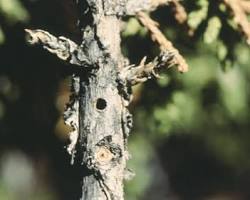
Juniper Twig Beetles are small wood-boring insects that attack the smaller branches and twigs of juniper trees. These pests are often secondary invaders, targeting weakened or stressed plants, but can still cause significant damage when populations are high.
The juniper twig beetle (Phloeosinus serratus) is a specialized bark beetle that targets the smaller, outer branches of juniper and related conifer species. Unlike larger bark beetles that attack the main trunk, this species focuses on twigs and branch tips, making it a primary cause of what is commonly referred to as “branch flagging.” In areas like Tucson and surrounding high-desert regions, this damage is frequently observed as scattered green twigs suddenly turning a bright reddish-brown.
Although juniper twig beetles are a natural part of the ecosystem, they are considered opportunistic pests in residential landscapes. They tend to seek out trees that are already weakened by environmental stressors such as drought, root damage, improper watering, or recent pruning. Once a suitable host is found, the beetles bore into small branches, disrupting the flow of water and nutrients, which leads to rapid dieback of affected twigs.
Taxonomy and Classification
- Kingdom: Animalia
- Phylum: Arthropoda
- Class: Insecta
- Order: Coleoptera (Beetles)
- Suborder: Polyphaga
- Superfamily: Curculionoidea
- Family: Curculionidae (True Weevils)
- Subfamily: Scolytinae (Bark Beetles)
- Genus: Phloeosinus
Common Species
- Phloeosinus serratus
Identification
Adult beetles are tiny and dark-colored, while larvae are white grubs that feed inside twigs. Their presence is often indicated by small holes and internal tunneling.
Habitat and Distribution
These beetles are found wherever juniper trees grow, especially in dry climates.
Life Cycle
Eggs are laid inside twigs, where larvae feed and develop before emerging as adults.
Damage and Impact
Infested twigs may die back, leading to thinning foliage and weakened plants.
Signs of Infestation
Dead or dying twigs, exit holes, and frass are common indicators.
Prevention and Control
Pruning affected branches and maintaining plant health are key control methods.