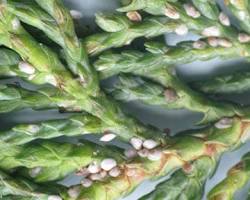
Juniper Soft Scales are sap-feeding insects that attach themselves to the stems, twigs, and foliage of juniper plants. These pests are particularly damaging because they extract large amounts of plant sap while simultaneously producing sticky honeydew that promotes the growth of black sooty mold. Over time, infestations can weaken junipers, reduce growth, discolor foliage, and significantly damage the ornamental appearance of landscape plants.
One of the most common species affecting junipers is Parthenolecanium fletcheri, commonly known as the Fletcher Scale. These insects belong to the family Coccidae, commonly called soft scales. Unlike armored scales, soft scales possess a protective outer covering that is integrated into their body rather than a separate wax shield.
Juniper soft scales are especially problematic in warm, dry climates where stressed ornamental plants are already vulnerable to insect attack. In residential landscapes, they are frequently overlooked because the adult females resemble natural bark bumps or juniper buds. Heavy infestations often remain hidden until visible symptoms such as yellowing foliage, sticky residue, or black fungal growth become widespread.
Quick Facts
- Common Name: Juniper Soft Scales
- Main Species: Parthenolecanium fletcheri
- Family: Coccidae
- Primary Hosts: Juniper, arborvitae, yew
- Main Damage: Sap loss and honeydew production
- Key Indicators: Sticky residue and sooty mold
- Most Vulnerable Stage: Crawler stage
Taxonomy and Classification
Juniper soft scales belong to the family Coccidae, one of the most important groups of soft-bodied scale insects.
Scientific Classification
- Kingdom: Animalia
- Phylum: Arthropoda
- Class: Insecta
- Order: Hemiptera
- Family: Coccidae
Soft scales are closely related to:
- Aphids
- Mealybugs
- Armored scales
- Whiteflies
All belong to the order Hemiptera and feed using specialized piercing-sucking mouthparts.
Physical Description
Adult Females
Adult female soft scales appear as rounded, immobile bumps attached to plant surfaces.
- Glossy brown, tan, or yellow coloration
- Hemispherical or dome-shaped body
- Smooth, leathery surface
- Typically 1/8 to 1/4 inch long
Their coloration and shape often camouflage them against juniper bark and buds.
Crawlers
The newly hatched crawler stage is:
- Tiny
- Yellowish or pale orange
- Highly mobile
- The primary dispersal stage
This is also the stage most vulnerable to treatment.
Males
Adult males are:
- Small
- Winged
- Short-lived
- Rarely noticed
Distribution and Habitat
Juniper soft scales are found throughout regions where ornamental junipers and related conifers are cultivated.
Common Habitats
- Residential landscapes
- Commercial landscapes
- Nurseries
- Parks
- Urban plantings
- Garden centers
These insects thrive in:
- Warm climates
- Dry conditions
- Dense plant growth
- Poorly ventilated foliage
- Stressed ornamental plantings
Host Plants
- Juniper
- Arborvitae
- Yew
- Cypress relatives
- Other ornamental conifers
Life Cycle
Juniper soft scales undergo incomplete metamorphosis and may produce one or more generations annually depending on climate.
Egg Stage
Adult females lay eggs beneath their protective body covering.
A single female may produce:
- Hundreds of eggs
Crawler Stage
The eggs hatch into mobile crawlers that move across the plant searching for feeding sites.
This stage usually occurs:
- In late spring or early summer
Once settled:
- The crawlers insert feeding mouthparts
- Become immobile
- Develop protective coverings
Adult Stage
Adult females remain stationary while continuously feeding on plant sap.
During feeding:
- Large quantities of honeydew are excreted
- Plant stress gradually increases
Behavior and Ecology
Juniper soft scales are persistent sap-feeding insects that thrive on stressed ornamental plants.
Sap Feeding
The insects feed by inserting needle-like mouthparts into:
- Twigs
- Needles
- Young stems
Continuous feeding removes:
- Water
- Nutrients
- Plant sugars
Honeydew Production
Soft scales produce large amounts of:
- Sticky honeydew
This sugary waste coats:
- Foliage
- Branches
- Sidewalks
- Cars
- Landscape surfaces
Ant Associations
Honeydew strongly attracts ants, which often:
- Protect scales from predators
- Attack beneficial insects
- Increase infestation severity
Damage and Impact
Juniper soft scales can cause both direct feeding injury and indirect fungal problems.
Direct Feeding Damage
- Yellowing foliage
- Reduced vigor
- Needle drop
- Branch dieback
- Slow growth
Severe infestations may eventually kill weakened plants.
Sooty Mold Growth
Honeydew serves as a food source for black fungi known as:
- Sooty mold
This fungus:
- Coats foliage black
- Blocks sunlight
- Reduces photosynthesis
- Ruins ornamental appearance
Landscape Impact
Heavy infestations may result in:
- Declining ornamental value
- Increased maintenance costs
- Replacement expenses
- Persistent sticky residue problems
Signs of Infestation
Juniper soft scale infestations are often diagnosed through indirect symptoms.
Common Indicators
- Sticky honeydew on foliage
- Black sooty mold
- Clusters of brown bumps on stems
- Yellowing needles
- Branch dieback
- Heavy ant activity
- Reduced plant vigor
The scales themselves are frequently mistaken for:
- Natural bark texture
- Plant buds
- Resin droplets
Prevention and Control
Successful management requires targeting the vulnerable crawler stage and maintaining overall plant health.
Monitoring Crawlers
Crawler emergence is the most important treatment period.
Monitoring methods include:
- Sticky tape traps on branches
- Visual inspections
- Checking new growth regularly
Horticultural Oils
Horticultural oils are highly effective because they:
- Smother scales
- Penetrate protective coatings
- Reduce crawler survival
Dormant oil applications during cooler seasons are commonly used on heavily infested plants.
Insecticidal Soaps
Insecticidal soaps are most effective against:
- Mobile crawlers
Multiple treatments may be necessary for full control.
Systemic Treatments
Systemic insecticides may be used for severe infestations on valuable ornamental plants.
These products are absorbed into the plant’s vascular system and ingested during feeding.
Encourage Natural Predators
Beneficial insects that help control scales include:
- Lady beetles
- Lacewings
- Parasitic wasps
Reducing ant activity improves predator effectiveness.
Interesting Facts
- Soft scales excrete much more honeydew than armored scales.
- Adult females become permanently attached to the plant.
- Heavy ant activity is often the first sign of infestation.
- Sooty mold itself does not infect plant tissue but blocks sunlight.
- Juniper soft scales are among the most common ornamental scale pests in dry climates.
Conservation and Research
Research involving juniper soft scales focuses on:
- Improved crawler detection methods
- Biological control strategies
- Reduced pesticide use
- Systemic treatment effectiveness
- Climate-related population changes
Scientists continue studying how drought stress and urban landscape conditions increase susceptibility to scale infestations in ornamental conifers.