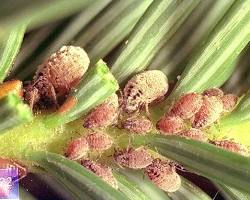
Juniper Aphids are small sap-feeding insects that infest juniper shrubs and trees. These pests can weaken plants by extracting nutrients and promoting the growth of sooty mold through honeydew production.
Juniper aphids, primarily insects in the genus Cinara, are specialized sap-feeding pests that commonly infest junipers, cedars, and cypresses in ornamental landscapes. Unlike the bright green aphids many gardeners associate with flowers and vegetables, juniper aphids are often much harder to spot because their bodies blend in with bark, stems, and evergreen foliage. They may appear grayish-brown, reddish-brown, or nearly black, allowing dense colonies to remain hidden deep inside shrubs until visible plant damage begins to appear. These insects are often referred to as giant bark aphids because they are noticeably larger than many other aphid species and tend to gather along woody stems and interior branches rather than clustering only on fresh new growth.
Juniper aphids can become a serious nuisance for homeowners when infestations build up unnoticed. Their feeding weakens branches, discolors foliage, and contributes to canopy thinning over time. In addition to direct feeding damage, they also produce large quantities of sticky honeydew, which can create secondary problems such as ant activity and black sooty mold growth on needles and stems. In dry regions such as Tucson, infestations are often more noticeable during the cooler parts of the year, particularly in spring and fall, when conditions are more favorable for aphid activity.
Taxonomy and Classification
- Kingdom: Animalia
- Phylum: Arthropoda
- Class: Insecta
- Order: Hemiptera
- Suborder: Sternorrhyncha
- Superfamily: Aphidoidea
- Family: Aphididae
- Genus: Cinara
Identification and Appearance
Juniper aphids are soft-bodied insects that typically live in dense colonies hidden along the inner stems and branches of host plants. Their coloration usually helps them blend into conifer bark and foliage, making them easy to overlook during early infestations. Depending on the species, they may appear gray, reddish-brown, dark brown, or black. Compared to many common garden aphids, they are relatively large and elongated, which is why they are frequently described as giant bark aphids.
Because these pests tend to stay in the interior of the shrub, homeowners often notice the effects of feeding before they spot the aphids themselves. Colonies may gather in protected areas with limited airflow, especially on older growth and woody stems. Their hidden feeding behavior allows populations to build quietly until sections of the plant begin to lose vigor.
Signs of Infestation and Damage
One of the earliest and most common signs of a juniper aphid infestation is the yellowing or browning of interior needles. As the aphids feed on sap, they weaken the plant’s ability to move nutrients and moisture through affected branches. Over time, this may lead to branch dieback, thinning foliage, and a generally unhealthy appearance. In severe cases, sections of the shrub may look sparse, dry, or patchy.
Juniper aphids also excrete large amounts of honeydew, a sticky sugary substance that coats stems, needles, and nearby surfaces. This honeydew attracts ants, which often protect the aphids from beneficial predators in exchange for the sugary food source. The residue also encourages the development of sooty mold, a dark fungal growth that can turn evergreen foliage black and reduce the plant’s ornamental value. While sooty mold does not directly feed on the plant, it can interfere with photosynthesis and make infested shrubs look neglected and unhealthy.
In hot desert climates, infestation patterns may shift with the seasons. Populations often increase during cooler periods in spring and fall, while extreme summer heat may naturally reduce their numbers. Even so, established hedges and ornamental junipers should still be checked regularly, especially if previous aphid problems have occurred.
Host Plants
Juniper aphids are most often associated with ornamental junipers, but they may also infest other conifers in the cypress family, including certain cedars and cypresses. Landscape plants that are stressed by drought, poor pruning practices, crowded spacing, or inconsistent irrigation may be more vulnerable to noticeable damage. Dense evergreen hedges are particularly attractive because they provide sheltered interior branches where aphid colonies can remain protected from wind and casual inspection.
Management and Control
Management of juniper aphids is usually straightforward when infestations are discovered early. For light infestations, a strong spray of water from a garden hose can often knock aphids off the plant and significantly reduce their numbers. Because these insects are soft-bodied, physical removal can be very effective when repeated as needed. It is important to direct the spray into the interior of the shrub where colonies are actually hiding, rather than only rinsing the outer foliage.
For heavier infestations, horticultural oils and insecticidal soaps are commonly used control options. These treatments work best when applied thoroughly, with special attention given to the inner branches and stems where aphids cluster. Complete coverage is important, since hidden colonies may survive if only the outer layer of foliage is treated. Applications should be made according to label directions, especially during periods of temperature stress, to avoid plant injury.
Encouraging natural predators is also an important long-term management strategy. Beneficial insects such as lady beetles, lacewings, and other aphid-feeding predators can help keep populations under control when broad-spectrum insecticides are avoided. Reducing ant activity may also improve biological control, since ants often interfere with predators that would otherwise feed on the aphids. In many landscapes, a combination of monitoring, water sprays, selective treatment, and support for beneficial insects provides the best results.
Prevention Tips
- Inspect interior branches of junipers and related evergreens regularly, especially during spring and fall.
- Watch for yellowing inner needles, sticky honeydew, ant trails, and black sooty mold.
- Prune dense growth when appropriate to improve airflow and make inspections easier.
- Avoid unnecessary use of broad-spectrum insecticides that may kill beneficial predators.
- Keep landscape plants healthy with proper watering and general care to reduce stress.
Identification
They are tiny, soft-bodied insects, typically green or brown, found clustered on new growth.
Habitat and Distribution
Common in landscapes and natural areas where junipers grow.
Life Cycle
Aphids reproduce rapidly, often without mating, leading to large populations.
Damage and Impact
They cause yellowing needles, reduced growth, and sticky residue.
Signs of Infestation
Clusters of aphids and honeydew are key indicators.
Prevention and Control
Natural predators and insecticidal soaps help control infestations.