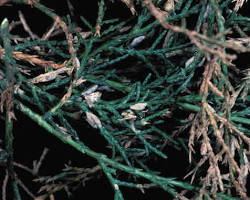
Juniper Leafminers are internal-feeding insect pests that attack juniper foliage by tunneling inside needles and scale-like leaves. Because the larvae remain protected within plant tissue, they are difficult to detect and often resistant to conventional surface treatments. Although individual mines may seem minor at first, severe infestations can cause widespread discoloration, thinning foliage, branch dieback, and long-term stress in ornamental juniper plantings.
Several species of moths and flies may be referred to as juniper leafminers, depending on the region and host plant involved. These insects are particularly problematic in ornamental landscapes, nurseries, and hedges where junipers are valued for their dense evergreen appearance. Once established, populations can spread rapidly through closely planted shrubs and stressed landscape environments.
Unlike external feeders that chew visible holes in foliage, leafminers consume plant tissue from within the needle or leaf itself. This hidden feeding habit protects the larvae from predators, weather exposure, and many pesticides, making early detection and monitoring essential for successful management.
Quick Facts
- Common Name: Juniper Leafminers
- Primary Hosts: Juniper species
- Main Damage: Internal leaf mining and foliage discoloration
- Order: Lepidoptera or Diptera (varies by species)
- Habitat: Ornamental landscapes, nurseries, natural juniper stands
- Key Symptoms: Browning foliage, mined needles, thinning branches
- Most Active: Spring through summer
Taxonomy and Classification
Juniper leafminers are not a single species but rather a group of internal-feeding insects capable of mining juniper foliage.
Scientific Classification
- Kingdom: Animalia
- Phylum: Arthropoda
- Class: Insecta
- Order: Lepidoptera / Diptera
- Family: Various
Depending on the species, the adult stage may be:
- A tiny moth
- A small fly
- A specialized foliage-mining insect
All species share one important characteristic: the larvae develop and feed entirely inside plant tissue.
Physical Description
Juniper leafminers are difficult to observe directly because most of their life cycle occurs inside the foliage.
Larvae
- Small and worm-like
- Pale yellow, cream, or greenish
- Hidden inside needles or foliage scales
- Protected from external threats
The larval stage is responsible for nearly all plant damage.
Adults
Adult leafminers vary by species.
- Small moths with narrow wings
- Tiny flies with delicate bodies
- Usually less than 1/4 inch long
- Short-lived and often unnoticed
Adults primarily exist to mate and lay eggs on suitable host foliage.
Leaf Mines
The feeding tunnels inside foliage are the most obvious sign of infestation.
Mined foliage may appear:
- Yellowed
- Brown
- Blotchy
- Wilted
- Hollowed out
Distribution and Habitat
Juniper leafminers occur wherever juniper plants are grown.
Common Environments
- Residential landscapes
- Commercial plantings
- Nurseries
- Windbreaks
- Parks
- Natural juniper woodlands
They are especially common in:
- Warm climates
- Dry regions
- Dense ornamental plantings
- Stressed landscapes
Preferred Host Plants
- Juniper shrubs
- Groundcover junipers
- Ornamental juniper trees
- Certain cypress relatives
Closely spaced plantings can encourage rapid spread between shrubs.
Life Cycle
Juniper leafminers develop through complete metamorphosis.
Egg Stage
Adult females deposit eggs directly onto foliage.
Eggs are usually laid:
- Near needle bases
- On young growth
- In protected foliage areas
Larval Stage
After hatching, larvae tunnel directly into the foliage.
Once inside, they feed internally on plant tissues.
This stage may last:
- Several weeks
- Entire growing seasons
- Longer in cooler climates
Because larvae remain hidden, infestations often progress unnoticed.
Pupal Stage
Pupation may occur:
- Inside mined foliage
- Within silken cocoons
- In nearby plant debris
Adult Emergence
Adults emerge during warm periods and begin mating shortly afterward.
Multiple generations may occur annually in favorable climates.
Behavior and Ecology
Juniper leafminers are highly specialized foliage feeders adapted to concealed development inside plant tissue.
Internal Feeding
Larvae consume chlorophyll-rich tissues from inside the foliage, disrupting:
- Photosynthesis
- Water movement
- Nutrient flow
This hidden feeding habit provides strong protection against:
- Predators
- Rain
- Extreme temperatures
- Many insecticides
Stress Association
Infestations are often more severe on:
- Drought-stressed plants
- Poorly maintained shrubs
- Overcrowded landscapes
- Improperly irrigated junipers
Healthy plants are generally more resistant to long-term damage.
Damage and Impact
Juniper leafminers damage plants by destroying internal foliage tissues.
Direct Damage
- Needle browning
- Yellowing foliage
- Branch thinning
- Reduced vigor
- Premature needle drop
- Stunted growth
Severe Infestations
Heavy infestations may cause:
- Widespread canopy discoloration
- Dead branch tips
- Loss of ornamental value
- Increased susceptibility to drought and disease
Long-term infestations can weaken plants enough to attract secondary pests such as borers and bark beetles.
Landscape Problems
Juniper leafminers are particularly damaging in:
- Formal hedges
- Foundation plantings
- Commercial landscapes
- Nursery production
Even moderate foliage discoloration can significantly reduce the aesthetic value of ornamental shrubs.
Signs of Infestation
Early symptoms are often subtle and easily mistaken for environmental stress.
Common Signs
- Yellow or brown foliage tips
- Visible internal mines
- Hollowed needles
- Patchy discoloration
- Premature needle drop
- Thin or sparse foliage
Closer inspection may reveal:
- Tiny larvae inside foliage
- Exit holes from emerging adults
- Pupal cases attached to needles
Prevention and Control
Successful management relies heavily on early detection and maintaining plant health.
Pruning
Remove and destroy infested branches before adult emergence.
Pruning helps:
- Reduce populations
- Improve airflow
- Prevent spread
Plant Health
Healthy junipers are better able to tolerate minor infestations.
Important preventive practices include:
- Proper irrigation
- Avoiding drought stress
- Improving soil drainage
- Reducing overcrowding
- Avoiding excessive pruning stress
Chemical Control
Systemic insecticides may help control larvae feeding inside foliage.
Because larvae are protected within the plant tissue, timing treatments correctly is essential.
Applications targeting newly hatched larvae before they enter foliage are often most effective.
Monitoring
Inspect junipers regularly during spring and summer for:
- Fresh discoloration
- Mining symptoms
- Adult activity
- Thinning foliage
Early intervention greatly improves control success.
Interesting Facts
- Leafminers spend most of their lives hidden inside plant tissue.
- Internal feeding protects them from many predators.
- Several unrelated insect groups evolved leaf-mining behavior independently.
- Heavy infestations may mimic drought stress symptoms.
- Juniper leafminers are especially problematic in ornamental landscapes.
Conservation and Research
Research involving juniper leafminers focuses on:
- Improved monitoring techniques
- Biological control agents
- Systemic treatment effectiveness
- Landscape stress factors
- Integrated pest management strategies
Scientists continue studying how drought, urban heat, and dense ornamental plantings influence leafminer outbreaks in modern landscapes.