Overview
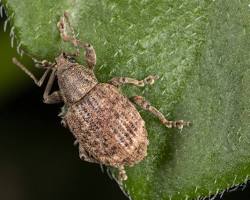
Garden weevils are plant-feeding beetles in the family Curculionidae, a large group recognized by the elongated snout, or rostrum, found on many species. In gardens, the term often refers broadly to weevils that attack ornamental plants, vegetables, fruiting plants, and container specimens. They can be frustrating pests because both adults and larvae may damage plants, though they usually do so in different ways. Adults tend to chew leaves, buds, and tender stems, while larvae live in the soil and feed on roots, crowns, or underground plant parts. This two-stage attack can weaken plants from both above and below the soil line.
Many garden weevils are nocturnal. During the day, adults hide in soil cracks, mulch, plant debris, under pots, or in sheltered crevices. At night, they climb onto plants and feed, often leaving behind irregular notches along leaf edges. Gardeners sometimes notice the damage long before they ever see the beetles responsible. Larvae can be even harder to detect because they remain underground and may only be discovered after a plant wilts, declines, or dies unexpectedly. Potted plants, strawberries, ornamentals, and small shrubs can be especially vulnerable where root feeding is severe.
Identification
Adult garden weevils are usually small to medium-sized beetles with compact bodies and a distinct snout. Depending on the species, they may be brown, gray, black, or mottled. Some have rough or scaled wing covers that help them blend into bark, mulch, or soil. They are not strong fliers in many cases, and some common pest species are flightless, which means they spread mainly by crawling and through the movement of infested plants or soil.
The larvae are soft-bodied, pale, legless grubs with curved bodies and brownish heads. They are found in the soil around roots and crowns. Above-ground signs include scalloped leaf edges, missing buds, chewed foliage, and general plant decline. Below-ground feeding may cause poor growth, yellowing, wilting, and weak root systems.
Habitat
Garden weevils occupy a wide range of habitats including flower beds, vegetable gardens, nursery stock, lawns, container plantings, greenhouse environments, and landscaped borders. They prefer areas that provide daytime shelter and nighttime access to host plants. Mulch, dense groundcovers, overgrown borders, and moist soil all help support populations.
Larvae thrive in soil near susceptible plants, especially where irrigation or organic matter keeps conditions favorable. In established gardens, weevils may persist year after year if host plants remain in place and there is little disruption to their life cycle.
Behavior and Damage
Adult feeding usually appears as irregular chewing along leaf margins. While a little feeding may be mainly cosmetic, repeated attacks can reduce plant vigor and deform new growth. On ornamentals, even minor damage may lower the plant’s visual appeal. On edible crops or nursery stock, the impact may be more serious.
Larval feeding is often the most damaging stage. By consuming fine roots or larger crown tissues, larvae interfere with water and nutrient uptake. Plants may wilt even when soil is moist, grow poorly, or collapse entirely. Young plants, transplants, and container-grown specimens are at especially high risk because they have limited root reserves.
Prevention and Control
Good sanitation helps reduce weevil habitat. Remove unnecessary debris, check under pots and boards, and inspect plants that show nighttime feeding damage. Hand-picking adults after dark with a flashlight can be effective for small infestations. Trapping adults around container rims or sheltered hiding spots may also help.
Because larvae live in the soil, root-zone management is important. Beneficial nematodes are often used against soil-dwelling larvae in gardens and containers. Avoid overwatering susceptible plants and inspect nursery plants before introducing them to the landscape. In persistent infestations, targeted treatments may be necessary, but healthy plants, reduced hiding places, and careful monitoring remain the foundation of long-term control.
Taxonomy
- Kingdom: Animalia
- Phylum: Arthropoda
- Class: Insecta
- Order: Coleoptera
- Family: Curculionidae