Overview
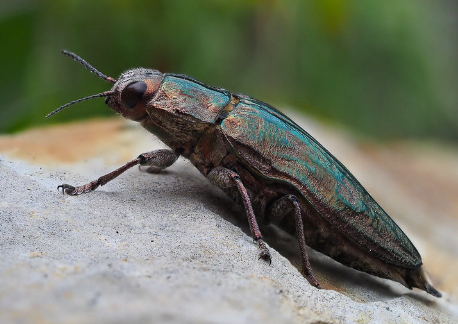
The Flatheaded Pine Borer (Chalcophora angulicollis), also known as the Western Sculptured Pine Borer, is a large wood-boring beetle belonging to the family Buprestidae. This species is one of the most recognizable metallic wood-boring beetles in western North America due to its impressive size and heavily sculptured appearance. The larval stage is responsible for extensive tunneling damage beneath bark and within wood tissues of pine and fir trees.
Flatheaded Pine Borers are considered secondary pests because they primarily attack trees that are already weakened, dying, drought-stressed, fire-damaged, or recently felled. Healthy vigorous trees are generally resistant to infestation. However, once a tree becomes stressed, adult females are attracted to weakened bark surfaces where they deposit eggs.
The larvae tunnel extensively beneath the bark and into sapwood, disrupting the movement of water and nutrients while also reducing timber quality. In forest ecosystems, these beetles contribute to decomposition and nutrient cycling, but in commercial forestry, landscaping, and urban environments they are considered economically important pests.
Taxonomy and Classification
- Kingdom: Animalia
- Phylum: Arthropoda
- Class: Insecta
- Order: Coleoptera
- Family: Buprestidae
- Genus: Chalcophora
- Species: Chalcophora angulicollis
- Common Names: Flatheaded Pine Borer, Western Sculptured Pine Borer
The Flatheaded Pine Borer belongs to the family of metallic wood-boring beetles known for their iridescent coloration and destructive larval wood-boring habits.
Like other Buprestid beetles, they undergo complete metamorphosis through four developmental stages:
- Egg
- Larva
- Pupa
- Adult beetle
The larval stage is the destructive wood-boring phase responsible for structural damage to trees and timber.
Physical Description
Adult Flatheaded Pine Borers are among the largest metallic wood-boring beetles found in western forests.
Adults may reach:
- 1 to 1.25 inches in length
Key identifying features include:
- Elongated bullet-shaped body
- Dark gray, bronze, or black metallic coloration
- Distinct raised sculptured ridges
- Indented iridescent markings
- Hard armored wing covers
- Strong chewing mouthparts
The heavily textured body surface closely resembles rough pine bark, providing excellent camouflage.
The larvae possess the classic “flatheaded” appearance characteristic of Buprestid borers.
Larval features include:
- Creamy white coloration
- Legless body
- Broad flattened segment behind the head
- Strong dark mouthparts
- Elongated segmented body
The widened thoracic region gives the larva its distinctive flatheaded appearance.
Identification Signs
Several visible symptoms indicate Flatheaded Pine Borer activity.
- D-shaped exit holes in bark
- Large oval larval galleries
- Sap flow from bark
- Loose or cracked bark
- Accumulations of frass (borer dust)
- Canopy thinning
- Branch dieback
The characteristic D-shaped exit holes are among the most reliable identification features of Buprestid beetles.
The larval tunnels are packed with fine powdery frass and may extend deep into sapwood.
Distribution and Habitat
Flatheaded Pine Borers are native to western North America and are commonly found throughout conifer forests.
Primary host trees include:
- Ponderosa pine
- Lodgepole pine
- Douglas-fir
- Other western conifers
Typical habitats include:
- Pine forests
- Mountain woodlands
- Forest plantations
- Urban pine landscapes
- Logging sites
- Recently burned forests
These beetles are strongly associated with:
- Drought-stressed trees
- Lightning-damaged trees
- Recently felled timber
- Fire-damaged forests
- Logging slash
Freshly cut logs and storm-damaged trees are especially attractive to egg-laying females.
Life Cycle
The life cycle of the Flatheaded Pine Borer is relatively slow compared to many other forest insects.
Development often requires:
- Two to three years
depending on temperature, moisture, and wood quality.
Egg Stage
Adult females deposit eggs within bark crevices or damaged areas on weakened host trees.
Eggs are usually laid on:
- Sun-exposed bark
- Freshly cut wood
- Stress cracks
- Injured tree surfaces
Larval Stage
After hatching, larvae bore beneath the bark and gradually tunnel into sapwood.
The larvae create:
- Flattened winding galleries
- Oval tunnels
- Frass-packed chambers
Feeding disrupts the tree’s vascular tissues and weakens structural integrity.
Large infestations can extensively damage timber quality.
Pupal Stage
Mature larvae create pupal chambers inside wood where they transform into adults.
The pupal stage remains protected within the tree until adult emergence.
Adult Stage
Adults emerge through D-shaped exit holes and become active during warm weather.
Adult beetles are often seen resting on bark or flying around weakened trees during summer.
Behavior and Feeding
Flatheaded Pine Borer larvae are concealed wood feeders.
They consume:
- Cambium tissue
- Phloem layers
- Outer sapwood
As larvae mature, they tunnel deeper into wood tissues.
Their feeding weakens:
- Nutrient transport systems
- Structural strength
- Water movement
Adult beetles feed very little and focus primarily on reproduction.
Unlike aggressive bark beetles that mass-attack healthy trees, Flatheaded Pine Borers generally require host stress before successful infestation occurs.
Damage and Economic Importance
Flatheaded Pine Borers are important pests in forestry and ornamental tree management.
Damage may include:
- Tree decline
- Canopy thinning
- Branch dieback
- Reduced timber quality
- Structural weakening
- Increased disease susceptibility
Their extensive galleries reduce the commercial value of lumber by creating internal defects and weakening wood structure.
Repeated infestations may:
- Accelerate tree mortality
- Increase vulnerability to bark beetles
- Contribute to wildfire fuel loads
Young transplanted trees are particularly vulnerable during periods of drought stress.
Signs of Infestation
- D-shaped exit holes
- Visible sap leakage
- Loose or cracked bark
- Powdery frass near tunnels
- Woodpecker activity
- Yellowing foliage
- Crown dieback
Woodpeckers often feed heavily on infested trees because the larvae are large and nutrient-rich.
Prevention and Control
Management of Flatheaded Pine Borers focuses heavily on maintaining tree health and reducing stress.
Maintain Healthy Trees
Healthy vigorous trees are naturally resistant to Flatheaded Pine Borer attacks.
Recommended practices include:
- Deep watering during drought
- Proper mulching
- Avoiding root damage
- Reducing soil compaction
- Maintaining adequate spacing
Remove Infested Wood
Promptly remove dead or heavily infested wood to reduce breeding sites.
This includes:
- Logging slash
- Storm-damaged trees
- Dead branches
- Recently felled timber
Avoid Bark Injuries
Protect trunks from:
- Lawn equipment
- Construction damage
- Sunscald
- Mechanical wounds
Adult females are strongly attracted to injured bark surfaces.
Monitoring
Inspect susceptible trees regularly for:
- Exit holes
- Sap flow
- Canopy decline
- Frass accumulation
Early intervention may reduce severe damage.
Chemical Control
Systemic insecticides may occasionally protect high-value ornamental trees if applied preventively.
However, treatment success is often limited once larvae are deeply established within wood.
Ecological Importance
Despite their pest status, Flatheaded Pine Borers contribute to natural forest processes.
They help recycle nutrients by accelerating decomposition of weakened or dead trees.
The larvae also provide food for:
- Woodpeckers
- Predatory beetles
- Parasitic wasps
- Small mammals
In natural forests, these beetles play important ecological roles within successional and disturbance-driven ecosystems.
Research and Scientific Importance
Researchers study Flatheaded Pine Borers because of their relationship with forest stress and timber degradation.
Current research areas include:
- Drought-related tree stress
- Forest pest ecology
- Climate change impacts
- Biological control
- Forest management strategies
- Wood decomposition processes
Scientists also study how wildfire, drought, and logging practices influence beetle population dynamics.
Conclusion
The Flatheaded Pine Borer (Chalcophora angulicollis) is a large metallic wood-boring beetle that primarily attacks weakened pine and fir trees throughout western North America. The destructive larval stage tunnels beneath bark and deep into sapwood, weakening trees and reducing timber quality. Although generally considered a secondary pest, severe infestations can accelerate tree decline and contribute to forest health problems. Maintaining healthy vigorous trees, removing infested wood, and reducing environmental stress remain the most effective long-term management strategies.