Overview
Forest Root Weevils are a group of root-feeding beetles belonging to the family Curculionidae, the true weevil family. These insects are common in forests, nurseries, ornamental landscapes, and plantations where their larvae feed on roots beneath the soil surface while adults feed externally on foliage. Although adult feeding is often considered cosmetic, the underground root damage caused by larvae can seriously weaken trees and shrubs.
Forest Root Weevils are especially problematic because their life cycle involves two destructive feeding stages:
- Adults feed on leaves and tender plant tissue above ground.
- Larvae feed on roots below ground, damaging the plant’s ability to absorb water and nutrients.
This combination of root injury and foliage feeding can weaken trees, reduce growth, and increase susceptibility to:
- Drought stress
- Transplant shock
- Root diseases
- Secondary insect pests
- Environmental stress
Forest Root Weevils are commonly associated with:
- Conifer forests
- Tree nurseries
- Landscape ornamentals
- Christmas tree plantations
- Forest regeneration areas
Heavy infestations may eventually lead to severe plant decline or death, especially in young trees or recently transplanted nursery stock.
Taxonomy and Classification
- Kingdom: Animalia
- Phylum: Arthropoda
- Class: Insecta
- Order: Coleoptera
- Family: Curculionidae
- Common Name: Forest Root Weevils
Forest Root Weevils belong to the massive beetle family Curculionidae, which includes thousands of species worldwide. Many species within this group are important agricultural and forestry pests because of their root-feeding larvae and plant-feeding adults.
Several different genera may be included under the common term “Forest Root Weevils,” depending on region and host plants.
These insects undergo complete metamorphosis consisting of:
- Egg
- Larva (grub)
- Pupa
- Adult beetle
The larval stage is typically the most destructive part of the life cycle.
Physical Description
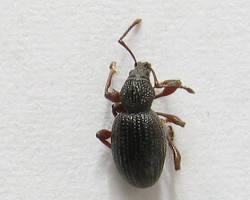
Adult Forest Root Weevils are small to medium-sized beetles with the elongated snout characteristic of true weevils.
Important identifying features include:
- Elongated snout (rostrum)
- Compact oval body
- Brown, gray, or black coloration
- Rough or textured wing covers
- Elbowed antennae
- Chewing mouthparts
Adults are often well-camouflaged against bark, soil, or leaf litter.
Many species are nocturnal and hide during the day beneath debris or around the base of host plants.
The larvae are white or cream-colored legless grubs with brown head capsules.
Larval features include:
- C-shaped body
- Soft white coloration
- Legless appearance
- Brown hardened head
Larvae remain underground throughout development and are rarely observed unless roots are examined directly.
Distribution and Habitat
Forest Root Weevils are distributed throughout temperate and boreal forest regions worldwide.
Common habitats include:
- Conifer forests
- Mixed woodlands
- Nurseries
- Ornamental landscapes
- Forest plantations
- Gardens
These weevils prefer moist soils that support larval root development.
Larvae are commonly found feeding near:
- Fine feeder roots
- Root collars
- Root hairs
- Small woody roots
Adult beetles may be found feeding on:
- Leaves
- Needles
- Buds
- Tender shoots
Recently transplanted or stressed trees are often especially vulnerable.
Life Cycle
The life cycle of Forest Root Weevils is closely tied to soil conditions and host plant availability.
Egg Stage
Females deposit eggs in soil near host plants or within protected organic debris around tree bases.
Moist soil conditions improve egg survival and larval establishment.
Larval Stage
After hatching, larvae move through the soil and begin feeding on roots.
Larval feeding damage may:
- Destroy feeder roots
- Reduce nutrient uptake
- Interfere with water absorption
- Destabilize young trees
Heavy root injury can result in severe stress or plant death.
The larval stage may last several months depending on species and climate.
Pupal Stage
Pupation occurs underground within the soil near host roots.
The pupal chamber protects the developing adult beetle.
Adult Stage
Adults emerge from the soil and begin feeding on foliage.
Many species are most active during warm evening hours.
Adults may overwinter beneath:
- Leaf litter
- Bark
- Mulch
- Soil debris
Behavior and Feeding
Forest Root Weevils damage plants through both underground and aboveground feeding.
Larval Root Feeding
Larvae consume root tissue beneath the soil surface.
This feeding reduces:
- Water absorption
- Nutrient uptake
- Plant stability
- Overall vigor
Young plants and seedlings may wilt or die rapidly under severe infestations.
Adult Foliage Feeding
Adults chew on leaves and needles, creating:
- Notched leaf edges
- Irregular feeding holes
- Scalloped margins
- Damaged buds
While adult feeding is often cosmetic, repeated damage may further stress weakened plants.
Damage and Economic Importance
Forest Root Weevils are economically important pests in forestry, nursery production, and landscaping.
Potential impacts include:
- Reduced tree growth
- Transplant failure
- Root system destruction
- Seedling mortality
- Weakened ornamental plants
- Increased susceptibility to diseases
Damage is especially severe in:
- Nursery stock
- Young conifers
- Recently planted trees
- Drought-stressed plants
Heavy infestations may also create entry points for fungal pathogens and root rot organisms.
Signs of Infestation
- Notched or scalloped leaves
- Wilting plants despite adequate moisture
- Reduced plant vigor
- Yellowing foliage
- Root damage visible during excavation
- Small weevils near plant bases
- Stunted tree growth
Because larvae remain hidden underground, infestations are often not noticed until plant decline becomes visible.
Management and Control (IPM)
Integrated Pest Management (IPM) strategies are commonly used to manage Forest Root Weevils.
Plant Health Management
Healthy plants are more resistant to weevil damage.
Important practices include:
- Proper watering
- Mulching
- Avoiding root stress
- Reducing transplant shock
- Maintaining soil health
Monitoring
Inspect foliage regularly for:
- Notched feeding damage
- Adult beetles
- Signs of plant stress
Root inspections may be necessary when decline symptoms appear.
Biological Control
Natural enemies may help suppress populations.
Beneficial organisms include:
- Predatory beetles
- Birds
- Parasitic nematodes
- Entomopathogenic fungi
Beneficial nematodes are sometimes applied to soil to target larvae directly.
Sanitation
Removing heavily infested plants and reducing excessive organic debris may help reduce breeding sites.
Chemical Control
Systemic insecticides or soil treatments may be used in nurseries or severe infestations.
Applications targeting larvae are generally more effective than treatments aimed only at adults.
Ecological Importance
Although considered pests in managed landscapes, Forest Root Weevils are natural components of forest ecosystems.
They provide food for:
- Birds
- Small mammals
- Predatory insects
- Soil organisms
Their feeding also contributes to nutrient cycling and natural forest succession processes.
Research and Scientific Importance
Forest Root Weevils are studied extensively in forestry and agricultural entomology.
Research focuses include:
- Root-feeding insect ecology
- Integrated pest management
- Biological control techniques
- Nursery pest prevention
- Forest regeneration protection
Scientists also study how environmental stress influences weevil infestation severity.
Conclusion
Forest Root Weevils are root-feeding snout beetles that damage trees and shrubs through both larval root feeding and adult foliage feeding. Larvae attack underground root systems, reducing nutrient uptake and weakening plants, while adults create characteristic notched feeding damage on leaves and needles. Heavy infestations can lead to reduced growth, transplant failure, and plant decline, especially in stressed or young trees. Effective management relies on maintaining healthy plants, monitoring infestations, encouraging natural predators, and targeting larvae with integrated pest management strategies.